


Interview: 'This Play is Universal': Director Alan Souza and Writer Michael McKeever on DANIEL'S HUSBAND Coming to Marylebone Theatre
'There's nothing better than seeing your words and work being built by really masterful theatre artists'

Next month, the play Daniel’s Husband will make its UK debut at the Marylebone Theatre. The show, written by Michael McKeever and directed by Alan Souza, follows Daniel [Joel Harper Jackson] and Mitchell [Luke Fetherston] as a crisis makes them question even the basic foundation of their relationship.
Recently, we had the chance to speak with McKeever and Souza about Daniel’s Husband’s upcoming London run. We discussed how each of them first got started in the world of theatre, what it’s been like to prepare the show for its upcoming run and what makes Daniel’s Husband more than just a show about gay marriage.
How did each of you first get started in the world of theatre?
Alan: I grew up in New Jersey, not so far from New York City, and my parents always took us to the theatre. My mother says that even when I was a little kid, I always pointed at the stage and kept saying, “I want to do that.” And I never stopped saying it from a little kid. So, when the moment came, my parents encouraged me to go towards what I loved and and I did! I was an actor for many years, on stage, on Broadway, on television.
Michael: I had a fairly late start. Like Alan, I've always been a big fan of the theatre and the magic of storytelling. I worked straight through my 20s as an art director, graphic designer and illustrator. I worked primarily at a film and television production studio as the art director, overseeing commercials and animations, that sort of thing. But I've always loved the idea of working in the theatre. Then I started writing commercials, and found I had a really good knack for dialogue. So, at thirty years old, without having any idea how to do it and no real education on how to do it, I wrote my first play, and then that first play got picked up by a tiny theatre in Miami called New Theatre, which specialised in new work. That did incredibly well, which led to a series of other shows in other regions. I've been very fortunate, I'm very prolific, and I love what I do. I love collaborating with people. I love the collaborative nature of working with actors and a good director, and telling a story. So, forty plays later, I'm where I am today!
And Michael, what inspired you to create Daniel’s Husband?
Michael: Oh, it's my own story, tragically! My husband and I have been together for 22 years, and he's about ten years younger than me. He always wanted to be married. This is before same-sex marriage was legal in the States. But I love the whole concept of being unique and not falling into the hetero-normalcy of getting married and having children, things that have happily become part of the normal experience of being a gay man or woman. But for me, for the longest time, I've liked being unique. It was one of the perks of being a gay man. But my husband really wanted it. And what was really interesting was the more I worked on the play, and the more I developed the situations involved, the more I understood the importance of having that very basic civil right of being married.
And Alan, what made you want to direct the play?
Alan: Well, I saw the original production in New York, and I remember leaving and thinking, “Oh, I love that.” It was a play with a gay couple at the centre, but it was about greater issues, and it had a straightforward integrity to it. It wasn't heavy-handed and dripping in sentiment, all of those things that I try to avoid. I even question the actor about what the character is saying, because part of my job is to play devil's advocate and make them either defend it or find their way together. And then looking at this play, because this is an American play, everything is on the docket for re-examination and regression.
Unfortunately, gay people are still fighting for their basic rights and privileges, though the privilege of marriage is something that is at the foundation of all of society - to be able to love the person you love, and ultimately to get the rights and privileges that come with that. The legal benefits that come with that, it's one of the reasons civil marriage was made!
But the play extends way beyond that. The relationships are extraordinarily complex. It certainly also is about what we bring from our childhoods to our relationships, and how we don't know what the person carries until it comes forward - in this case, marriage. So it's a play that wrestles with the idea of marriage and gay people getting married, but Michael's play is rich with characterisations and all kinds of thematic things that run underneath that. And to me, that's the best kind of play. Why we make choices, why we think things, why we behave the way we do, and who influences us. All of that is so human and so playable. So we've been having such fun and have been incredibly challenged by exploring layers. And attending to a play that was written in 2016 allows for a whole new headspace from which to not only make it, but to hear it. History repeats itself.
Michael: It'll be interesting to see whether the audiences side with certain characters, whether you can feel the tension about who they're siding with.
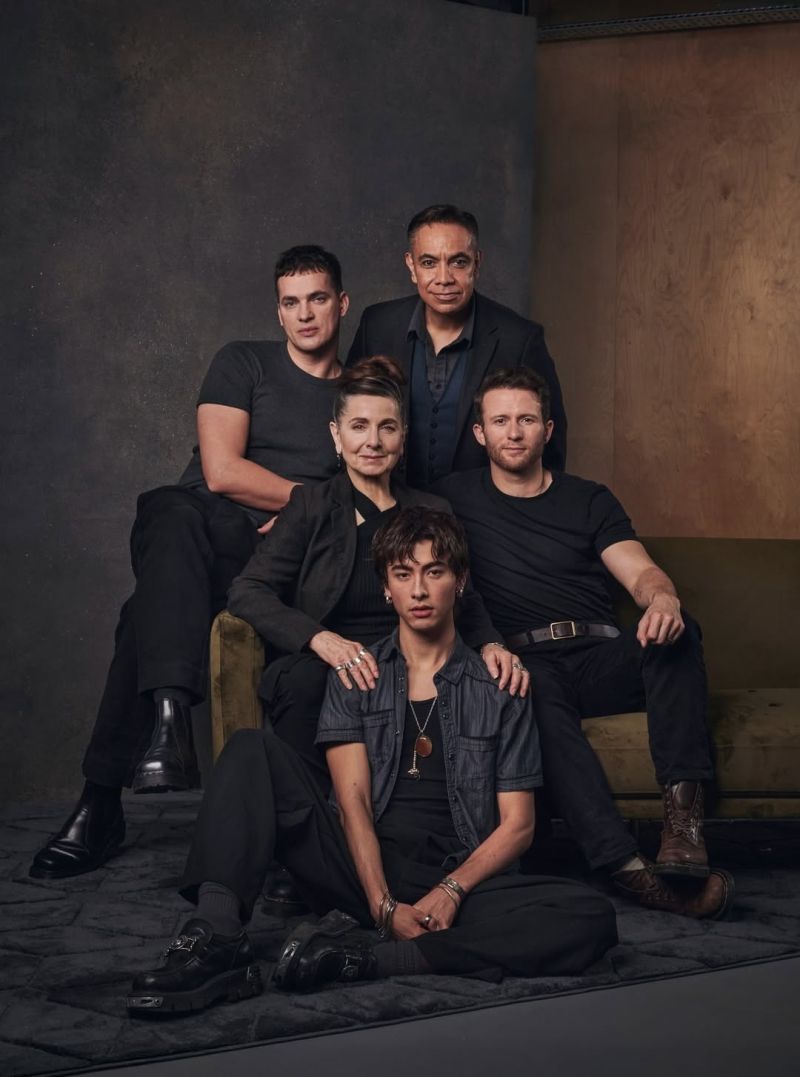
Photo Credit: Matt Crockett
What is it like bringing an American show over to London?
Alan: This play is universal. It happens to be American characters and it takes place in America, but this play is accessible. You can access these people right when they start talking. And we all know some version of every one of these characters, whether you're gay or not. I don't see this as a gay play, either. It's a play that has gay characters. What's great is the universality and accessibility of this piece.
Michael: There's something very human about the situation and about the reactions to things that are happening. It's simply because these are very human people making very human choices, and, in some cases, very human mistakes.
Alan: Our common humanity, and how it's difficult to negotiate that all the time.
And how have the rehearsals been going so far?
Alan: It's been going really well! Arthur Carrington and I worked very hard to get five very different actors on stage, because that makes a really interesting room. They're completely different acting beasts. When I got here, I knew that they had all really thought about this. And so we said, “Hello,” grabbed a cup of coffee, and I just let them read it and say anything about it. I just wanted to hear where they were. And it was really fascinating to hear what they brought, where they started. For me, it tells me about their instincts.
And then when we addressed each scene on the first pass, I had a bunch of knowledge about that, so we've been enjoying each other as artists. It doesn't always happen. It's a gracious bunch, a completely committed bunch of people. And they are intrigued by how different they are stylistically, age-wise and sensibility-wise. They all have come to support each other. Michael does a lot of the work, and what I mean by that is the words of the play will come. The words of the play are the words of the play. So you can let him do some of that work and not get in his way. So it's a real balancing act. The play is ninety minutes long, and a lot happens in ninety minutes!
Michael: I have to say, there's nothing more rewarding than when a director and the actors get that. There's something in me that just curdles when an actor says, “Well, this character would never do that.” And I said, “Well, sweetie, actually, they would. And I know this because I created that character!” It's always wonderful exploring the work. And I love the collaboration of it. As long as we understand the guidelines to stay within, there's a world to explore. Many times, a wonderful actor or a great director has shown a side of a character or gone down a path that I didn't even know existed, and that's incredibly rewarding. When that happens, you learn things!
They're into finding their way on the map that exists, which is fun and which is wonderful. And when there's a gorgeous production like this one going on, and you have these incredibly talented people in the room, and I'm not there, I get so jealous! Just to sit there and watch, there's nothing better than seeing your words and work being built by really masterful theatre artists. It's really, really exciting.
How would each of you describe Daniel’s Husband in one word?
Michael: Human.
Alan: Compelling.
Daniel’s Husband runs from 4 December 2025 - 10 January 2026 at the Marylebone Theatre.
Sign up for all the news on the Fall season, discounts & more...


.png?format=auto&width=365)




