


Review: MAROONED! A SPACE COMEDY at The Kennedy Center
Puppeteering duo, Alex and Olmsted's, latest story played the Kennedy Center Family Theater
When was the last time you saw a live puppet show? It’s not exactly a common event, but Alex and Olmsted, a Baltimore-based puppeteering and theatrical duo, are wholeheartedly - and more remarkable than that, successfully - pursuing this all-but-extinct art form.
Alex and Olmsted design and build original puppets, write the stories they then act out together, and they create the lighting, sound, set, costumes, and everything else to go with it. Their latest work, Marooned! A Space Comedy, played at the Kennedy Center’s Family Theater over the weekend. In its simplicity, the performance shows the universality of human emotions and experience which transcend age, background, and even language. There is hardly any dialogue in Marooned!, but it’s remarkable how much Alex and Olmsted manage to say without words.
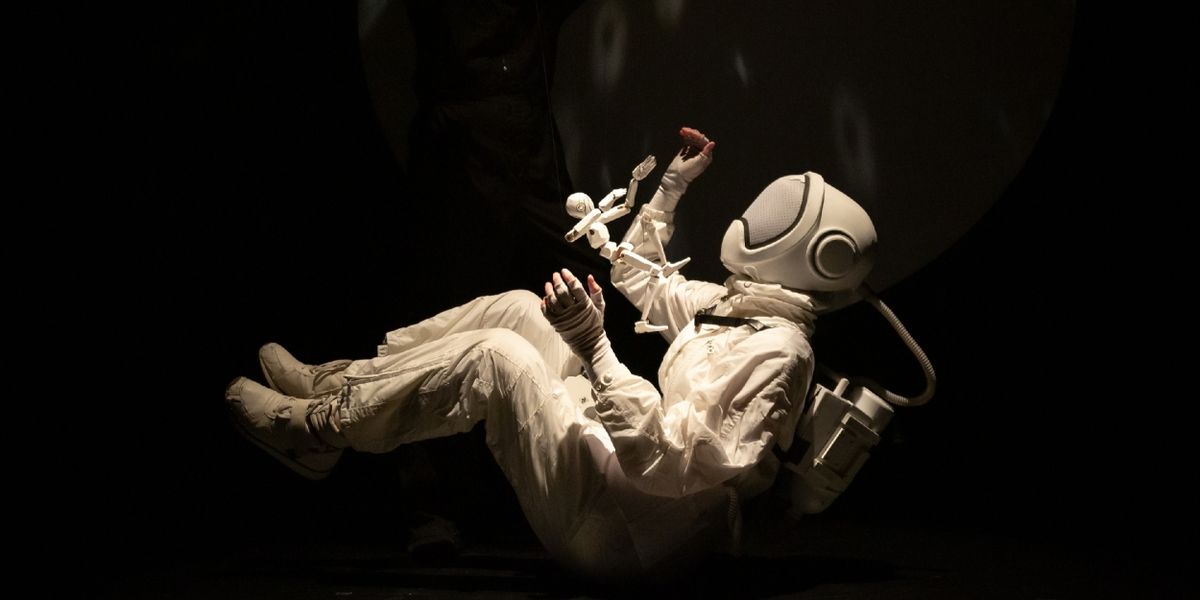
(1).jpg?format=auto&width=800) The show opens with elaborate hand puppetry showing a rocket launching from Earth and flying thousands of light years into space before crash landing on an unknown planet. We then follow the astronaut who was piloting the ship as she attempts to determine where she might be and how she might get home to Earth. Though Marooned! takes place entirely in outer space, it is a story about the frustrations, fear, and drama of everyday life. In a way, this stranded astronaut could be any one of us just trying to get through a day.
The show opens with elaborate hand puppetry showing a rocket launching from Earth and flying thousands of light years into space before crash landing on an unknown planet. We then follow the astronaut who was piloting the ship as she attempts to determine where she might be and how she might get home to Earth. Though Marooned! takes place entirely in outer space, it is a story about the frustrations, fear, and drama of everyday life. In a way, this stranded astronaut could be any one of us just trying to get through a day.
With the combination of this romantic but everyday story, which is divided into chapters, constant fourth-wall breaks, and the intentionally slow but unpredictable progression, the show reminded me of a Wes Anderson film. Perhaps most of all because of a superb soundtrack, inspired by the Voyager Golden Record. The soundtrack included multiple songs from this record that NASA launched into interstellar space to, as they say, “communicate a story of our world to extraterrestrials…containing sounds and images selected to portray the diversity of life and culture on Earth.”
These expert music selections help fill out a story told mostly through movement. As the astronaut, Sarah Olmsted Thomas leads the story silently. She manages to convey a sense of distorted gravity despite being firmly planted on a regular stage. She does not speak once. We don’t even see her face. Yet we feel her confusion, her hope, and her despair as she faces challenge after challenge trying to make it home. We understand her.
.jpg?format=auto&width=800)
And then there are the puppets, which are incredibly expressive in Alex and Olmsted’s hands. The other main character and the astronaut’s companion in this outer space adventure, a kind of phone robot, is basically a giant eyeball with legs. Yet it’s a surprisingly developed character. More anthropomorphic than the rigid R2-D2, this little phone robot learns, grows, and expresses relatable questions, concerns, and feelings through its one blinking eye. So much so that puppeteer Alex Vernon fades into the background, and you feel personally connected and invested in this robot’s journey as it learns to be brave and kind, comforting the stranded astronaut and helping her go on when she is losing hope.
While the themes of Marooned! are nothing new in children’s entertainment - bravery, adventure, helping others - the form allows for a less direct and obvious exploration of them. Alex and Olmsted expertly follow the age-old advice “show don’t tell.” This is a refreshing change from overly literal and often condescending children’s TV shows. Though at times, the play did go beyond its audience.
Some of the jokes, especially at the beginning, were clearly written for the parents. References to dial-up internet and DOGE seemed out of place, and I worried the play might lose the young audience it was directed at. But as the tale progressed, Alex and Olmsted brought the kids along and you began to hear small voices asking questions like “why?” “what’s that?” and “oh no!” When it came time for the audience to help carry the dialogue, they were ready to jump in - fully engaged and shouting out their lines, along with some additional, unscripted advice.
In this era of increasingly rapid scene changes in movies and shows, and the corresponding decrease in attention spans, it was remarkable to see a theater full of kids stay mostly engaged for this intentionally slow, simple, and largely wordless hour and ten minutes. There were no bright colors, no flashing lights, very little direct dialogue. But there was a story - a story of maintaining hope in a hopeless situation, of facing fear and overcoming it, of making unlikely connections that give us strength. It was a story that everyone in the audience, regardless of their age, could relate to, because it’s a story that we all live, in different ways, every day.
It’s always rewarding to watch people do what they’re good at. Alex and Olmsted are passionate about and talented in telling stories. They understand human emotion and experience so well, they don’t even need words to do it.
If aliens ever do find the Voyager Record and come to visit us, we’ll have to figure out how to explain who we are and what we experience without relying on language. I would nominate Alex and Olmsted as the humans for the job.
Photo Credit: Glenn Ricci Photography
Sign up for all the news on the Summer season, discounts & more...
|
Brian Henson's Puppet Up! Lincoln Theatre (9/30-9/30) |

|
GARBO: EL ACTOR QUE SAVÓ AL MUNDO (Garbo: The Actor Who Saved The World) GALA Hispanic Theatre (9/03-9/27) |

|
Special Event: ARTS By George!: Jeff Goldblum and the Mildred Snitzer Orchestra Center for the Arts (10/03-10/03) |

|
The Second-Best School Shooting NextStop Theatre (9/17-10/11) |

|
Coming to America: An Immigrant Cabaret ExPats Theatre (9/30-10/18) |

|
Some Like It Hot Bernard Family Theatre, Olney Theatre Center (9/18-11/08) |

|
Stonewall's Bust The Writers Center (10/09-10/25) |

|
The Fruits of Our Labor Arena Stage at the Mead Center for American Theater (9/10-11/01) |

|
The Judy Carmichael Trio The Alden Theatre (11/08-11/08) |

|
"The Addams Family" The Alden Theatre (10/09-10/18) |

Reader Reviews
To post a comment, you must register and login.