


Review: DUNGEONS & DRAGONS THE TWENTY SIDED TAVERN at The Kennedy Center
The Official Dungeons & Dragons Live Theatrical Experience, Now on Tour

Dungeons & Dragons The Twenty-Sided Tavern is not just a play. It’s an active (albeit simplified) D&D campaign set in the Forgotten Realms. There is an expert Dungeon Master (Conner Marx) and a Tavern Keeper (Alex Stompoly) who serves as his partner in crime. The two of them manage live storytelling, special effects, and the rules of the game, which is played by a rotating cast of three player characters - and you.
Entering the theater, you’re handed a paper explaining your role as audience-member, which requires no prior knowledge of D&D. You scan a QR code to open Gamiotics software which miraculously spares you the hassle of providing your email or downloading an app. You’ll also get a sticker. Green means you’re on team mischief so you’ll be playing with the bard character, red is team might with the barbarian character, and blue is team magic with what’s closest to a wizard.
This division of the audience into teams really pulls you into the game by focusing your influence and your role. To start, you get to pick your team’s character from three options in their class. Then, as they continue through the adventure, you help determine what choices they make, how they attack, and at times can even influence their success.
Imagine: the three characters set off on their adventure, traveling to meet a powerful sorceress who has information on a mysterious evil force in town. Along the way, three rogues corner them to rob them of their gold. What do you do?
The Dungeon Master asks just that, complete with NPC voices and dramatic effect - Marx is very good, all you could ask for from a DM and more. In response, you pull out your phone and vote - should we attack the rogues or try to talk our way out of it? Attack it is! At your bidding, the characters all run to their dice. Each roll is projected on a large screen built into the backdrop. Our barbarian rolls an 8, +6 for strength. That’ll hit. She offers team might an option, a vague one like, should I show them who’s boss or take them to finishing school? Vote again. Finishing school? Great, roll for damage, and now… I smash them over the head with a giant hammer and finish them! Back to the center of the stage she runs, bang, bang, bang, she acts out the attack and narrates the effect on her unfortunate enemy.
Okay, one rouge down. Two to go. Team magic, your turn. Alas, you roll but a 2, and +3 still isn’t much… but wait! Team magic, keep your phones out for a rapid click. If you can collectively get the bar above the threshold with your speedy fingers you’ll add an additional 10 points of damage to team magic’s attack! 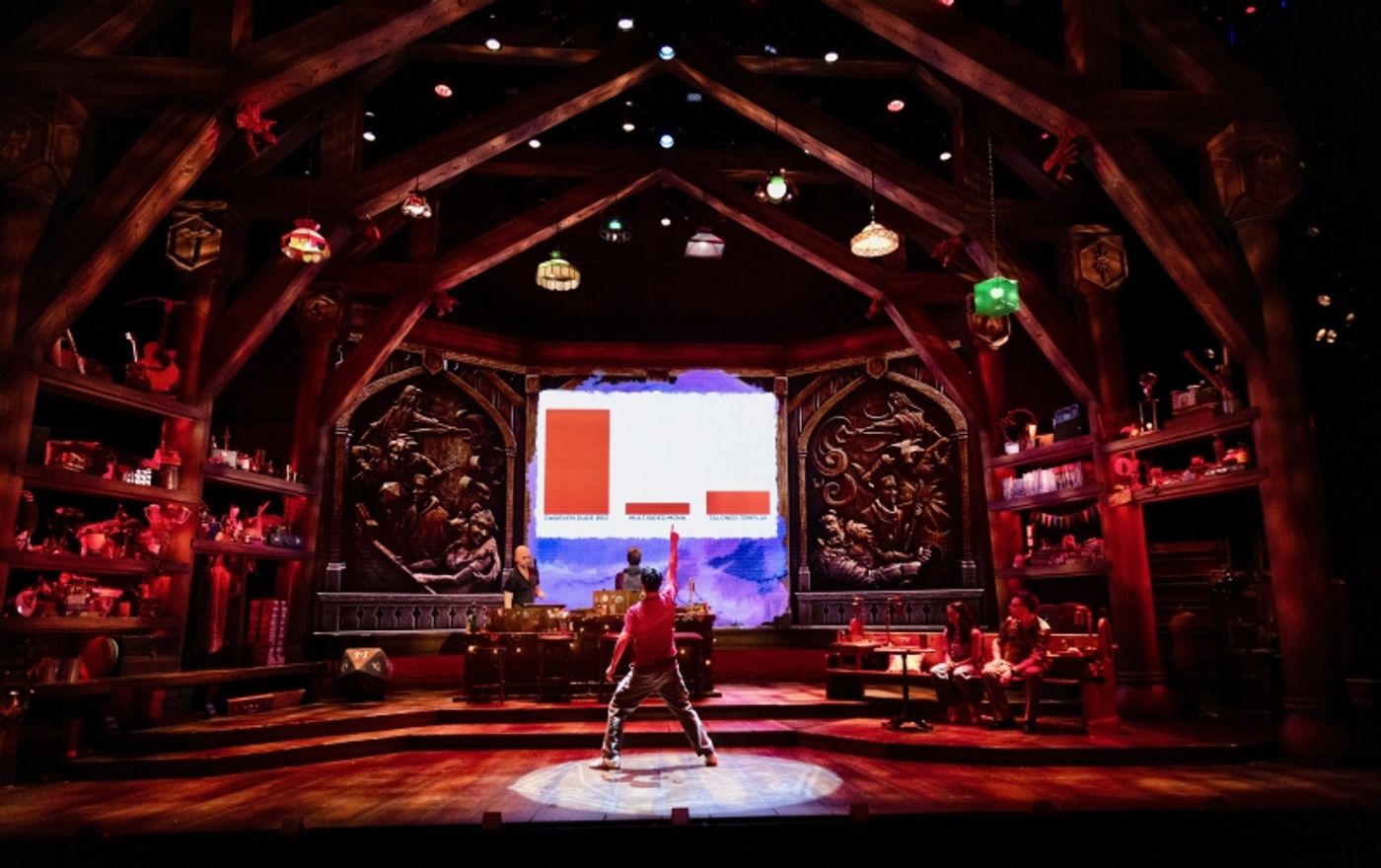
The experience is seamless, which can assuredly be credited to show-creator David Carpenter who also happens to be the co-founder and CEO of Gamiotics Technology. Carpenter developed the software during the pandemic as a way to liven up Zoom performances. Hence the idea of an interactive D&D style show was born.
Carpenter partnered with game designers Sarah Davis Reynolds and David Andrew Laws to create the first campaign, Carriers of Chaos. The latter became the show’s first Dungeon Master when it premiered at the Philadelphia Fringe Festival in 2021. In just four years since, the show scored a run at Asylum NYC, was officially adopted by “Daddy Hasboro” as the cast members call the toy company, and secured a national tour, kicking off here at the Kennedy Center with a new campaign, The Tomb of Havoc.
This is quite an impressive rise, especially given the current low break out rate of original shows. Perhaps a Dungeons & Dragons play was a risky bet in that climate, but in retrospect it also seems a natural pairing. Still, it would be easy to mess up. The Twenty-Sided Tavern manages to combine the best of live theater and D&D at once.
Artistically, there is the same level of expertise and attention to detail you’d expect in the production of any nationally touring show - an enchanting set, original soundtrack, various special effects, and super talented actors.
The Twenty-Sided Tavern cast are professionals, improvisers, and D&D experts. They take the show, but not themselves, seriously. This offers the treat of watching artists enjoy their craft. You see the actors thinking, scheming as they go. With all the improv, the stakes are higher than in a scripted show, which makes watching more exciting.
But I expect a play about D&D, even an excellently executed one, would fall flat. What makes The Twenty Sided Tavern work is that it’s also a live game where the audience has a real role to play.
Each night the characters take on a new quest, informed by the audience present and the one who came before. While there is certainly some scripting, much of the adventure is based on audience input. The detail of dividing the crowd into teams increases the impact of that input and makes you feel more like an active player. Overall, The Twenty Sided Tavern stays true to the chaos, fantasy, and imagination of D&D, and pretty true to the rules of a real campaign without getting bogged down in details.
My only complaint is the obligatory moralizing contemporary theater cannot seem to escape. At this point, I go to shows expecting someone to start randomly spouting about abstract moral ideas like the importance of kindness. But this feels extra out of place in a show about dungeons… and dragons… when characters are pommeling, seducing, stealing, and knocking people over the head.
This is supposed to be fun. Don’t tell me how to be a good person. Tell me about how you’re going to conquer the one armed troll accosting you in the alley way on the way to the dock to meet the bearded bar keep who has promised a ride to meet the kidnapped queen who has a brass key you need to open a door that a riddling gargoyle guards, and etc.
Imagine if your DM decided to insert lectures with thinly veiled political allusions in the middle of your campaign, or if they made everyone at the table sit for an extra ten minutes at the end of the game to explain the lessons they’ve taught you along the way. Likely, you’d want to find a new game.
But it’s easy enough to ignore the pedantic parts and still enjoy the show. In fact, I don’t think I’ve ever seen a crowd having more fun, and that itself is reason enough to go. If you’re like most of the audience members there, you’ll be laughing, chanting, shouting out towards the stage, and having a great time.


|
Misery Aldie Mill Historic Park (8/20-8/30) |
|
Gershwin, Bernstein & American Mosaic Wolf Trap (8/15-8/15) |

|
Natural History Mosaic Theater Company (1/21-2/07) |
|
Rockville Little Theatre presents "The Game's Afoot" F. Scott Fitzgerald Theatre (9/25-10/04) |
|
Dracula The Washington County Playhouse (9/12-11/01) |

|
Victorian Lyric Opera Company presents "The Merry Widow" F. Scott Fitzgerald Theatre (2/26-3/07) |
|
Hamilton (Angelica Company) National Theatre (12/15-2/07) |
|
Philadelphia Ballet Stars and Stripes Forever! Wolf Trap (9/10-9/10) |

|
7th Street Echo Mosaic Theater Company (3/25-4/18) |
|
Rockville Little Theatre presents "Fences" F. Scott Fitzgerald Theatre (4/30-5/09) |
Reader Reviews
To post a comment, you must register and login.