


Review: CULLUD WATTAH at Mosaic Theater
The effects of the Flint water crisis on three generations of women
The Flint, Michigan water crisis began when the city decided to save money by switching its source of water from Detroit to the Flint River in 2014. It resulted in highly elevated lead levels and essentially toxic waste coming from the household taps on which tens of thousands of residents had depended.
The city’s biggest employer, General Motors, quietly switched its water source when its machinery was being corroded by Flint River waters. The city and state took its time to even admit there was a problem.
Meanwhile, there were documented rises in rashes, hair loss, itchy skin, disease and other maladies from the discolored, foul-smelling and bad tasting water they still had to pay for in municipal bills. That Flint was a poor community that had a majority Black population bolstered the idea that the lingering crisis was, as the Michigan Civil Rights Commission stated, the “result of systemic racism.”
Aside from the misery, its lessons could be the basis of some strong drama, and it has produced some, such as the 2017 Lifetime movie, “Flint,” with Queen Latifah and Jill Scott.
Mosaic Theater joins in by marking its 10th anniversary of mixing theatrical arts with social activism with a production of Erika Dickerson-Despenza’s “cullud wattah.”
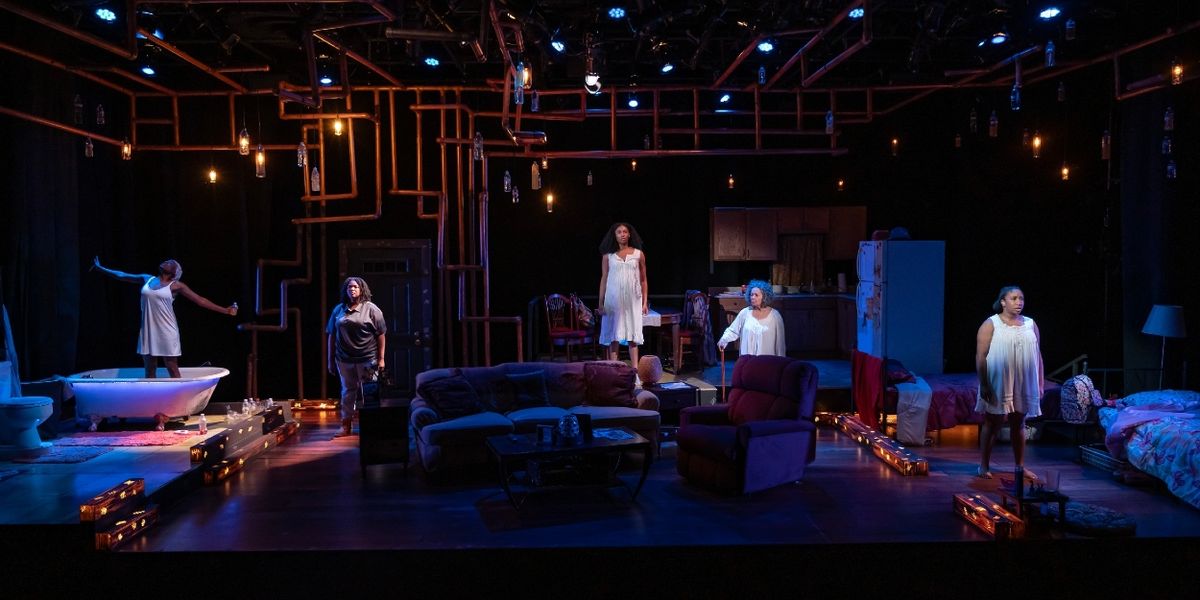
The 2018 play follows one household of three generations of women dealing with the crisis in Flint. Marion (Kelly Renee Armstrong) has a bad rash, but has a job at GM that may be threatened if she joins the class action lawsuit supported by her sister, Ainee (Andreá Bellamore), who is prominently pregnant after six miscarriages.
Of Marion’s daughters, the youngest, Plum (Ezinélia Baba) has leukemia and is prone to sleepwalking; Reesee (Khalia Muhammad) tries to help by praying to African water gods (she’s got her own health concerns).
And presiding over all of them, with a grumble and a cane, is Big Ma (Lizan Mitchell, who originated the role in the 2021 premiere at New York’s Public Theatre).
Together they try to cope, with very little help from outside, though the city has promised to send a water filter soon. Instead, they’re surrounded by water bottles and forced to determine how many bottles they’ll need, say, to wash vegetables for Thanksgiving.
The bottle motif is multiplied tenfold in the elaborate and striking set by Nadir Bey, lined with entwining copper pipes, prominent sinks, tubs and toilets (all put to use), and dozens of water bottles dangling from the sky, just as they hang in the women’s minds.
Likewise, the soundscape by navi is full of the old home’s echoey and ominous drips.
When the surrounding water bottles that also line the stage suddenly light up as if in reaction to bits of dialogue, it gets a little hard to read, though. Do these flashes from lighting designer Hailey LaRoe serve as rimshots or celestial pokes? It’s almost as if this Flint is suffering electrical problems as well as water ones.
More likely, it’s where the surrealism is kicking in, as in the extended beginning, when Plum takes a long, slow procession to the tub, and the other women appear in their bathrobes as if an angelic Greek chorus, adapting an old spiritual with updated words: “Lead in the water.”
Or should we say “wattuh”? Like the purposely misspelled words in the title, it’s meant to denote a kind of Southern accent in Afro-poetics — the title is also intended to be all lower case, bell hooks-style.
Dickerson-Despenza, author of “shadow/land,” describes herself in the program as “a Blk radical leftist writer, ecowomanist, and cultural memory worker.”
So the family interaction that is the core of the play is interrupted by spacey interludes, declarations to the audience, or repetition of rote facts between cast members that doesn’t always ring natural — giving the play an alternating tone of Black girl magic with old educational films.
Director Danielle A. Drakes reveals arguably the most dramatic turn before intermission is over, as people are rushing back to their seats with the house lights still on. And the door delivery at the play’s end wasn’t clear to me until I could examine the small box still sitting on the coffee table during the post-show discussion, which began immediately after curtain on opening night.
It had already been a long night, but in some ways this was the most illuminating part of the evening.
Dickerson-Despenza was present with a pointed political discourse that dismissed both the weekend’s widespread political marches and Alexandria Ocasio-Cortez, for that matter.
But she sat next to another member of the squad, Rep. Rashida Tlaib of Michigan for the post-show discussion, although they didn’t much interact.
Tlaib, for her part, wept at the memory of the Flint scourge that raged while she was in the Michigan statehouse and and continues to rage as she’s in Congress (it was day 3,952 since the crisis began, we were told). That, and the fact that even now, “there’s no justice in Flint. No one’s been sent to jail,” she said.
Her presence could enhance every performance at Mosaic, but alas, it was only scheduled for one night.
Running time: Two hours and 15 minutes with a 15 minute intermission.
Photo credit: Ezinélia Baba as Plum, Kelly Renee Armstrong as Marion, Andreá Bellamore as Ainee, Lizan Mitchell as Big Ma and Khalia Muhammad as Reesee in Mosaic Theater’s "cullud wattah." Photo by Chris Banks.
“cullud watuah” runs through April 27 from Mosaic Theater Company performing at the Sprenger Theatre at the Atlas Performing Arts Center, 1333 H St NE. Tickets available online.

|
Misery Aldie Mill Historic Park (8/20-8/30) |

|
The Dinner Detective Murder Mystery Dinner Show The Dinner Detective Washington DC (9/26-9/26) |

|
Murder at the Mansion presents "Funeral for a Gangster" Glenview Mansion (11/06-11/08) |

|
ArmEvents presents: An Evening of Elegance & Virtuosity Live Concert F. Scott Fitzgerald Theatre (9/12-9/12) |

|
Hook in Concert Wolf Trap (9/05-9/05) |

|
Hamlet Folger Shakespeare Library (3/02-4/11) |

|
Hairspray Hylton Performing Arts Center (9/18-9/27) |

|
Measure for Measure Folger Shakespeare Library (9/22-11/01) |

|
Ford''s Theatre presents: Come From Away Ford's Theatre (9/10-10/18) |

|
The Comedy of Errors Folger Shakespeare Library (5/18-6/27) |
Reader Reviews
To post a comment, you must register and login.