


Interview: Theatre Life with S. Katy Tucker
The video and projection designer on the differences between designing for theatre and opera and more.
.gif)
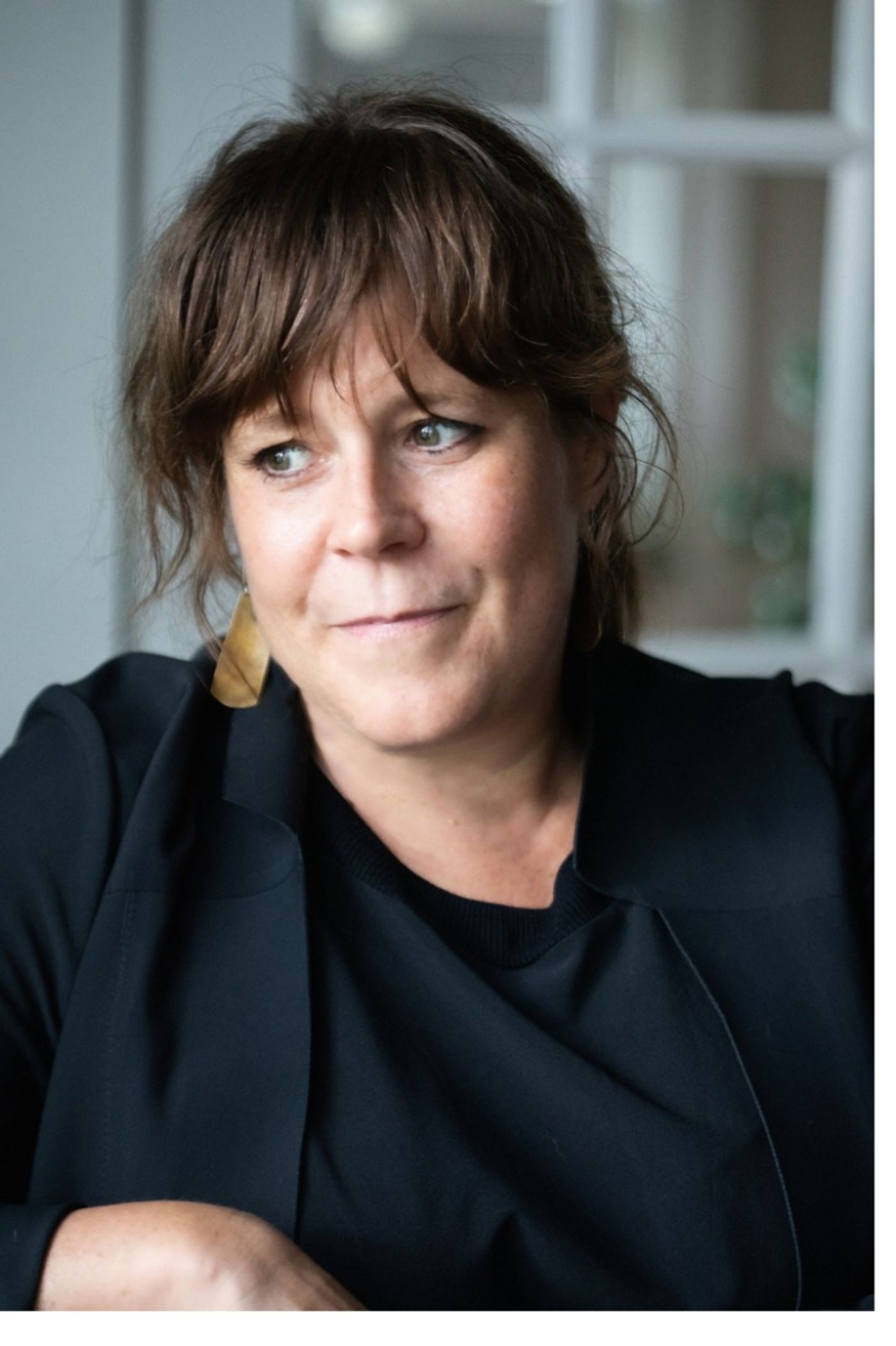
Today’s subject S. Katy Tucker is currently living her theatre life as the projection designer for Washington National Opera’s (WNO) production of The (R)evolution of Steve Jobs. The production runs May 2nd through 10th in the Opera House at Kennedy Center.
S. Katy Tucker designs video and projections for live performance internationally, working frequently in opera and collaborating with composers and musicians, including Paul McCartney, Helga Davis, Pamela Z, and Amanda Gookin. Her work has been seen around the world, including Broadway, Off-Broadway, and at New York City Ballet, Carnegie Hall, Park Avenue Armory, BAM, San Francisco Opera, the Metropolitan Museum of Art, Dutch National Opera, Sydney Opera House, Houston Grand Opera, Chicago Lyric Opera, and the Canadian Opera Company, among others.
She began her career as a painter and installation artist, exhibiting her work at a variety of galleries, such as the Corcoran Museum, Dupont Underground, the Dillon Gallery, and Artist’s Space in New York City.
Recent opera credits Eurydice and Verdi’s Requiem at the Met, Florencia en el Amazonas at Lyric Opera of Chicago with Francesca Zambello, Orpheus and Eurydice at Seattle Opera and The (R)evolution of Steve Jobs at Austin Opera.
She is currently represented on Broadway with Smash. Past Broadway credits include Wonderland, and Women on the Verge of a Nervous Breakdown.
Projection design is becoming more and more prevalent in theatre and opera. When used wrong, it can overpower a production. When used correctly, it can definitely enhance the story. S. Katy Tucker’s work is always the latter. I can personally say that her work on Smash is pretty incredible.
Grab your tickets to WNO’s production of The (R)evolution of Steve Jobs and see for yourself. S. Katy Tucker is truly an accomplished artist and is definitely living both her theatre and opera lives to the fullest.
Had you been interested in another discipline in the arts before becoming a projections designer?
Yes -- I wanted to be a visual artist, mainly working in video installation and oil painting. I moved to NYC to assist visual artists, but I missed a sense of community. Having grown up seeing a lot of theater, it felt like a natural next step to pursue a career in theater.
Where did you receive your training?
I never received formal training to be a projection designer. I went to a liberal arts college, Kenyon College, because my parents wouldn’t let me go to art school and I was a good tennis player – so we agreed on a liberal arts school with a strong tennis program. I’m happy I ended up at Kenyon, I got a great well-rounded education and learned how to think conceptually as well as training as a video artist and a lot of artistic freedom. After Kenyon, I learned how to design projection by working for other designers.
What was your first professional job in the theatre? If it was a non-projection job, please include the first job ever and first projection gig.
In the theater, I was a paid technical intern at the Metropolitan Opera. Interning at the MET in 2004 is where I first learned I wanted to be a projection designer, after meeting Francesca Zambello, who was directing the opera Cyrano. She asked me what I wanted to do one morning while I was helping setup tech tables, and I told her something with video and set design. Zambello told me I wanted to be a projection designer, which was the first time I’d ever heard of that, and she then helped me get my first job working for a projection designer.
Right now, I’m working at Houston Grand Opera with the lighting designer Amith Chandrashaker, and we were just reminiscing about our first show together, which happened to be my first professional projection show. It was an Off-Broadway show called CLEAN at Urban Stages in 2006.
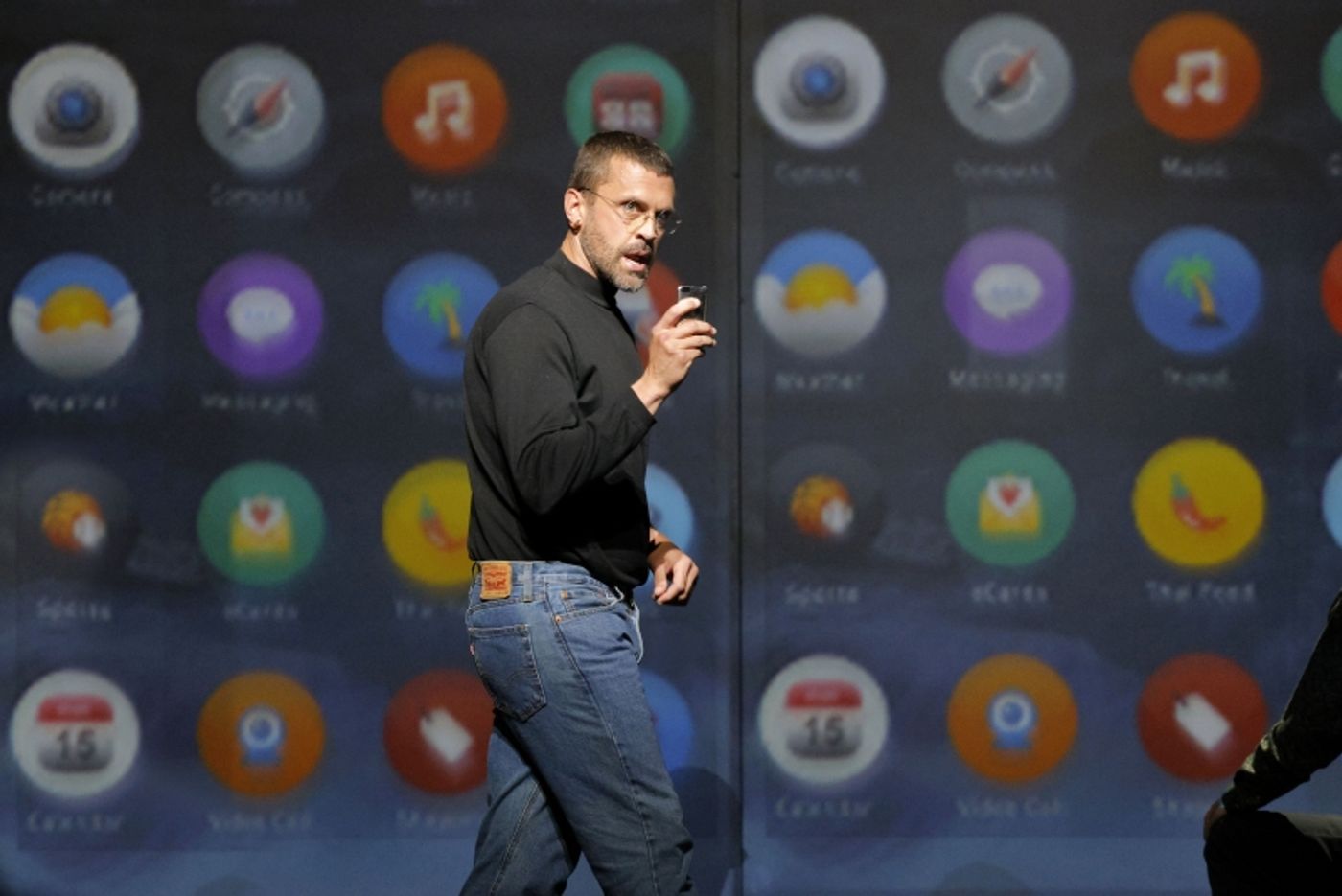
The (R)evolution of Steve Jobs.
Photo by Cory Weaver.
How did you first get involved with The (R)evolution of Steve Jobs?
Tomer Zvulun came to NYC, and we met for a drink at the Empire Hotel. He told me he wanted to create a version of Jobs that was more affordable to produce than the original production (which was a beautiful production that used more extensive projection mapping), and I of course was excited to join. I’d heard many wonderful things about the previous iteration of Jobs and was excited to get to play a role in a more financially accessible version of it.
evolution%20of%20Steve%20Jobs_photo%20by%20Ken%20Howard.jpg?format=auto&width=1400)
The (R)evolution of Steve Jobs.
Photo by Ken Howard.
From first meeting to first performance, how long did the process of creating the projections for The (R)evolution of Steve Jobs take?
This is a difficult question, as we began work on Jobs in 2019. We were discussing designs and Jacob Climer finished the set, then of course the pandemic happened. So, at that point time took on a life of its own. If I were to estimate, it took about 3 months to create the content for Jobs. Jacob and I like to create rules for ourselves when we design, and for Jobs we wanted all the content to be what is included when you buy a Mac. We did a lot of research from early Mac’s to present day. Due to copyright issues, we couldn’t use Apple’s IP, but we used this as a framework for the imagery.
Can you please take us through the process of designing projections for a production?
Like all other design disciplines, the process starts with reading the libretto or script and listening to the music. I like to start imagining what I see before collaborating with the other departments, just to know what my initial instincts are. Then I meet with the director and hear their interpretation of the story, and next meet with the set designer to see how they are choosing to set the story. Once our direction of the production is defined, I like to think of visual artists that remind me of the show. For Jobs, the Korean video artist Nam June Paik was a big inspiration. I like to pull images by different artists that might encompass the feel of the piece (for Smash, Barbara Kruger was my inspiration for the social media component) and then I put together a research board that summarizes the feel for me. Next I always consult my absolutely amazing associate, Blake Manns. He is the technical wizard behind all my shows, and we discuss the best way to technically achieve what we want artistically in the show. After that, I like to put together a cue sheet that reads more like a journal, to help linearly layout my plan. Once I have a rough framework, I like to start making content. The process of generating content helps me figure out the design. All the research and inspiration get backgrounded, but I like to reference it to make sure I remember what my initial instincts were. Depending on the scale of the project, once I know the direction I want to take the content, I get help from people like Blake. He and I have worked together for so long, we have a nice shorthand, and he also becomes instrumental in my design process as his contribution to content helps generate new ideas. I typically generate a few terabytes of content. Most of it never sees the stage, but I like to be armed with a lot of ideas incase our initial approach doesn’t work. Projection takes on a new life when it moves from computer monitor to stage. Seeing the imagery with the set, lighting and costumes can give it a new life, and I like to remain nimble so I can change my mind in the room. Depending on the show, the video can really change once you see it at a larger scale, so ideas that made sense when we storyboarded them, sometimes don’t make sense when you see it all together.
You recently designed the projections for Smash on Broadway. Do you find doing a design for a Broadway show more or less stressful than designing for opera? What is the biggest difference between the two genres?
Designing for Broadway is a marathon, and designing for opera is a sprint. Both are stressful and hard, but the biggest difference is that opera only has a few days of tech, and no previews, so you must work quickly and make changes on the fly and generate new ideas and content as fast as you can. You want to get as many ideas in as you can, then take away what is not needed once you see it all with an orchestra. Broadway is a lot more complex with timings that are much faster and precise, as well as a lot of scenic shifts, light cues, and movement within the cast. Additionally, the show continues to evolve as more and more discoveries are made throughout the preview process, so you must remain engaged and focused over a much longer period. Design wise, in Opera projection helps reflect the emotional state of the characters, the music is slower and perhaps less accessible (though not so much in the case of Jobs) so video also helps translate some of the musical themes for the audience. Particularly when working with Wagner, I feel like my job is to help visualize leitmotifs and themes the average audience member might not know. With Broadway, design can still be about the emotional state of the story, but it’s also about helping shift locations and amp up musical numbers, as well as assisting with storytelling.
Of all of the projects you have designed thus far, what stands out to you as a few of your favorites?
I have many favorites and feel lucky to have worked on so many interesting shows, these are not my only favorites, but to call out a few: The American Ring Cycle I worked on with Francesca Zambello, that premiered at Washington National Opera in 2016 will always remain special to me. In a way I feel like working on that show was my masters in projection design. I really learned how to help visualize music, to translate complex emotional themes and refine my storytelling. The production was such a clear translation of Wagner’s very complex Ring Cycle, that I really fell in love with the Ring. Smash is absolutely a favorite. I had the opportunity to work with and learn from the legend that is Susan Stroman, as well as incredibly talented collaborators like Beowulf Boritt, Ken Billington, and Alejo Vietti - all decorated veterans of Broadway who taught me how to design for musical theater. Despite having designed over 100 shows, I still felt like I was learning something new. Lastly, I really enjoyed Letters from Max, a Sarah Ruhl play I designed at the Signature with Kate Whoriskey. It felt like an intersection of the design I do for opera but in theater. I was able to approach projection more like poetry, which was a rewarding challenge.
What does the rest of 2025 and into 2026 hold in store for you workwise?
After Jobs I’m working on Donald Margulies’ play Lunar Eclipse at 2nd Stage with director Kate Whoriskey, then I leave to head to La Scala in Milan, Italy to continue on Sir David McVicar’s production of Wagner’s Ring Cycle. We completed Die Walkure in January and are doing Siegfried in May, then back again in January 2026 for Götterdämmerung and the full cycle. I’m also working on a new production of the opera The Handmaid’s Tale at Banff, a remount of Medea at Chicago Lyric and then a new play at The Public Theatre. I’m really enjoying the challenge of shifting between opera and theater.
Special thanks to Kennedy Center's Senior Press Representative, Classical David Hsieh for his assistance in coordinating this interview.
Theatre Life logo designed by Kevin Laughon.

|
Misery Aldie Mill Historic Park (8/20-8/30) |
|
Macbeth Three Notch Theatre (8/06-8/15) |
|
Step Afrika!'s Magical Musical Holiday Step Show Arena Stage at the Mead Center for American Theater (12/04-12/23) |
|
Body Language The Allan Lefcowitz Theater at The Writer's Center (9/25-9/27) PHOTOS |
|
Grand Kyiv Ballet presents "The Swan Lake: Symphony of Lights F. Scott Fitzgerald Theatre (11/18-11/18) |
|
Hairspray Hylton Performing Arts Center (9/18-9/27) |
|
Beethoven’s Ninth Symphony Wolf Trap (8/14-8/14) |
|
Commedia Christmas Carol (2024) Streaming Traveling Players Ensemble (12/23-12/23) |
|
Rockville Little Theatre presents "Fences" F. Scott Fitzgerald Theatre (4/30-5/09) |
|
Measure for Measure Folger Shakespeare Library (9/22-11/01) |