

Interview: S. Asher Gelman of AFTERGLOW at Eternity Playhouse
A passionate, sultry new work which leaves no stone unturned, arrives in Sydney in February
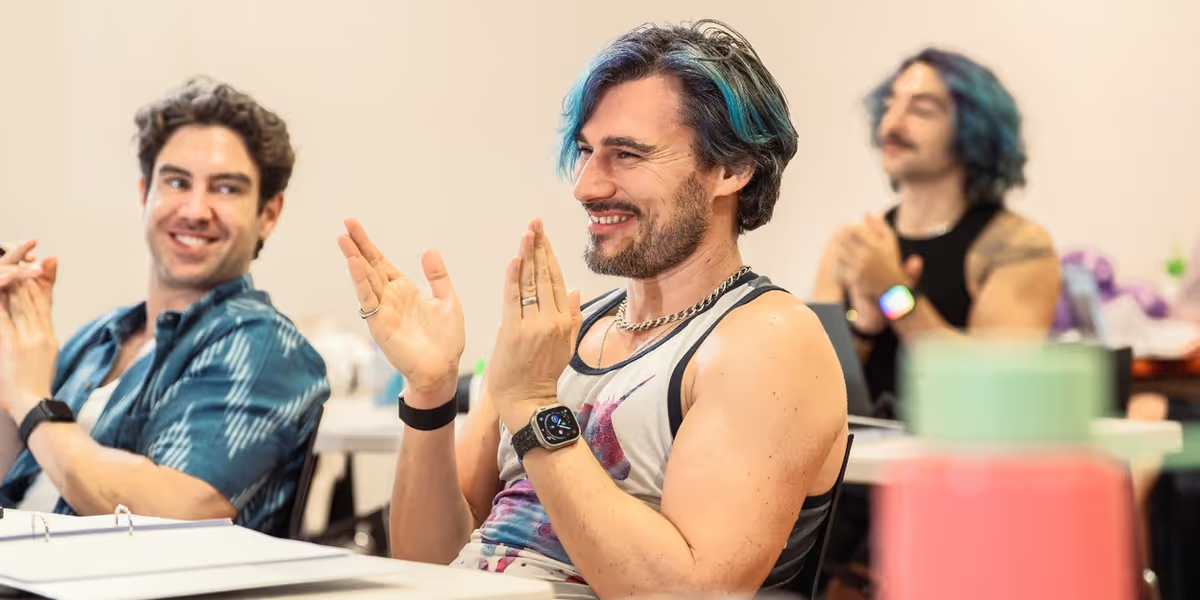
As the new year kicks off, an exciting and turbulent new year of theatre begins. Fresh off an international tour brimming with industry acclaim, AFTERGLOW sets its sights on Melbourne and Sydney in the coming weeks. The work follows married couple, Josh and Alex, who open their relationship for one night with a man named Darius. What develops is a complex and devastatingly beautiful story that explores the complexities of queer identity, love and relationships. I was able to chat with playwright S. Asher Gelman about the journey of the work, its place in Australia and what audiences can expect from a passionate, sultry and tender new work.
Can you describe Afterglow in three words?
Sensual. Honest. Provocative.
Afterglow has already been up and down across the world already. How do you feel about taking this story down under for the very first time?
The play’s journey has been absolutely incredible; I could not be more grateful to everyone who has contributed to it in both large and small ways! Australia has been on our radar since we closed the original Off-Broadway production - we’ve been getting nine years of requests to bring the show Down Under. I couldn’t be more thrilled that our stars have aligned, and now we’re finally here!
In terms of content, do you adapt and develop the work for its location? Or do you see an international relevance in its original form?
Adaptation is always tricky, because it fundamentally changes the work; that isn’t necessarily a bad thing, but it is certainly something to consider. We’ve had a few requests to adapt the work and localize it, but ultimately, we decided that part of what makes the play so strong is its specificity. Specificity makes theater more relatable. When we try to tell a universal story - a story about “everyone” - it becomes more difficult to connect with because when it is, in fact, supposed to be about everyone, and when we can’t see ourselves represented, we lean out, because “the play about everyone wasn’t actually about me.” When we get more specific, when we say, “this play isn’t about you at all, it’s just about the characters, but we invite you to find ways to connect with them,” that’s when art actually becomes universal, because we, as its audience, start to look for other ways to relate to the work, and we can remove our ego and our need to be represented. Afterglow is a product of the context in which it was first written and produced. As such, the play will always take place in New York City in 2017. How we build and explore relationships with each other and the way technology interacts with those relationships is constantly shifting. The play captures a moment in time and place, and while its themes and conversations are still very much relevant, adapting it, at this point, feels disingenuous to the work.
How do you want audiences to feel after exiting Afterglow?
I want audiences to feel conflicted, confused, and maybe even a bit frustrated. Not by the material itself, but by the way it makes them feel. All the characters are right and all the characters are wrong, so we have to decide for ourselves how we feel about that. Our world has become increasingly polarized, simplified, and flattened, mostly because of social media, which tells us we need to form and express opinions about subjects, events, and histories we often know little to nothing about. I so wish we could normalize being able to say “I don’t have enough information to form an opinion on this,” but, unfortunately, that’s not the world we live in, and we’re told we’re ignorant if we don’t already know what we think about virtually everything. We’re expected to absorb that information from 15-second videos, memes, and 240 character summaries because someone in our network told us what to think and how to feel. The short form is convenient. It’s bite sized. It’s palatable. It’s easy. I’m not interested in that. I’m interested in exploring nuance. Putting relatable, three-dimensional characters in difficult situations where many things can be true at once, and watching them attempt to navigate the complexities of their lives. This is why I love theater so much - we’re asking our audience to go on a journey with us, because all of us are complex, intricate human beings and we are all deserving of the same grace. By sitting in a theater, you’re committing to a long-form experience, something we’re becoming increasingly hesitant to do. Even in answering this question, I’m left wondering if my answer is too long for people to actually feel compelled to read it through to the end, even though it’s only about a paragraph.
You take on the role of both director and writer. Do you find this combination challenging to balance? Or does it come with its benefits?
Sometimes the combination of multiple roles can be daunting (I’m also choreographing). On Afterglow, specifically, it’s a blessing. Being able to explore this play from all angles gives me true freedom of expression - there are many moments in the play, particularly the tightly choreographed transitions, that used to be scenes in previous drafts. My background is in dance and theater, and I’ve always considered the two art forms as being two sides of the same coin. Being able to lean into the many ways one can tell a story is really liberating, especially when exploring emotion and connection (or the lack thereof). The play deals with sex and sexuality (which is extremely personal to each of us), so we found a language of sensuality that moves away from simulated sex and instead captures its feeling through choreography. I’d be remiss to not mention that I also have a phenomenal team working on this production with me, and their wisdom and guidance is truly invaluable. Having that support allows me to cross the street without having to look both ways (especially in a place that drives on the opposite side of the road).
Before heading to Sydney, Afterglow opens as part of Midsumma, Melbourne’s queer arts festival. How significant is it to you that the work forms part of a packed line up representing queer voices in Australia and beyond?
We’re beyond honoured to be included in such an incredible festival of queer artists. It’s quite remarkable to see how far we’ve come as a society; to see our stories celebrated. I remember growing up, the queer content was few and far between, and rarely of any quality. Also, it’s worth noting that the generation of queer artists that was supposed to precede us was decimated by the AIDS epidemic. I often think about all the art, community, and family they didn’t get to create. The world they didn’t get to leave behind, alongside the world they did. I share my life with my husband, Mati, on whom the character Alex is based, and my partner Stef, who is producing the show with me. In many ways, the progress we have made as a community is simultaneously reflected in my own family, which, of course, becomes rather meta when viewed through the lens of the play that put me on the map; that same play that has literally travelled the world, in no small part because of our communal progress and collective understanding that change is not only necessary, it’s inevitable. The change is so welcome, and to be even a small part of it truly means the world to me.
Afterglow runs from February 26th to March 22nd at the Eternity Playhouse in Darlinghurst.
Photo Credit: Cameron Grant Parenthesy
Sign up for all the news on the Fall season, discounts & more...

|
Shrek The Musical Pioneer Theatre (10/30-11/08) |
|
Next Fall Eternity Playhouse (10/22-11/07) PHOTOS |
|
Silver Tongue Hayes Theatre (11/13-12/12) |
|
Morning Melodies: Christmas with Lucy Durack Kingston City Hall (12/08-12/08) |
|
Beetlejuice the Musical Capitol Theatre, Sydney (11/21-1/10) |

|
Where is the Green Sheep? Riverside Theatres (10/07-10/10) |

|
Dixon and Daughters by Deborah Bruce Old Fitz Theatre (9/18-10/03) |
|
Macbeth Sydney Opera House (11/18-12/06) |

|
dentistparramatta dentistparramatta (9/28-9/28) |
|
I Love Your Faces: The Don Lane Story Ballina RSL (10/18-10/18) |
