


Interview: Michelle Azar on Embodying RBG Again for the 'All Things Equal' National Tour
“Theatre can shift how people think. I want to be part of storytelling that impels action," says Azar.

Few figures stand out in recent American history like Justice Ruth Bader Ginsburg. With a tiny frame but seismic impact, she was a historic figure later turned reluctant pop icon.
In All Things Equal: The Life & Trials of Ruth Bader Ginsburg, written by Tony Award-winning playwright Rupert Holmes, the solo play now touring nationally, Michelle Azar steps into RBG’s unmistakable silhouette once again – the lace collar, the big framing glasses, and the quiet but unshakable force.

When Azar first originated the role, the pressure and weight of such a figure were undeniable.
“It was enormously daunting,” she admits. “As an actor, you’re trained never to stand on stage and say something you don’t fully know. It meant studying the people who shaped Ruth, as well as Ruth’s work, rather than just the names or words.” Azar knows Ruth would have done that. “She always did the homework,” she states.
Preparation also meant mastering the voice and posture, her stillness and emotional restraint. It wouldn’t be the “Notorious” RBG without her characteristic traits.
Over time, her connection to Ginsburg deepened. Azar met members of the Ginsburg family and friends, as well as others who had spent time with her. “They breathed life into her,” she says. “I only knew her as the woman in her 80s with the big glasses. But she was so much more.”
There is something fitting about portraying a Justice who believed in the long game. Ginsburg modeled a quiet confidence rooted not in volume, but in precision. “She questioned one thing at a time,” Azar explains. “She wasn’t in a rush. That was transformative for me — even in motherhood. It’s a kind of discipline.”
Now, performing the role on a national tour in a politically tense moment, the experience carries new weight.
“The world feels like it’s on a tightrope,” she says. “I have to be mindful of how she would react, not how I would.” The script incorporates Ginsburg’s actual words and writings wherever possible. “I’m not RBG,” Azar says, fully aware of the pressure that carries. “It’s humbling, but it sparks real conversations. People come up to me to ask what I think about abortion or the Supreme Court, hoping to hear RBG’s thoughts on new issues. And even though I’m the actor, I love having these moments with our audiences. Some even come dressed up in white lace collars!” Azar shares, “I think I got cast because I have a scrappiness. I’ll get in the trenches with people. Ruth did that too.”
What excites her most about touring is not just the performance, but the places and their people.
She likes to walk the streets of each town before performing. Unlike some actors, she doesn’t cling to superstition but rather lets the new places energize her. She talks to locals and asks what they know about Ginsburg.
The play balances humor and history with heart. It begins intimately, as if Ginsburg is speaking to a family friend making it immediately personal rather than preachy.
Director Laley Lippard and the team were clear about their intention, Azar explains: “We want every person in the audience who has ever felt on the periphery to realize they can make a difference.”
Ginsburg often quoted the Jewish teaching: It is not incumbent upon you to finish the work, but neither are you free to desist from it. That idea anchors the production.
“Find one thing,” Azar says. “One thing you care about. Every little bit matters.”
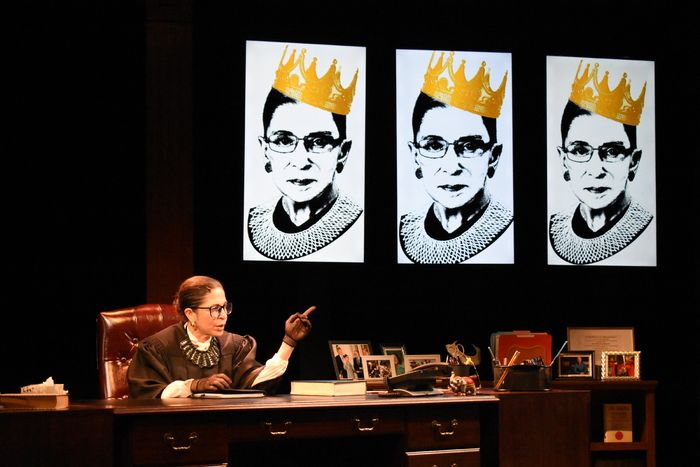
Portraying Ginsburg has also challenged her emotionally. Azar describes herself as someone who accesses tears easily. Ginsburg, by contrast, was famously restrained. “Her mother taught her to always be a lady. To not let your emotions sway you,” she explains.
And yet, Ginsburg endured extraordinary loss: her sister, her mother, and the shadow of the Holocaust over her extended family. She attended Harvard Law while raising a daughter and caring for a husband battling cancer. She fought for women’s rights in the 1970s before often condescending, all-male courts. “She never let her emotions derail her purpose.”
There are a few moments in the play when another side of Ginsburg is imagined. “Even we think she had moments when it became too much,” Azar says. “But she always stayed steady.”
That steadiness has changed Azar’s own relationship to storytelling. Married to a rabbi, she admits she once shied away from centering her own voice. Since playing Ginsburg, she has revisited her solo show From Baghdad to Brooklyn, newly emboldened.
“Ruth instilled that quiet confidence in me,” she says. “She made me realize every story is important.”
For Azar, storytelling itself is a form of activism. “RBG listened to people’s stories. She was a storyholder as much as a storyteller. Theatre can shift how people think. I want to be part of storytelling that impels action.”
In All Things Equal, Ginsburg does not claim perfection. She acknowledges criticism and passes the baton, asking new generations, “What would you do differently?” Above all, she leaves us with hope: things can change, and we can be the ones to change them.
All Things Equal will play at Balboa Theatre on March 21 and 22. More information and tickets can be found at https://www.sandiegotheatres.org/events/detail/all-things-equal-2026.


Sign up for all the news on the Fall season, discounts & more...

|
BEGIN AGAIN The Old Globe (9/06-10/11) |
|
Good Night, Oscar North Coast Repertory (9/16-10/18) |

|
Ripcord The Roustabouts Theatre Co. (10/08-11/01) |

|
Charlie and the Chocolate Factory Casa del Prado Theatre (10/23-11/08) |

|
Curious George and the Golden Meatball Poway Center for The Performing Arts (1/16-1/16) |

|
Ripcord Scripps Ranch Theatre (10/08-11/01) |

|
National Comedy Theatre National Comedy Theatre (5/02-12/28) |

|
Odds Are Mosaic Theatricals (10/02-10/18) |

|
MJ Live Michael Jackson Tribute Concert Poway Center for The Performing Arts (4/03-4/03) |

|
Take3 Jukebox Rock Poway Center for The Performing Arts (4/18-4/18) |
