


Interview: Amy Goodyear of SWEAT at Playhouse 2000
IN WAKE OF COMMUNITY CRISIS, PLAYHOUSE 2000 BRINGS PULITZER-WINNING ‘SWEAT’ TO KERRVILLE
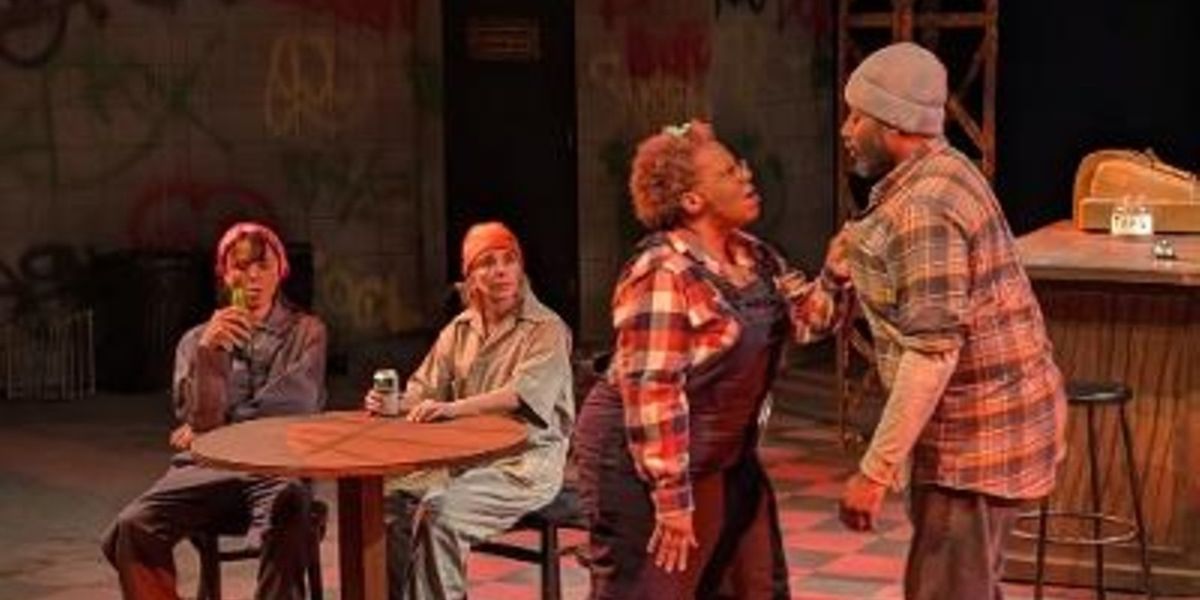
Kerrville’s Playhouse 2000 presents “Sweat,” the Pulitzer Prize-winning drama by Lynn Nottage, February 6–22 at its VK Garage Theater. The production, part of the Playhouse NOW! season, examines the effects of industrial decline on a working-class community and the strains it places on long-standing friendships, loyalty and economic security. “Sweat” depicts a group of factory workers and their families in Reading, Pennsylvania, whose lives are upended by layoffs, wage cuts and labor disputes, alternating between scenes set in 2000 and 2008 to show how decisions and pressures reverberate over time.
“Sweat” premiered in 2015 and won the 2017 Pulitzer Prize for Drama. The play’s narrative focuses on workers at a local mill whose relationships fracture under economic strain and shifting social dynamics, exploring themes of labor, class, race and community cohesion. The Texas Hill Country cast includes Cheri Brown as Cynthia, Lisa Calvet-Smith as Tracey, Marcus Fifer as Evan/Brucie, Brandon Newton as Jason, Treston Woods as Chris, Justin Elliott as Stan, Victor Salinas as Oscar, and Donna Provencher as Jessie.
Director Amy Goodyear – also the Associate Director of Playhouse 2000 – said she chose the play for its relevance to both broader societal challenges and the experiences of the Hill Country in the wake of last summer’s flooding. She sees parallels between the play’s exploration of economic and social pressures and ongoing conversations about recovery, resilience and shared responsibility. Here’s a bit more of what she had to share.
Q. What feels most urgent to you about doing this script right now, in this community at this moment in time?
A. For me, “Sweat” is ultimately about community – a tight-knit community that has suffered a crisis that threatens to tear them apart but also provides a lesson in what it means to be one people – varied, complex, divided – but also working towards a complicated – but very real – hope for the future. I realized this was a perfect production choice for our current political, social and cultural environment – and especially for our suffering community as we work to put this city and its people back together after July’s devastating floods.
Q. What do you hope audiences leave talking about in the parking lot afterward? What community conversations do you hope this sparks beyond the theater?
I’ve heard people talking about the honesty in the show and the fact that it doesn’t really take any side – it is about the human cost of deindustrialization and how the struggles of the working-class people … often ignored by the intellectual elite – and perhaps this helps explain why we are where we are today.
Q. What’s your guiding principle for approaching characters who make morally complicated — or uncomfortable — choices? How do you help actors avoid playing the ideology instead of the humanity in a play this politically charged?
I always encourage my actors to put as much of themselves into their portrayals as possible so they can find commonality with someone who might be very different than them. The more an actor can pull from their own experiences, their own emotions, the more realistic their performance, (the better.) We’ve all made a wrong or very difficult choice in our lives – we can’t judge our characters by that. We can only find that experience in ourselves and use it to humanize them.
Q. What do you think people often miss about the characters who are easiest to judge? How do you want the audience to think differently about blame by the end of the play?
I think “Sweat” uniquely helps you understand and empathize with where every character is coming from; I don’t feel the show judges any of them. We all “sweat” the same, and my goal for the show would be that the audience leaves realizing that we should take care of each other no matter what because “that’s how it oughta be.”
Q. What has surprised you most during this process? Do you think this play asks more of the audience than comfort — and is that part of the point?
I think any show that encourages an audience to do a little self-reflection, a review of their own biases and assumptions, is a show doing its job: “to teach and delight.”
Q. What does this play teach us about how quickly communities can fracture under economic pressure? If this play were a warning, what would it be warning us about?
I think many of us live not realizing how close we all are to complete devastation. We’re all one health diagnosis, one accident, one bad decision, one job loss, etc. away. If there is a “warning,” I hope that it’s that we are all lost without empathy and understanding for what people are going through even if we may not understand it ourselves. Making assumptions about motivations only leads to further isolation and division.
Q. Has working on “Sweat” changed the way you think about empathy or responsibility? Where do you see silence doing as much harm as violence in this story?
I chose “Sweat” because it had a message about empathy and responsibility to each other without judgement that I believe is critical right now. The silence I see causing harm is the way we refuse to talk to each other because we assume we don’t want to hear what the other side has to say. When we don’t see people, they feel like they don’t have to see us. We must start by seeing each other.
In addition to its regular performances Fridays and Saturdays at 7:30 p.m. and Sundays at 2:30 p.m., Playhouse 2000 will host post-show talkbacks with the cast and creative team following the 2:30 p.m. performances on Sunday, Feb. 15 and Saturday, Feb. 21. Audiences are invited to stay after the show to engage with actors about the production, the process of theater and their experiences bringing “Sweat” to the stage.
Tickets are available online through the theater’s box office at https://shorturl.at/LXbXz. “Sweat” is rated R for language and mild violence.
Enter Your Article Text Here!
Love Theater in San Antonio? Join The Community!
Whether you've got past experience writing about theater or just starting, the BroadwayWorld Community offers a unique opportunity to become a champion for your local arts community, helping raise awareness of local offerings and adding another local voice to the conversation at a time arts coverage is shrinking in the press across the continent. Join us and become a pivotal part of the movement that celebrates and promotes the arts in the digital age.
Learn MoreSign up for all the news on the Fall season, discounts & more...

|
AUDAZ TO THE MAXX: Sketchy Nights in San Antonio Teatro Audaz (7/29-10/28) |

|
The Rocky Horror Picture Show Spooktacular Tour with Nell Campbell The Majestic Theatre (10/22-10/22) |

|
Doja Cat Frost Bank Center (11/06-11/06) |

|
Wicked Majestic Theatre (6/02-6/20) |

|
Glory Gone Opera Luminaria Festival (11/14-11/14) |

|
Celtic Thunder Majestic Theatre (10/15-10/15) |

|
Clue: The Movie - A Screening to Die For! Hosted by Lesley Ann Warren Majestic Theatre (3/04-3/04) |

|
Esperanza Rising, written by Alvaro Saar Rios and directed by AnaLisa Leos Teatro Audaz (12/17-12/22) |

|
If You Give A Mouse A Cookie Magik Theatre (10/03-10/25) |
