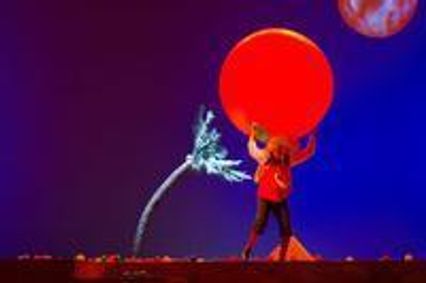
AS PART OF MODIFICATIONS
Carlo Gozzi, who recorded the tale "The Love for Three Oranges» (L'amore delle tre melarance, 1761) in the spirit of the Italian commedia dell'arte, was fond of saying: "It must be remembered that if it hits in a parody of an exaggeration, it will never reach positive goals!" .
Starting in 1918, in the long tour of America, 27-year-old Sergei Prokofiev took with him a theatrical magazine, which published Vsevolod Meyerhold with a group of leaders of the new Russian theater. The magazine was named as the famous fairy-tale-parody ("fyaba") by Carlo Gozzi, - "The Love for Three Oranges." Her freestyle stage version was printed in the first issue. Vsevolod Meyerhold and Vladimir Solovyov and Konstantin Vogakom rethink Gozzi tale in the spirit of conventional theater. The play was fascinated by the young composer, "a mixture of stories, jokes and satire, and most importantly - his theatricality," so when the management of the Chicago Opera has decided to order the "invincible Scythians' new work, Prokofiev thought of Meyerhold's board to write on this subject ostrosovremennuyu opera, which would have blown up stage stamps and canons, and went to work.
Bryzzhuschaya fun opera was created in the shortest possible time, and by the autumn of 1919 the score was ready.
"It's easy, fun" opera, as he called it himself, Prokofiev, got a witty and inventive, remembering in the form of a parody of his own impressions of the theater of pre-revolutionary Russia. A bold experiment with a genre that combined sharp and grotesque lyrics, however, did not lead to its destruction, and opened new possibilities of the old Italian opera buffa. The main effect of "Love for Three Oranges" and is accompanied by a parallel interrupted: the characters of the prologue - freaks, comedians, tragedians - constantly intervene in the event, commenting on them, helping those in need heroes. The introduction of these characters connected with the theatrical nature of the design: the time characteristic of the debate about how to be art - mindlessly funny, tragic or a lyric - and carriers are the main action, and commenting on his "audience." Well, the story unfolding around hypochondriac Prince fall in love accursed witch Fata Morgana in the three oranges, says, as befits a fairy tale, the victory of good over evil, love over witchcraft.
The premiere of "Oranges" was held on December 30, 1921 in Chicago. Conducted by the author, the opera was in French. The success was huge. February 18, 1926, "Oranges" was first sounded in Russian - at the Leningrad Theatre of Opera and Ballet (Mariinsky). Meyerhold staged opera student Sergei Radlov, the composer himself, who was present at the premiere, admitted to setting the best.
The opera "The Love for Three Oranges" - a wonderful mixture of commedia dell'arte, theater, theater, slapstick, satire and stories. This is one of the most fun, dynamic and lively operas of the XX century, full of imagination, inventiveness, sharp rhythms and contrasts, combining the grotesque and the lyrics, reality and fairy tale. "We tried to establish on what I'm laughing, above the audience, Gozzi on above operatic form, or who can not laugh. Found in "Oranges" and laugh, and challenge, and grotesque, while I just wrote an amusing show "- recalled the composer.
"Love for Three Oranges" FIRST STAGE EKATERINBURG OPERA AND BALLET THEATRE
From an interview with the creators of the show newspaper "Ekaterinburg Opera and Ballet Theatre"
Catherine recorded Ruzheva
Klinichev Paul, Conductor
Together with Uwe Schwartz - director, who is now very well known in Europe - we are working on the production of Sergei Prokofiev's opera "The Love for Three Oranges." This spring will be a real boon for the city and all the fans of our theater. I believe that this is the most cheerful comic opera of the Russian composer, created in the twentieth century. Viewers expect positive emotions, laughter - and it's wonderful! Also, for us it will be a new style, new language, because the theater has long been performed opera of the twentieth century, our repertoire consists mostly of classics of the nineteenth century. To top it all - beautiful scenery, interesting staging, this should make an impression on the viewer.
The philosophy of this opera is understandable to everyone, both adults and children, as the story of her fairy-tale, and fairy tales in our lives sometimes lacks. I hope that "The Love for Three Oranges" will be the ornament of the repertoire of the Ekaterinburg Opera and Ballet Theater.
In my opinion, this is the best, the brightest opera by Prokofiev. I highly recommend it to everybody!
Unfortunately, this work was performed in our country is quite rare, now it can be seen, perhaps, only in Moscow and St. Petersburg. On stage, the Yekaterinburg Opera and Ballet Theatre, "The Love for Three Oranges" will be staged for the first time. By the way, it will happen to the 120th anniversary of the birth of Sergei Prokofiev, which will be celebrated in April.
Soloists and musicians are treated with great sympathy to the choice of works for the production and enthusiastically joined in the work on new material. And I am very happy because this is also one of the components of success.
Uwe Schwarz, director and production designer
To participate in a new production on the stage of the Ekaterinburg Opera and Ballet theater director invited me to Andrei Shishkin. We chose the name for a long time future performance. There was a lot of different proposals. Together with the chief conductor of the
Theater by Paul Klinichevym we advocated that the choice was made in favor of some modern opera. We wanted to show the future was significantly different from that now goes to the theater. Decided to stop by Sergei Prokofiev's opera "The Love for Three Oranges." I know this product is great and I really like it. Prokofiev, I think one of the most interesting composers of the twentieth century. In addition, the opera was never in the Yekaterinburg Opera and Ballet Theater.
Prokofiev's opera is quite different from anything that the public used to seeing on the opera stage. Thus was conceived by the composer, and I'm using a variety of means of expression is sought to emphasize. First of all, I mean the so-called method of "theater in the theater." When you watch the play, you have the illusion that some of the spectators, now and then interfering in what is going to affect the course of action, forcing some events and suspending others. People who were about to ordinary spectators rise from their seats on stage, and adding some minor details to his usual costume, transform into certain characters. It seems that the decision to play the story tale of love for three oranges comes to them before our very eyes!
Of course, I try to use advanced technical capabilities, the stage will be a lot of metamorphosis. The action quickly moves from one picture to another, if you participate in the excursion, and the abundance of impressions was almost dizzy ...
Despite the presence of external effects, staged, Prokofiev's opera for me and our formulation of the first part of his musical interest! The music in this opera is truly fantastic. And if there are people who do not know, they were as soon as possible should go to the theater and hear it.
Carlo Gozzi, who recorded the tale "The Love for Three Oranges» (L'amore delle tre melarance, 1761) in the spirit of the Italian commedia dell'arte, was fond of saying: "It must be remembered that if it hits in a parody of an exaggeration, it will never reach positive goals!" .
Starting in 1918, in the long tour of America, 27-year-old Sergei Prokofiev took with him a theatrical magazine, which published Vsevolod Meyerhold with a group of leaders of the new Russian theater. The magazine was named as the famous fairy-tale-parody ("fyaba") by Carlo Gozzi, - "The Love for Three Oranges." Her freestyle stage version was printed in the first issue. Vsevolod Meyerhold and Vladimir Solovyov and Konstantin Vogakom rethink Gozzi tale in the spirit of conventional theater. The play was fascinated by the young composer, "a mixture of stories, jokes and satire, and most importantly - his theatricality," so when the management of the Chicago Opera has decided to order the "invincible Scythians' new work, Prokofiev thought of Meyerhold's board to write on this subject ostrosovremennuyu opera, which would have blown up stage stamps and canons, and went to work.
Bryzzhuschaya fun opera was created in the shortest possible time, and by the autumn of 1919 the score was ready.
"It's easy, fun" opera, as he called it himself, Prokofiev, got a witty and inventive, remembering in the form of a parody of his own impressions of the theater of pre-revolutionary Russia. A bold experiment with a genre that combined sharp and grotesque lyrics, however, did not lead to its destruction, and opened new possibilities of the old Italian opera buffa. The main effect of "Love for Three Oranges" and is accompanied by a parallel interrupted: the characters of the prologue - freaks, comedians, tragedians - constantly intervene in the event, commenting on them, helping those in need heroes. The introduction of these characters connected with the theatrical nature of the design: the time characteristic of the debate about how to be art - mindlessly funny, tragic or a lyric - and carriers are the main action, and commenting on his "audience." Well, the story unfolding around hypochondriac Prince fall in love accursed witch Fata Morgana in the three oranges, says, as befits a fairy tale, the victory of good over evil, love over witchcraft.
The premiere of "Oranges" was held on December 30, 1921 in Chicago. Conducted by the author, the opera was in French. The success was huge. February 18, 1926, "Oranges" was first sounded in Russian - at the Leningrad Theatre of Opera and Ballet (Mariinsky). Meyerhold staged opera student Sergei Radlov, the composer himself, who was present at the premiere, admitted to setting the best.
The opera "The Love for Three Oranges" - a wonderful mixture of commedia dell'arte, theater, theater, slapstick, satire and stories. This is one of the most fun, dynamic and lively operas of the XX century, full of imagination, inventiveness, sharp rhythms and contrasts, combining the grotesque and the lyrics, reality and fairy tale. "We tried to establish on what I'm laughing, above the audience, Gozzi on above operatic form, or who can not laugh. Found in "Oranges" and laugh, and challenge, and grotesque, while I just wrote an amusing show "- recalled the composer.
"Love for Three Oranges" FIRST STAGE EKATERINBURG OPERA AND BALLET THEATRE
From an interview with the creators of the show newspaper "Ekaterinburg Opera and Ballet Theatre"
Catherine recorded Ruzheva
Klinichev Paul, Conductor
Together with Uwe Schwartz - director, who is now very well known in Europe - we are working on the production of Sergei Prokofiev's opera "The Love for Three Oranges." This spring will be a real boon for the city and all the fans of our theater. I believe that this is the most cheerful comic opera of the Russian composer, created in the twentieth century. Viewers expect positive emotions, laughter - and it's wonderful! Also, for us it will be a new style, new language, because the theater has long been performed opera of the twentieth century, our repertoire consists mostly of classics of the nineteenth century. To top it all - beautiful scenery, interesting staging, this should make an impression on the viewer.
The philosophy of this opera is understandable to everyone, both adults and children, as the story of her fairy-tale, and fairy tales in our lives sometimes lacks. I hope that "The Love for Three Oranges" will be the ornament of the repertoire of the Ekaterinburg Opera and Ballet Theater.
In my opinion, this is the best, the brightest opera by Prokofiev. I highly recommend it to everybody!
Unfortunately, this work was performed in our country is quite rare, now it can be seen, perhaps, only in Moscow and St. Petersburg. On stage, the Yekaterinburg Opera and Ballet Theatre, "The Love for Three Oranges" will be staged for the first time. By the way, it will happen to the 120th anniversary of the birth of Sergei Prokofiev, which will be celebrated in April.
Soloists and musicians are treated with great sympathy to the choice of works for the production and enthusiastically joined in the work on new material. And I am very happy because this is also one of the components of success.
Uwe Schwarz, director and production designer
To participate in a new production on the stage of the Ekaterinburg Opera and Ballet theater director invited me to Andrei Shishkin. We chose the name for a long time future performance. There was a lot of different proposals. Together with the chief conductor of the
Theater by Paul Klinichevym we advocated that the choice was made in favor of some modern opera. We wanted to show the future was significantly different from that now goes to the theater. Decided to stop by Sergei Prokofiev's opera "The Love for Three Oranges." I know this product is great and I really like it. Prokofiev, I think one of the most interesting composers of the twentieth century. In addition, the opera was never in the Yekaterinburg Opera and Ballet Theater.
Prokofiev's opera is quite different from anything that the public used to seeing on the opera stage. Thus was conceived by the composer, and I'm using a variety of means of expression is sought to emphasize. First of all, I mean the so-called method of "theater in the theater." When you watch the play, you have the illusion that some of the spectators, now and then interfering in what is going to affect the course of action, forcing some events and suspending others. People who were about to ordinary spectators rise from their seats on stage, and adding some minor details to his usual costume, transform into certain characters. It seems that the decision to play the story tale of love for three oranges comes to them before our very eyes!
Of course, I try to use advanced technical capabilities, the stage will be a lot of metamorphosis. The action quickly moves from one picture to another, if you participate in the excursion, and the abundance of impressions was almost dizzy ...
Despite the presence of external effects, staged, Prokofiev's opera for me and our formulation of the first part of his musical interest! The music in this opera is truly fantastic. And if there are people who do not know, they were as soon as possible should go to the theater and hear it.
Cast and Creative Team for Love for Three Oranges at The Opera And Ballet House Of Ekaterinburg
Libretto by Carlo Gozzi's
Music Director - Paul Klinichev
Director and Art Director - Uwe Schwarz
Choirmaster Director - Honored Artist of Russia and Bashkortostan
People's Artist of Bashkortostan Elvira Gaifullina
Staging - Honored Artist of Russia Nadezhda Malygina
Music Director - Paul Klinichev
Director and Art Director - Uwe Schwarz
Choirmaster Director - Honored Artist of Russia and Bashkortostan
People's Artist of Bashkortostan Elvira Gaifullina
Staging - Honored Artist of Russia Nadezhda Malygina
News About Love for Three Oranges at The Opera And Ballet House Of Ekaterinburg
We have no news on this show at the current time.
About the Theatre
The Opera And Ballet House Of Ekaterinburg
Lenina Prospect, 46/A (???????? ?????? 46?)
Ekaterinburg,
Phone: +7 (343) 350 80 57
More Other New York Stages Coverage
Videos
TICKET CENTRAL


Tickets From $68

Tickets From $59

Tickets From $66
Tickets From $58

Get Broadway's #1 Theatre Newsletter
Get the best news & discounts for Broadway Shows & beyond.