


Review: TWELFTH NIGHT Gloriously Ends an Era at Pittsburgh Public Theater
Pittsburgh Public Theater closes their season with a community-oriented production
If you're not a professional actor, chances are you've never heard the term "Pittsburgh contract." Pittsburgh is one of the relatively few major theatrical cities in which the non-Equity professional scene is as strong and thriving as the Equity scene. The "Pittsburgh contract" is a unique Equity situation in which these few towns can hold hybrid equity and non-Equity productions, hiring a small handful of Equity actors in a mostly non-Equity production. Though the last two years have seen a temporary pivot from performer to producer for me, I have spent most of my life in the theatre performing in Pittsburgh contract productions, where Equity and occasionally even Broadway performers take the stage alongside full-time professional non-Equity actors, community members, students and volunteers. These were productions where a cast of fifty is small, and casts over one hundred are not uncommon. (When my musical Tink! moved from Pittsburgh to Off-Broadway, it had to be reduced from "cast of 105, orchestra of 20" to "cast of 19, orchestra of 5," which proved... difficult.) Post-pandemic, this sort of theatrical maximalism has been greatly reduced; budgets and community engagement are not what they were, after all. I never expected to see that kind of all-skate community engagement across multiple levels onstage again, let alone at a prestigious venue like the Pittsburgh Public Theater.
Enter, or rather exit, Marya Sea Kaminski, who has spent seven years leading the Public in new and often adventurous directions. As her tenure as artistic director ends, Kaminski has closed this chapter with a Public Works production of Shakespeare and Shaina Taub's Twelfth Night, replicating the classic Pittsburgh contract style and then taking it one step further. Alongside a cast of Public veterans and Broadway stars, Kaminski and company bring in not only non-Equity pros and amateurs, but representatives of additional companies like Big Storm's professional fight choreographers and Iron City Circus Arts' aerial silk artists. This creates a true and immersive depiction of a community onstage, and it speaks to the material, the direction AND the community that no one onstage seemed to be "just there for the numbers;" everyone was active, engaged and completely at home in the professional theatre world.
This is Shakespeare's most popular comedy, so I'll skip my usual thumbnail sketch of the plot. Suffice it to say that Shakespeare's script, only slightly abridged, has been paired to music and lyrics by Shaina Taub and set not in historic Illyria (Montenegro today), but approximately modern-day New Orleans. Housso Sémon lords it over the city as the imperious Countess Olivia, a striking figure in New Orleans Gothic mourning dress. When her ice-queen facade and almost vampiric elegance begins to thaw, the voice that emerges is so warm it's difficult not to fall in love the way her suitors do. Michael Campayno, as Duke Orsino, doesn't have quite as much to do in his corner of the love triangle, but there's no arguing with his honeyed voice and Broadway leading-man presence. Tying the two of them together, as always, is the gender-bending Viola, who takes on the persona of young man Cesario to gain employment. Chelsea Zeno, affecting a wig of tight Afro curls and a short black jacket (shades of Michael Jackson's "Off the Wall" persona), slips naturally into the physical and vocal comedy of Viola constantly code-switching between male and female interactions. As much as she takes an appopriately light touch in her zanier comic moments, Zeno truly shines in an introspective scene added by Taub to this musical version. There are Violas who feel trapped in their male clothes, and Violas who find a true innate gender fluidity in them. Zeno and Kaminski (plus of course songwriter Taub) strike a third angle: Viola is still Viola, but she feels seen, respected and treated like a human for the first time when seen not as a woman but a man. Though she longs to be herself again, the ability to finally have an equal Playing Field proves intoxicating to her.
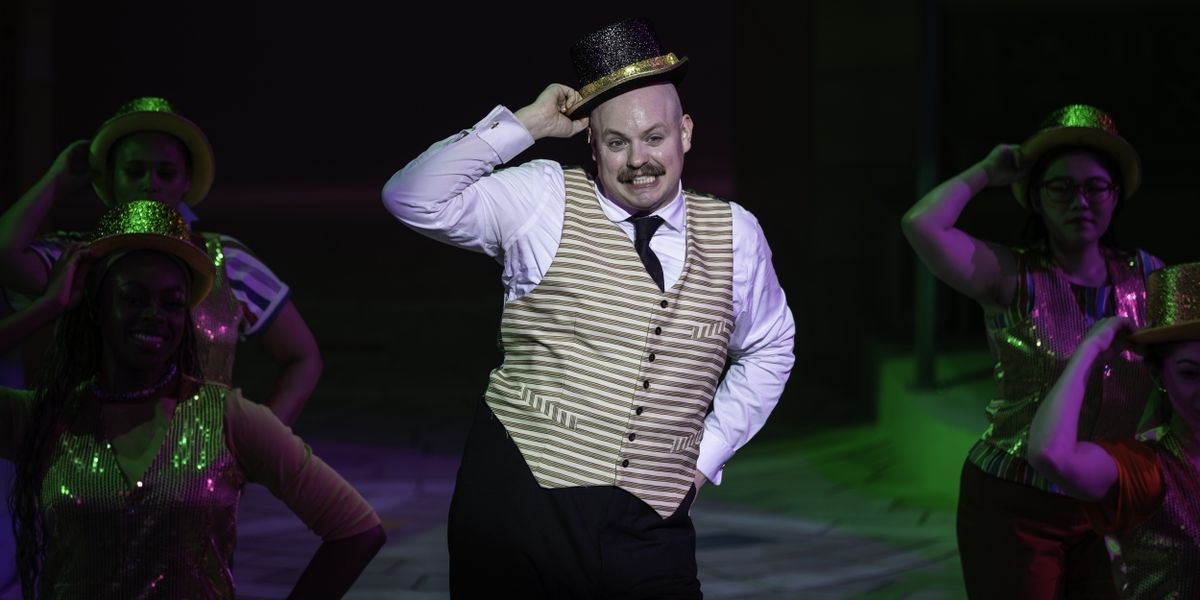
Twelfth Night tends to belong more to the comic subplot of the fools, more than the lovers, and this musical adaptation leans even further in that direction. Connor McCanlus steals the show, over and over, as Olivia's butler Malvolio. Though initially conceived as a Puritan type, the musical adaptation's relatively mild abridgments often focus on Malvolio's material, reconfiguring him from a censorious scold into a stiff-upper-lip, impeccably posh boor. In Connor McCanlus's hands, Malvolio becomes an immediate candidate for one of the greatest musical-comedy character roles of all time, part Mama Rose and part Squidward. When McCanlus's Malvolio lets down his hair (well, technically puts on his wig) and starts vamping, camping and kick-lining, the crowd goes justifiably wild. Even better is his showcase towards the end of the show; this adaptation mostly cuts the somewhat controversial torture scene and inserts a pseudo-"Rose's Turn" for Malvolio instead. To create a character audiences can both sympathize with AND hate at the same time is no great stakes is no small feat, and it's a testament to McCanlus's chops that he can bring cheers with Malvolio's queer self-actualizing, while also leaving no doubts whatsoever that this character is a self-obsessed malignant narcissist. (Can we get McCanlus as Sharpay Evans in an abridged High School Musical trilogy, please and thank you? In fact, let him play Ryan too! He will MAKE IT WORK!)
Garbie Dukes brings his usual warm but raucous energy to Toby Belch, weaving notes of Redd Foxx's Sanford into the wealthy drunken prankster. His earthy vibe plays well opposite Breden Peifer's airier Sir Andrew, played here as a dance-loving party animal and quasi-club kid. These two Public veterans are joined by two community members, both giving warm and fully-conceived performances: Georgia Taylor (of the Vintage Senior Center) as Toby's sly girlfriend Maria, and John Ploskina (a Renaissance man across multiple fields) as the hanger-on Fabian. Rounding out the group is Caro Dubberly as Feste the fool. Reconfigured from court jester to a street busker, often seen in the presence of two community-member street musicians, Dubberly wisely plays their role with an understated, dry coolness, making Feste the viewpoint figure around which everything else revolves. They also get without a doubt the best song in the show; when Orsino calls for music, Dubberly sings Shaina Taub's "Is This Not Love," embodying Viola's internal turmoil as Zeno and Campayno perform a slow, minimalistic dream ballet.
Twelfth Night's use of a New Orleans funeral second line repeatedly in the show feels pointed, even metatextual: this is indeed a farewell, a sendoff to seven adventurous years that saw the Public not only produce the classics but newer, edgier and less expected work. It isn't lost on me that Kaminski's final show was a big, splashy and innovative production of one of the most mainstream and recognizable shows of all time. Is this a look at Kaminski's future? The Public's? Both? Like Viola and Cesario, here's hoping for a world in which we, the audience, CAN indeed have it both ways; the old and the new, the innovative and the familiar, the large and the small, the gaudy and the intimate. Is this, after all, not love?


|
Bruno Mars & DJ Pee.Wee Acrisure Stadium (8/29-8/29) |

|
Golden Girls The Laughs Continue Byham Theatre (10/02-10/03) |
|
Broadway at the Overlook Pittsburgh Musical Theater (8/27-8/30) |
|
Nunsense The Strand Theater (3/12-3/21) |

|
Man of La Mancha The Strand Theater (9/11-9/20) |

|
Rainbow Kitten Surprise Stage AE (9/23-9/23) |

|
The Lion King Benedum Center for the Performing Arts (9/09-9/27) |

|
Zac Brown Band PPG Paints Arena (9/13-9/13) |
|
The Dinner Detective Murder Mystery Dinner Show The Dinner Detective Pittsburgh (9/12-9/12) |
|
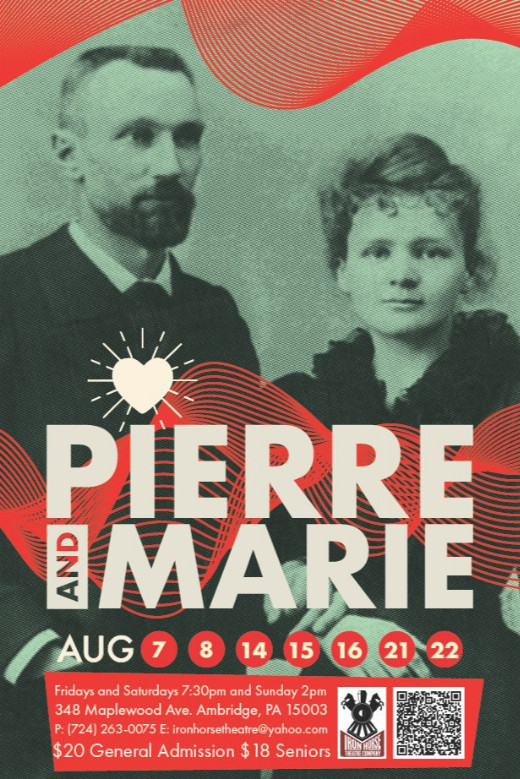
Pierre & Marie Iron Horse Theatre Company (8/07-8/22) |
Reader Reviews
To post a comment, you must register and login.