


Review: SUNDAY IN THE PARK WITH GEORGE Paints a Complex Picture at Front Porch Theatricals
Front Porch closes its season with a Sondheim classic
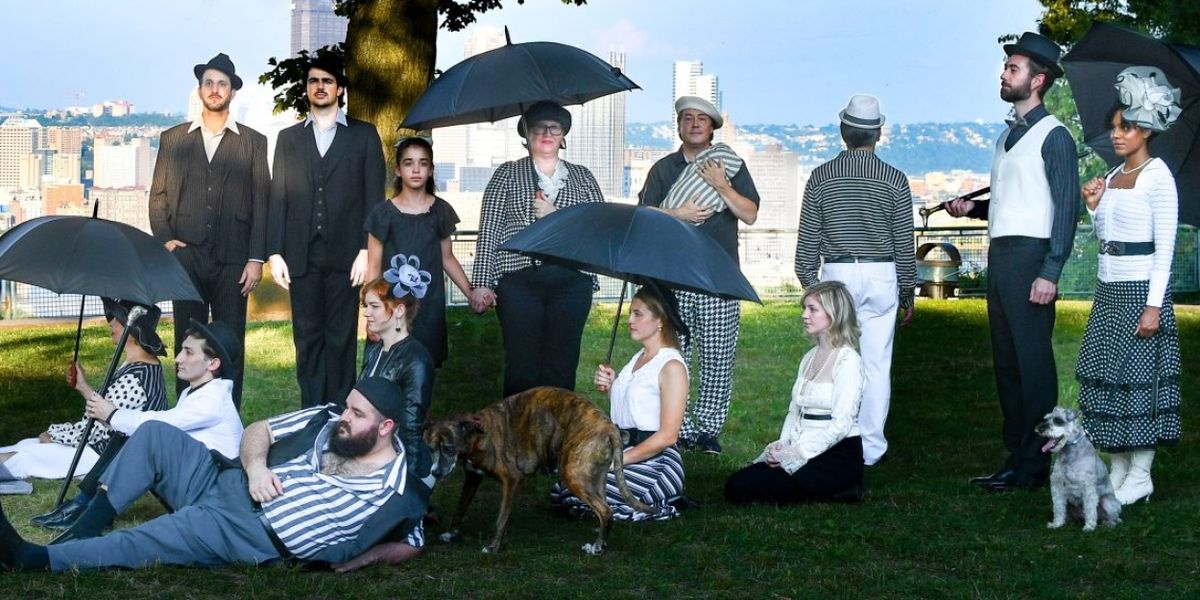
When it comes to Stephen Sondheim, people often have very strong opinions on "blue-book Sondheim" (the first half of his memoirs is a blue book covering his origins through Merrily) versus "pink book Sondhiem" (the second half, a pink book, covers Sunday through Bounce). I am a blue-book guy, but pink-book Sondheim aficionados famously hold an almost religious reverence for his collaborations with James Lapine that marked the start of his "Sondheim is God" era. After all, when Sondheim died, what was the song almost universally chosen to eulogize him, sung in public and at concerts around the world? "Sunday."
This is all prologue to explain that I walked into Front Porch's production of Sunday in the Park with George to see a good musical by a great composer, not as a disciple poised to receive the definitive statement on art and artists of the twentieth century. Naturally, I was impressed as always: write it in marble, there is no such thing as a less than impressive Front Porch show. But if the role of the critic- hell, the role of the audience- is examining the way art reflects both its own time and ours, I did find myself wondering if the musical's second act means something a little bit different than it did when it initially premiered.
Much like Into the Woods, Sondheim and librettist James Lapine begin with a self-contained Act 1 which feels like a show in and of itself, and then close with a shorter, more contemplative and conceptual Act 2. Act 1 gives us the semi-fictionalized story of pointillist painter Georges Seurat (Aaron Galligan-Stierle), whose obsession with color theory and machinelike precision in his new painting method alienates both the critics (Brad Smoak and Becki Toth), and his own lover, the model Dot (Saige Smith). Seurat died young, but history has proven his painting "Sunday in the Park" a masterpiece, and as we flash forward to the 1980s, Seurat and Dot's illegitimate great-grandson George (also Galligan-Stierle) has become an experimental artist himself, as well as caretaker to his grandmother Marie (also Smith). George Jr (give or take a few generations) is at a crossroads between popular success and burnout, and finds the pressures of being an Artist as draining as the process of making art. A trip to France leads him to a breakthrough... maybe.
Of all the Sondheim scores, Sunday is the most overtly Sondheimy in the general usage of the term: beautiful and lyrical but rarely tuneful, with long and demanding passages of repetitive sound and an almost Philip Glass quality. This is used in deliberate contrast to the moments of aching lyrical beauty which come at the end of each act: a ballad for our two leads, and then a full-ensemble anthem. Director Rob James and music director Camille Rolla have both done yeoman's work fitting this piece together. As much as it is a popular classic of the theatre, it is also very much an experimental work which touches at times on the avant-garde, and their collaboration has been integral to keeping the pieces together.
Our two leads, Aaron Galligan-Stierle and Saige Smith, expertly both differentiate and unite their characters separated by the generations. Smith finds the warmth, humor and forward-thinking attitude in both Dot and Marie. The scenes in which she rails against the stuffiness of Paris or the single-minded obsession of Seurat are comic highlights, whether she's spitting rapid-fire lyrics in one of Sondheim's famous patter songs, or just reacting wordlessly in an effortlessly silly bit of physical comedy. She sings with that luminous, bright mezzo-soprano tone we associate with her; it's not for nothing that Saige Smith is almost synonomous with Pittsburgh's theatrical scene.
Galligan-Stierle has a much more difficult role to play, perhaps the most challenging male role in musical theatre (or most challenging TWO roles, perhaps). His Seurat is all sublimated passion and vaguely autism-coded eccentricity, whether pacing in his study shouting out color combinations to finish a single hat, or performing both sides of a conversation between two dogs he is sketching. Galligan-Stierle walks a fine line to find both the humor and the dignity in Seurat's eccentricities, letting us invest and believe in him as a serious artist and forward-thinker while also acknowledging Seurat DID get a bit weird when he's in the work-hole. When he emerges for Act 2 as George Jr, sans beard and perm and with a much more relaxed and socially adroit affect, Galligan-Stierle is almost unrecognizable. Even his voice has changed: Galligan-Stierle sings George Jr essentially as himself, but approaches Seurat with the exceptionally mannered and unconventional tone which Mandy Patinkin used in the role. (Close your eyes and you'll hear exactly what I mean; the resemblance is uncanny.) When George works the art reception in "Putting It Together," Galligan-Stierle plays him as tense but still relaxed, casual and jokey, an ocean from the tense, tightly-wound and eccentric Seurat.
While the show is an ensemble piece, full of recognizable Front Porch and Pittsburgh faces, only two other performers have large, fleshed-out roles alongside our central duo. Brad Smoak and Becki Toth play Jules and Yvonne, the art intelligentsia of turn-of-the-century France. Smoak's resonant bass and Toth's powerful soprano emphasize the influence they wield over the scene, but their preening and comic flair (at least from Seurat's perspective) repeatedly shows us that they are not gods, and their opinion is not absolute. Toth in particular, a beloved Front Porch regular, has a knack for going from catty to warm to tragic to absurd at the drop of a hat... perhaps the wonderfully ludicrous hat Yvonne wears, in fact. Finally, if one ensemblist comes close to stealing the show, it's Ben Nadler in the double role of a puckish philanderer in Act 1 and a harried software engineer in Act 2.
This brings me into my personal qualms about Act 2 as mentioned above. George Jr is a conceptual artist in the 1980s, and his work in "color and light" is intended to directly parallel how Seurat was working in "color and light" with his color-theory analyses and development of pointillism a century earlier. George Jr has devoted his whole career to "chromolumes," a form of digital optical art projected onto screens. This is all well and good (and the projection design by Joe Spinogatti is indeed a cool slice of early CGI retro-chic)... but as time and technology marched on, the way the chromolume is described began to sound first dated, and then dubious. It's repeatedly mentioned that the abstract visuals and lights require a NASA-tier level of computing power to generate and maintain; how were Sondheim and Lapine to know that forty years later, it would sound an awful lot like George Jr is an AI artist? Though that association made it slightly harder to hold sympathy for him, oddly enough the insinuation works: if George Jr is a tech-bro hack, the ending reads less as "passionate experimentalist overcomes writer's block" and more like "successful but lazy creative learns to reconnect with his organic artistic roots."
On the drive home, I spoke to my companion (an artist and lover of art history) about the show. We soon discovered a major biographical similarity between Seurat and Sondheim: though both artists were considered cold, fussy, experimental and unapproachable at their career peak, posterity (posthumous in Seurat's case, late-career in Sondheim's) made them popular successes when people loosened up and learned to look and listen with a more critical eye. Where would we be without Seurat and Sondheim? Thankfully, Front Porch needs no critical appraisal: like they always have, and hopefully they always will, they have painted a picture well worth admiring.

|
Golden Girls The Laughs Continue Byham Theatre (10/02-10/03) |

|
Pierre & Marie Iron Horse Theatre Company (8/07-8/22) |

|
Broadway at the Overlook Pittsburgh Musical Theater (8/27-8/30) |
|
The Dinner Detective Murder Mystery Dinner Show The Dinner Detective Pittsburgh (9/12-9/12) |

|
Man of La Mancha The Strand Theater (9/11-9/20) |

|
Hadestown Benedum Center for the Performing Arts (10/27-11/01) |

|
A Funny Thing Happened on the Way to the Forum The Strand Theater (4/30-5/09) |

|
The Lion King Benedum Center for the Performing Arts (9/09-9/27) |
|
|
Hadestown (Non-Equity) Benedum Center for the Performing Arts (10/27-11/01) |
|
Nunsense The Strand Theater (3/12-3/21) |
Reader Reviews
To post a comment, you must register and login.