


Review: VANITIES, THE MUSICAL: Reflections in Three Mirrors at School Of Theatre, Film, & Television
A graceful farewell to the BFA in Musical Theatre as TFTV’s broader theatre program evolves.
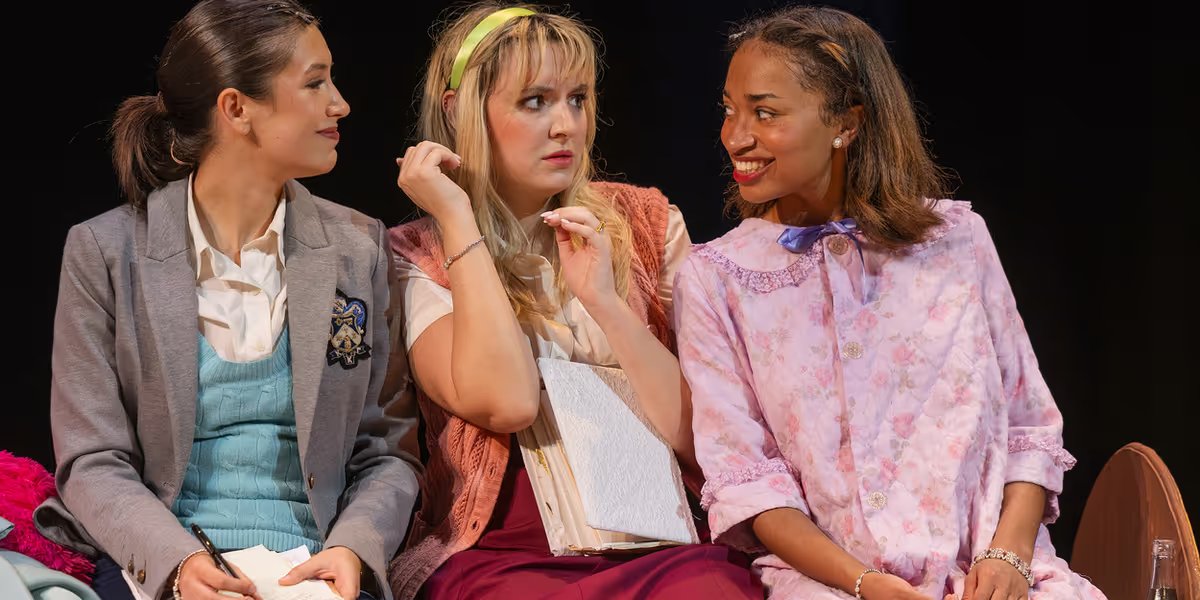
It takes a measure of brass to launch a season with an obscure, three-hander musical, a calculated risk that trades box-office certainty for quiet intimacy. History has shown that small, earnest productions can leave lasting impressions—Tick, Tick… Boom!, The Last Five Years and The Fantasticks remind us that strong material endures long after stagecraft has exhausted its influence.
In the case of the University of Arizona's expiring BFA in Musical Theatre, the choice feels less like provocation than practicality—a matter of roster integrity. It reflects the quiet attrition that accompanies the dissolution of a once-elite program.
Though the BFA is concluding, TFTV’s theatre training remains vibrant, bolstered by a new Musical Theatre Minor and a growing Live and Screened Performance degree, with plans already in motion for the 2026–27 theatre season.
The newly added Musical Theatre Minor is designed to help students across the university develop their voice, dance, and acting skills. The initiative ensures that musicals remain vital to TFTV's future performance seasons.
Not a bad concession, but it's difficult to imagine a "minor" cultivating the same breadth of artistry that distinguished the university's BFA graduates over the years.
Lest I digress, none of this context detracts from the work of the talented trio leading VANITIES, THE MUSICAL, now playing at the Marroney Theatre under the direction of Christie Kerr, the new Head of Acting and Musical Theatre. As the program takes its final bow, VANITIES showcases a standout senior trio, trading the usual breadth of casting for focus and storytelling. (It's hard to believe TFTV's transcendent production of SWEENEY TODD was merely two years ago.)
VANITIES, a chamber piece by Jack Heifner (based on his play) with music and lyrics by David Kirshenbaum, won't bowl you over with pageantry or reinvention. It unfolds as a memory play in its elemental form: three women tracing the shape of their friendship across the shifting cultural sands of the 1960s, '70s, and '80s. The plot feels dated, occasionally verging on pablum, but this student production finds, in its young cast, moments of startling intimacy and truth.
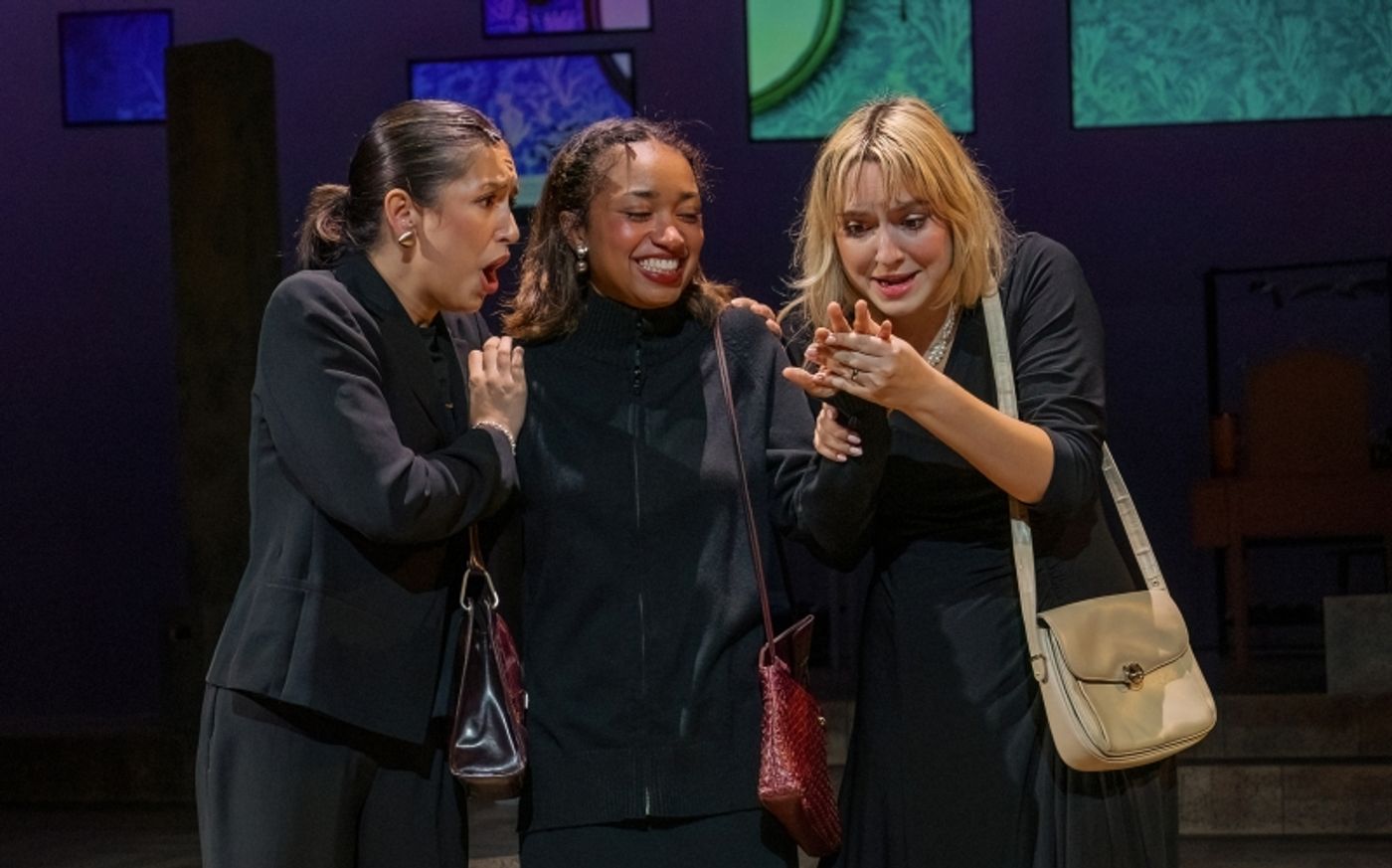
At its core, VANITIES is a meditation on time—how it shapes and betrays us, and how friendship endures in its wake. It follows three Texas cheerleaders whose youthful confidence carries them into adulthood with varying degrees of success and self-delusion. Their lives unfold across three decades, each scene tracing the arc from the casual optimism of youth to the sobering compromises of maturity.
SAMANTHA ADAMS approaches Joanne with poised precision, embodying a devout traditionalist whose moral clarity both defines and constrains her. JAZMINE GOMEZ brings a calm intelligence to Kathy, becoming the pragmatic center that holds the friendship together even as her own direction wavers. NOELLE ROBINSON’s Mary is all kinetic energy: defiant, curious, and quietly aware of what her freedom demands. Each singer brings a distinct vocal color: Adams's measured warmth suits Joanne's composure; Gomez's steady tone gives Kathy quiet authority; and Robinson's brighter timbre lends Mary both spirit and vulnerability.
These women embody three responses to the passage of time: faith, order, and rebellion. Joanne clings to her ideals, Kathy manages her ambitions, and Mary searches for meaning beyond the lines. Their bond becomes a portrait of friendship in flux—how we grow together, and how we grow apart.
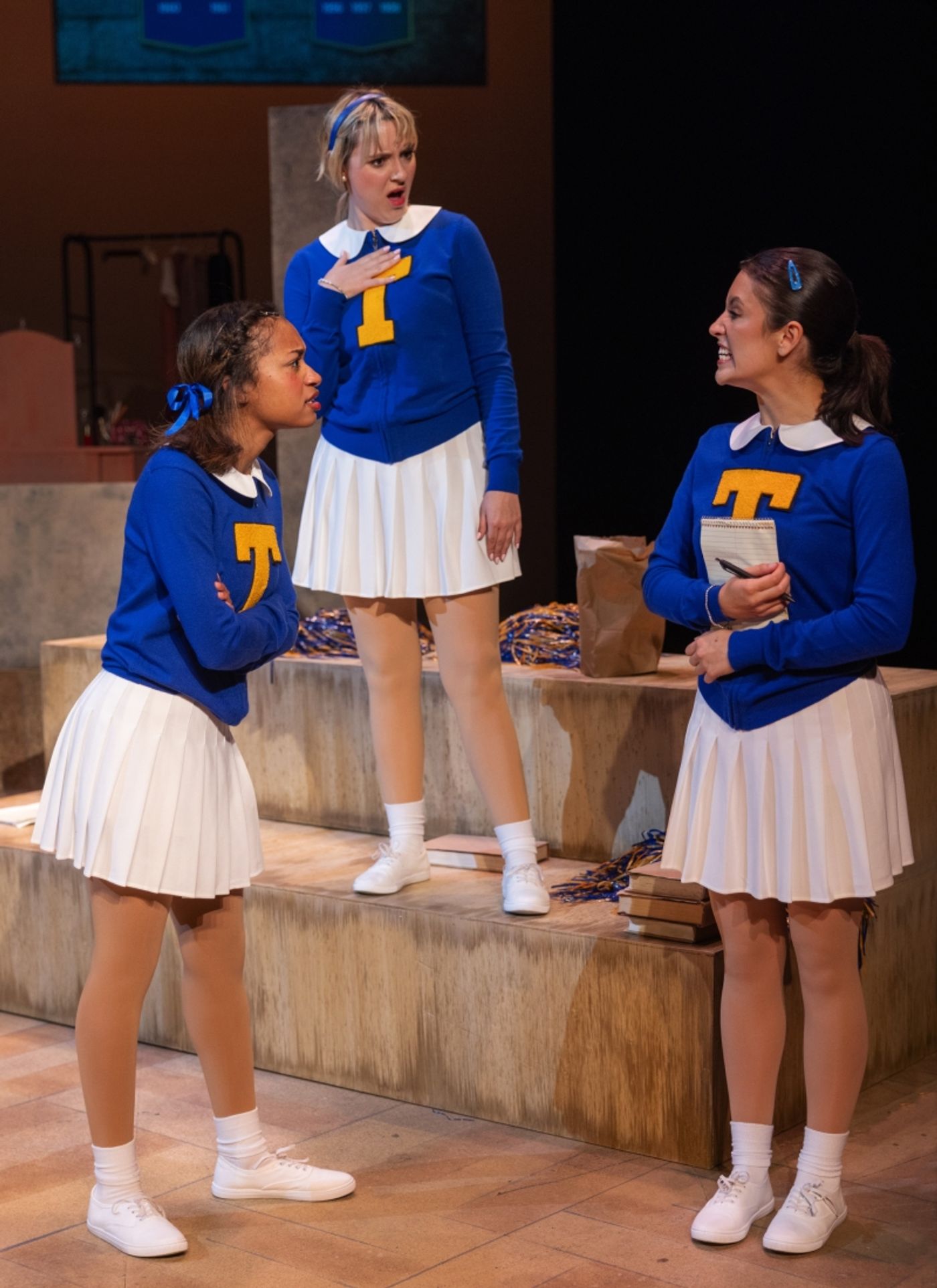
Presuming the extensive table work between cast and director, I'm surprised by the curious ensemble choice at the top of the play. In portraying teenage cheerleaders, the cast appears awkwardly strained—illustrating types in broad archetypes as opposed to inhabiting the girls with youthful ease. The result is a collective performance that leans on caricature, a characterization of stock gestures rather than authentic impulses.
Ironically, these college actors find greater truth as their characters age, revealing depth and emotional nuance in the later decades. You'd expect high-school exuberance to come easily to actors so near their characters' age, yet the early scenes play more like sketches than lived-in moments.
The staging, on the other hand, is compelling in its restraint. As a dramaturgical nod, director Christie Kerr leans into the defining throughline of a small-cast musical: individual stories carrying a shared story. The minimalist design—three vanities, a few costume changes, and lighting that subtly traces the passage of time—keeps the focus where it belongs: on the women. It's a study in understatement, and it works.
Irene Nguyen's scenic work adopts a presentational aesthetic, anchored by tall, square columns and elevated platforms that add structure and flexibility to Marroney's renovated space. The set adapts fluidly to changing time periods and emotional tones, with minimal furniture to tether it to realism—the lone exception being a bed, rolled in from stage right, that anchors key domestic moments. Domino Mannheim's lighting enriches this world with texture and color shifts. (One quibble: the bed area could use a touch more wash, or a downstage adjustment, as the performers were occasionally underlit during quieter scenes.)
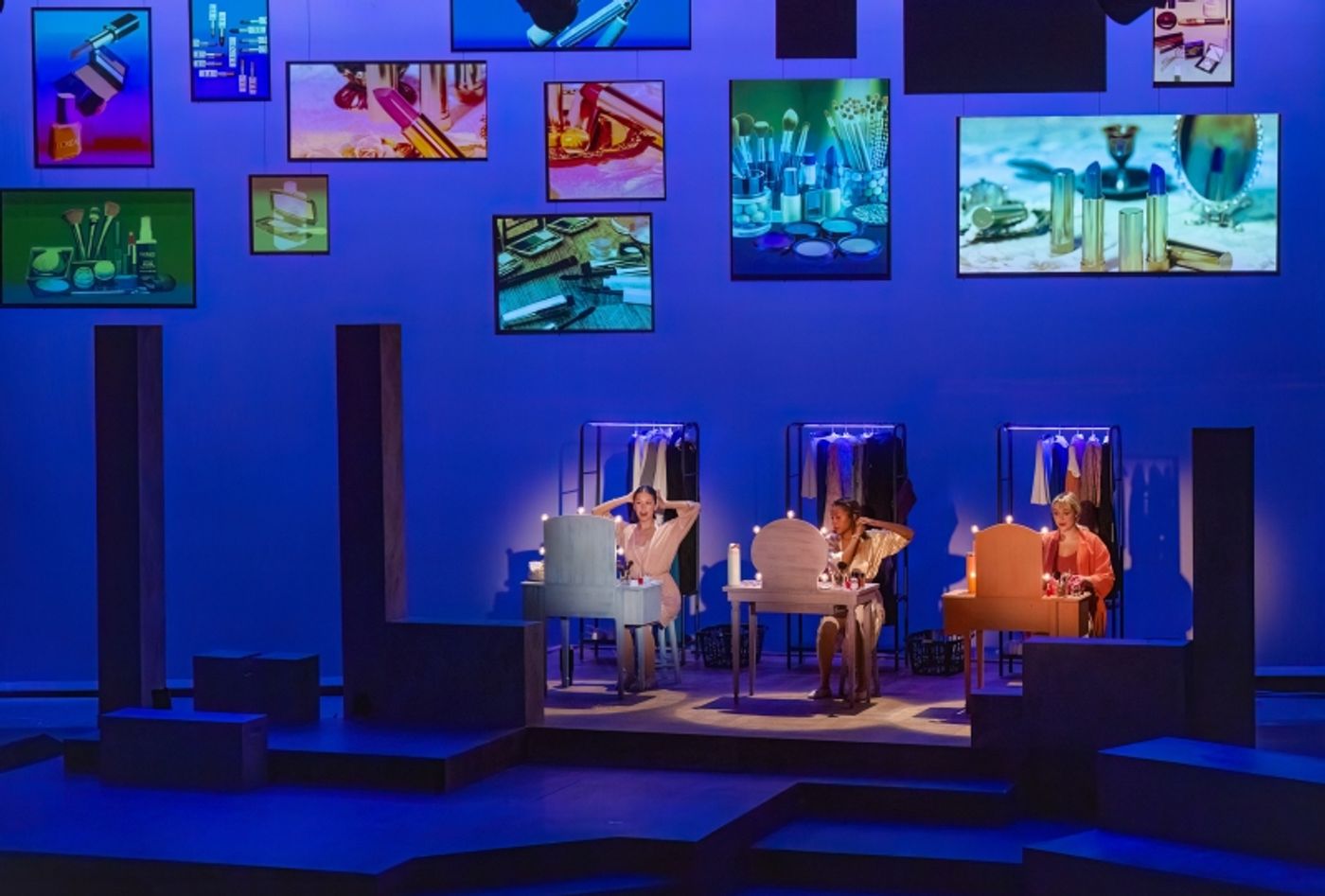
The vanities, positioned upstage, serve mainly as a transitional space where the women prepare to enter new phases of their lives—a striking irony, considering the title's significance. Yet the device feels ponderous, consuming time and diverting the audience's attention. Bridging that gap, incidental music plays beneath a montage of framed, period images projected across the cyclorama. Though visually apt, the sequence functions more as a distraction than a transition—an attempt to mask the tedium of offstage business. One can envision a more dynamic approach, where shifts are seamlessly integrated into the action, with performers remaining the primary drivers of transition.
Ultimately, VANITIES, THE MUSICAL feels like a shrewd choice: intimate, character-driven, and anchored in emotional truth rather than display. Yet the book remains incomplete, sketching lives that promise complexity but stop short of it. The musical score borrows from familiar idioms while still finding its own voice. The episodic form mirrors the ebb and flow of friendship over time, though at the expense of sustained tension.
Still, within that design, the cast finds coherence, uniting the fragments with sincerity and grace. It's a bittersweet glimpse at the superb industry training this university has provided young performers over the years.
If this is in fact the program's final act, it's a graceful one: honest, heartfelt, and rooted in the kind of simplicity that outlasts showmanship. In a time when grandiosity often wins the day, there's something quietly triumphant about ending on a whisper rather than a shout.
Photo Credit: Tim Fuller


|
Red Herring Puppets: The Friendly Chupacabra The Scoundrel and Scamp Theatre (9/12-9/12) |
|
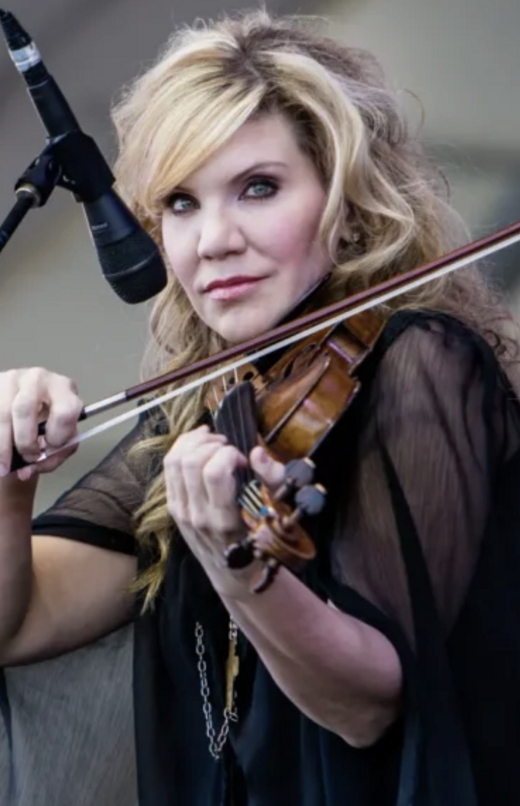
Alison Krauss Pepsi Amphitheater (9/28-9/28) |

|
The Taming Beaver Street Theatre (9/17-10/04) |

|
The Tempest Arizona Theatre Matters (10/05-12/31) |

|
Staged Reading of Las Nuevas Tamaleras By Alicia Mena Live Theatre Workshop (9/05-9/06) |

|
Much Ado About Dinosaurs Beaver Street Theatre (10/16-10/25) |
|
A Doll's House Part 2 The Scoundrel and Scamp Theatre (4/15-5/02) |
|
Before Oz by Lauren Grove Actors PLAYground (8/07-8/16) |

|
Grupo Arga Detectives Privados Grupo Arga Detectives Privados (5/18-10/18) |

|
Godsmack, Stone Temple Pilots & Dorothy Talking Stick Resort Amphitheatre (9/12-9/12) |
Reader Reviews
To post a comment, you must register and login.