


Review: 'MUCH ADO ABOUT NOTHING' AND 'ROMEO AND JULIET' at Shoreside Theatre
Shakespeare: "the course of true love never did run smooth"
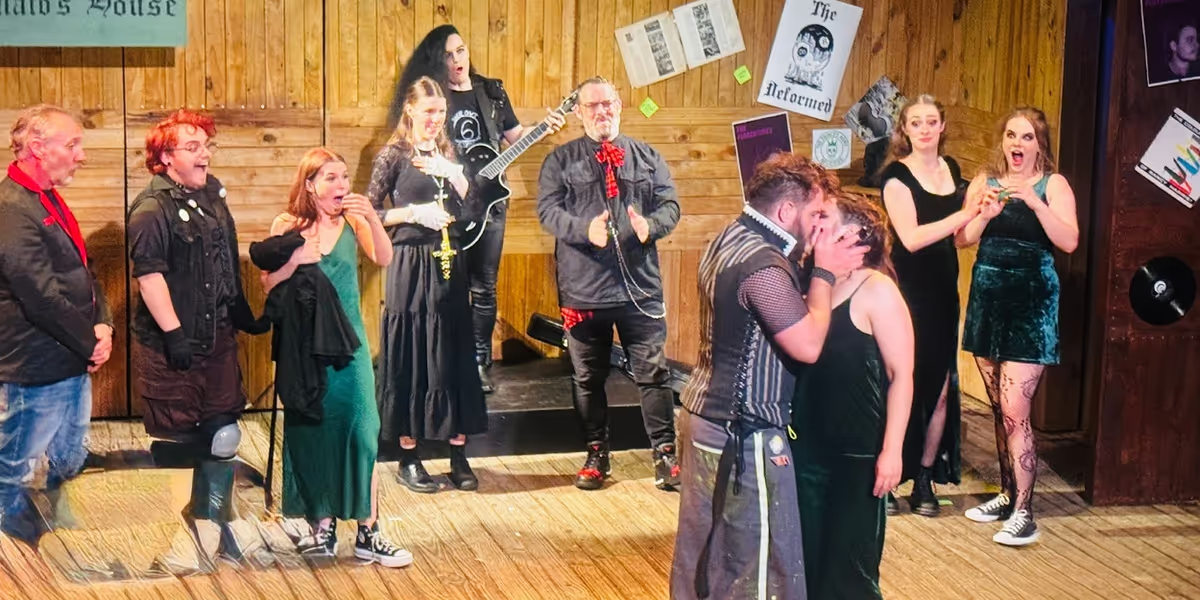
Every summer for the past thirty years, Shoreside Theatre prove that Shakespeare isn’t just some old classic and hard to understand English writer of centuries past. Rather, he remains current and relevant. Despite the tragic nature of Romeo and Juliet and the comic twists of Much Ado about Nothing, Shakespeare captures the nature of love and conveys the common theme of how appearances can be deceptive in both these plays. They are an excellent pairing. Shakespeare’s intricate plots, complex and real characters and clever words can show us how to deal with identity issues, how misunderstandings and mistakes are part of being human, how to stand up for our rights, how things are definitely not as they seem, how we might need to take a stand against wrongdoing and injustice. His philosophies are timeless, and his words can resonate long after they have been heard. These are plays that can be enjoyed time and time again.
Even frequently attending Shakespeare fans, and those who know these two plays well, will appreciate new perspectives in the clever reimagining of the directors, Michelle Atkinson (Much Ado) and Steph Curtis (Romeo & Juliet). Their approaches show us the timeless nature of Shakespeare’s themes. Juxtaposition is a significant feature in Romeo and Juliet, with the language reinforcing the contrasts with light/dark, infatuation and genuine love, hate/love, violence and delight. Romeo and Juliet is directed with interesting approaches to the gender roles, with some male roles interpreted in new ways that challenge our assumptions. Particularly powerful twists were achieved in the strong performances of Benvolio (Emily Cuff) as Romeo’s best friend, the authoritative stern but merciful Prince (Terri Mellender) and in the harsh nature of Lady Capulet (Philippa Hibbs).
Much Ado about Nothing is set in Leonato’s (Greg Campbell) house which is an iconic music venue, and the various characters are involved in a range of ways in a punk music world. This is established well within the outdoor, multi-level stage which ensures the audience remains thoroughly involved and engaged. Romeo and Juliet is more traditionally set, with minimalist use of trappings and set. However, in both plays the action is briskly paced, with creative use of space, with high energy exits and entrances, and faithful, emotionally charged delivery of Shakespeare's text. Some cast might need to remember to lift their eyes to share their thoughts out to the audience, as at times, the emotional intensity and clarity of important lines was lost. However, entrances and exits are typically strong, creative, and often engage the audience as Shakespeare intended.
In Much Ado, the rivalry between well-meaning and powerful music producer Don Pedro(Daniel Moore) and Defamed band member and beautiful younger sister Don Jon (Asha 0’Connor-Palacios) provides a valid provocation for the villainous mischief Don Jon creates for the lovers, emotional Claudio (Kierron Diaz-Campbell) and wronged Hero (Grace Blackwell). Talented work from El Boasman as the wicked side-kick, Borachio who brings the “seeming proof of Hero’s disloyalty.” Wronged Hero (Grace Blackwell) is realistic in her range of emotions: sweet daughter, playful friend, wounded bride. We feel her pain when the villains use the wedding as a chance to get revenge. Rose Herda as confident and strong bawdy Margaret is a fabulous foil to Beatrice, spirited, lower class and flirtatious, with her own range of double entendres. Sadly, she lacks the insight to realise she’s being used as a pawn in the villainous plot.
The ‘love” narrative focuses on the enduring theme of distinguishing between appearances, making careful observations, and discerning the underlying truth in a range of situations. Much Ado is built around powerful word play, the intellectual banter of Beatrice and Benedick, the dramatic irony of fooling these two strong headstrong characters into falling in love, clowning, deliberate entrapments and lines that can be twisted easily into sexual innuendo. The intelligence, wit, and interplay of fiercely independent and loyal Beatrice (Heather Warne) and confirmed bachelor Benedick (Jack Powers)are outstandingly captured and thoroughly energized. Excellent work from these two, who know how to deliver their lines with a fresh spontaneity and spirited clarity.
You can’t judge by appearances warns Shakespeare. This trickery builds on Shakespeare's timeless truth that not everything you see is what it seems to be! We need to be aware of "information" we might learn from deliberate eavesdroppings, mistaken conclusions, assumptions and misreporting.. True touches of comic genius are seen in the delightful novel Friar (Sofia Shaw) and the well-executed demanding role of Dogberry (Amanda Moore) and Verges (Zoe Atkinson)
Love in Much Ado is presented through the various pairings – the romanticized love of Hero and Claudio, the sexually charged love of Borachio and Margaret, and the initially adversarial but ultimately deeper love of Benedick and Beatrice. Beatrice and Benedick have a tense relationship. To say the least. Beatrice describes Benedick as an idiot, as “the prince’s jester, a dull fool”. Benedick is as unkind, his comments unpleasant. It appears they can’tt stand each other but their matchmaking friends decide that hate is akin to love. The elaborate scheme convinces each that the other is in love with him/her. Shakespeare perhaps realised that we love flattery and praise, and that positive readings of negative comments can be persuasive, despite the unlikelihood.
Love in Romeo and Juliet is a force – both divine and destructive, passionate and powerful, seen in the demands of family and “name”, full of joy and grief, supported by friends and threatened by enemies. “Never did the course of true love run smooth.” Love, conflict, family. Love, without a doubt, can provide a pole vault. Stable characters become risk takers. Romeo and Juliet fall into this category. Two teenagers of feuding families, they would have been unlikely to even meet. But, through being a teenager and deciding to crash a party to which he was not invited, Romeo and Juliet do meet, within a few hours marry in secret, and find themselves up against a relentless barrier of harsh consequences.
In this interpretation the love struck nature of Romeo (Grant Zent) is that impulsive teenager, heedless and ignorant of the consequences of his many rash actions. Juliet (Alice Dibble) is captured well. Initially dutiful, innocent, sheltered and willing to do as her family wishes, her passionate nature is ignited. She’s sensible enough though to insist on marriage and brave enough to defy her family. Yes, teenagers will want to take control of their own lives, and they might well make the wrong decisions, not thinking through all the ramifications. And yes, when Juliet appears dead, she is in fact not. The tragedy ensues when the Friar’s (Sage Carruthers) plans to help the lovers by marrying them to end the feuding shows how easily even well intentioned plans are -- not.
Make sure you get along to see both plays. They cement a single vision in which Shakespeare’s ideas and language are alive and well. We are reminded what it is to be human. With talented and cohesive cast who all contribute to the impact of each play, we get comic, entirely focused and sometimes endearing characters. The audience appreciate the humour and feel the tragedy. Add inventive costuming and Shakespeare is being presented with original twists, depth, comic flair, emotional connection and audience interaction. Don't miss it!
The 30th Summer 2026 Shakespeare in the Park (MUCH ADO and ROMEO AND JULIET) runs January 16 – Feb 14. Tickets on eventfinda.co.nz or (09) 489 8360.
Prefer BroadwayWorld in Google Search?
Add us as a preferred source so our stories show up more often in Top Stories and Google’s AI answers — for you.
Sign up for all the news on the Fall season, discounts & more...

|
Jersey Boys Isaac Theatre Royal (9/18-10/03) |

|
Fletch, Vaughan and Hayley LIVE - The Genuine Friends Tour Christchurch Town Hall (10/16-10/16) |
|
The Gobline and Swallowe Inne Stray Theatre Company (9/23-9/26) |

|
Fletch, Vaughan and Hayley LIVE - The Genuine Friends Tour The Opera House Wellington (10/09-10/09) |
|
Jesus Christ Superstar Civic Theatre (10/21-11/08) |

|
Garithmetic: The Maths Show for Dumb People Basement Theatre (9/22-9/26) |
|
5 Seconds of Summer Spark Arena (10/24-10/24) |
|
Femmes and Thems Comedy Basement Theatre (8/27-11/19) |
|
Jesus Christ Superstar St James Theatre Wellington (11/18-11/28) |
|
Little Shop of Horrors Q Theatre (12/16-12/20) |

Reader Reviews
To post a comment, you must register and login.