


Review: COMMENÇONS PAR FAIRE L'AMOUR at Grand Théâtre
The on the literary tetralogy by Jean-Philippe Toussaint.
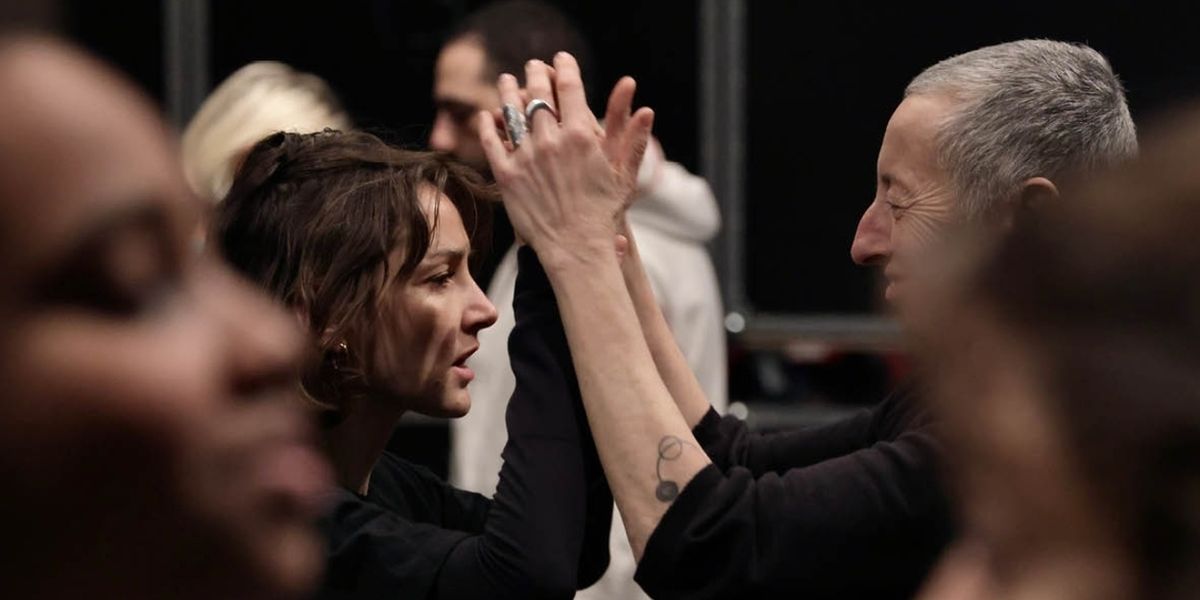
Last week at the Grand Théâtre of Luxembourg, Laura Bachman’s new creation Commençons par faire l’amour premiered as an intimate, yet universal meditation on love, memory, and gender. Drawing on the literary tetralogy by Jean-Philippe Toussaint, the piece dissolves the boundaries between dance, theatre, light and song to tell the story of “Marie” — a complex woman whose emotional journey resonates with numerous facets of modern society. Here are some highlights:
The couples’ scene: from mundane gestures to choreographic crescendo. One of the evening’s most unforgettable moments arises in a scene with the two couples. What begins as a somewhat tense but ordinary interaction between a man and a woman — small gestures, subtle looks, familiar back and forth — slowly transforms into something else: a choreographic mosaic, where regular physical fragments of a conversation spiral into a crescendo of corporeal expression. Something which regular couples can probably relate to is first crystalized in a sequence, and then emotionally hyperbolized in physical form.
Magali Caillet Gajan: one of the magnetic threads of the story. Among an already great ensemble, Magali Caillet Gajan stood out with a formidable presence, from the very first scene to its last. Whether through her elegance, a subtle shift of weight, a glance across the stage, or a moment of stillness, in several moments she anchored the emotional and narrative flow of the show.
A song that takes your breath: in what might have seemed an unexpected turn in a dance-performative piece, a song performed by Julien Ferranti emerged as a moment of great emotional clarity. The rendering is so raw, so full of longing and vulnerability, that it momentarily took you somewhere else. His performance catches you off guard — and in doing so added a profound layer to the overall narrative, amplifying the emotional resonance of the piece.
In sum, Commençons par faire l’amour isn’t just a dance piece: it’s a living reflection on intimacy, identity, and the often-unseen gestures that define relationships. With Bachman’s daring adaptation, a carefully assembled ensemble and choreography that transforms the banal into the poetic, the show offers a powerful, Moving Theatre experience that lingers well beyond its final bow.
As always, our thanks to the Grand Théâtre and the entire cast.
To reach out to the writer: nuno.de.sousa.lopes@gmail.com
Photo Credit: © César Vayssié

Reader Reviews
To post a comment, you must register and login.