


Interview: Paige Hathaway of THE MIRROR CRACK'D at Alley Theatre
We talk to the scenic designer for Miss Marple!
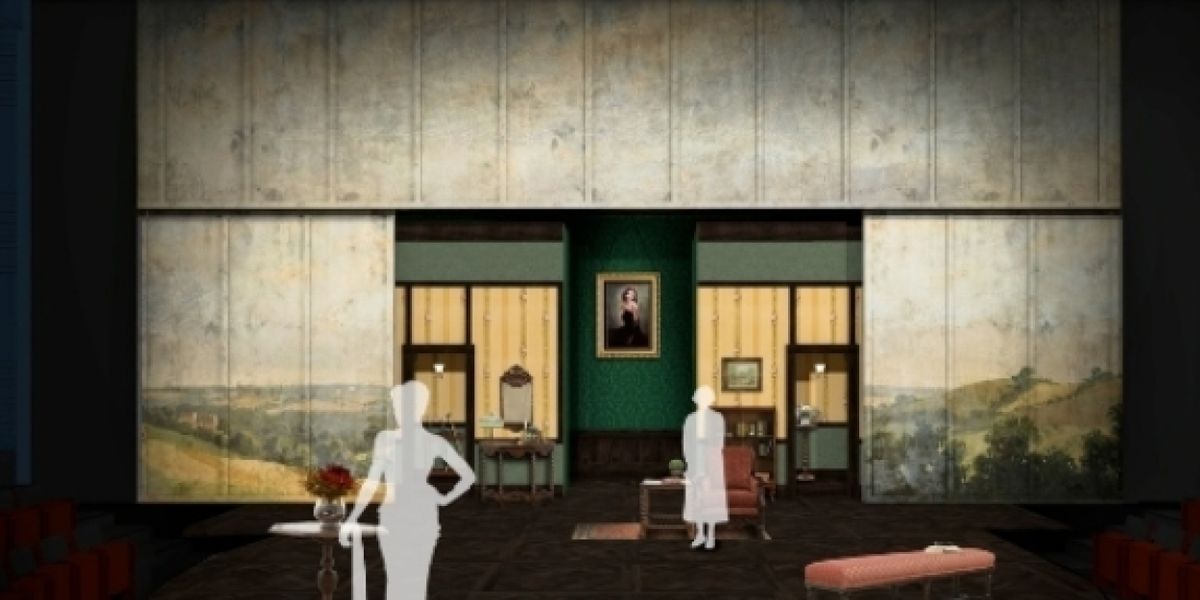
Paige Hathaway is a freelance scenic designer based in the Washington, DC area. She helps to create dynamic stage pictures that give a piece a setting and helps tell the story. She has designed at places such as the Kennedy Center, Folger Theater, Solas Nua, Imagination Stage, Everyman Theatre, and Studio Theatre. Paige holds a Master's in Scenic Design from the University of Maryland and got her bachelor’s from the University of Oklahoma. She is in Houston because she has designed the sets and scenery for Agatha Christie's The Mirror Crack'd. Broadway World writer Brett Cullum got to talk with Paige about creating the world for Miss Marple. You can see the show through August 24th at the Alley.
Brett Cullum: Paige, thank you for being here!
Paige Hathaway: Thank you so much. I'm so pumped. This is my first time out here to The Alley, and it's been just an absolute joy. It's been wonderful.
Brett Cullum: How did Alley Theatre find you? Did you submit for this, or did they track you down based on your previous work?
Paige Hathaway: So, typically, how I get a job is that a theater company will reach out to me. And be like, “Hey, we have this show with this director. Are you interested and available?” Maybe I'll have a conversation with the director just to make sure we're a good fit, or something like that. But for this one, I had worked with the director before, Delicia Turner Sonnenberg. And so, she and I have worked together at a theater out near DC called Roundhouse Theater, in Bethesda, Maryland. We worked on a show called THE MOUNTAINTOP, which is about the last night of Martin Luther King, Jr's life. It's a really interesting show. So we worked together a few years ago, and I just loved working with her. It was so much fun. And then I hadn't heard anything, because she's a West Coast director, and I hadn't heard anything. And then, just out of the blue, The Alley reached out to me and was like, “Hey, Delicia wants you on the show, and we would love to work with you.” It was an absolute shock and a joy, and it's been a great process, and I could not be happier because I've heard of The Alley, and heard truly wonderful things about the people there, the resources, the community. It's always been on my bucket list to work here; here I am, and it's wonderful.
Brett Cullum: Well, I will say one of the things with Alley Theatre, and what I appreciate the most about the company, is that the scenic design is off the chain! Even when they do a comedy, the sets are just so amazing! NOISES OFF, they recently did with the spinning set, neon signs, and everything. They go all out on scenic design. In light of that, and coming to THE MIRROR CRACK’D. What's challenging about this show?
Paige Hathaway: I love designing murder mysteries because there's this inherent attention to detail, because you have to show the process and the clues. So there's this really needy given circumstances for the show, and normally with murder mysteries, you're in a unit set or one location. I recently designed AND THEN THERE WERE NONE, and also DIAL M FOR MURDER. They are both one room and one location.
So the challenge with this show is, it is not just one location. It's like Miss Marple's cottage. It's a movie studio. It's a dressing room and a soundstage in the filming studio. And then there's this enormous manor called Gossington Hall. There's also the way that the story unfolds in which Miss Marple is in her home, and people come and tell her what happened when the murder occurred. So there are these flashback moments. So it's like, so how detailed do you get in representing those flashbacks? Do we fully go to that location? Do we do a partial version? That's a challenge unto itself.
The space of The Alley Theatre is challenging in that it's a three-quarter thrust, which means that you have audience on three sides of the stage, which means that you have to be conscious and cognizant of blocking sight lines, of making sure everybody has equal visual access to what's happening on stage. Not only do we have a million locations, but a decent chunk of these locations need to be fully realized.
Brett Cullum: I love the world of Miss Marple. I mean, it's a totally different thing, because she seems to be the sunnier stand-in for Agatha Christie herself. Agatha was a poison expert. It's not like a cool and aloof Poirot or Sherlock Holmes. So, is there a different approach to designing for Marple versus maybe a Perot or a Sherlock?
Paige Hathaway: The thing that's different about this is that we see her at home. We see her in her village. We see her with her friends, and moving amongst people whom she knows very well, and who know her. I feel like the other sort of Christie detectives are kind of unknowable. We don't see people from their past; it's like they are very serious, you know little about their backgrounds. You kind of learn pieces. But there's a mystery to them, and I feel like Miss Marple is so much more grounded in reality, and she's a fascinating woman. So crafting her home that we see on stage was definitely a very different approach than what I feel like how you typically approach one of those other shows, because you're at a location that we know. We're in her home, which is pretty cool and unique.
Brett Cullum: And one of the show's aspects that I think is interesting is that it's American Hollywood invading England. You get a chance to play with a kind of opulence. Are you leaning into that, or are you kind of minimizing that? What's your strategy here?
Paige Hathaway: It's interesting because it’s sort of how Hollywood glamour comes into this small village. Marina Greg purchases this manor, which has been a part of the village. It was owned and lived in by one of Miss Marple's good friends, Dolly. Okay, so how does a Hollywood star come in and transform a space that is very English? A beautiful English manor!. So, how does she do that? So it's like they're the bones of British architecture there with this infusion of Hollywood glamour. She changed out the sconces to be something that looks almost like a clamshell footlight. She put huge portraits of herself on the wall. The colors are very saturated and glamorous. The Hollywood glamour comes from showing this movie studio, too, of this enormous space that has a little glimmer of the filming of this movie.
I really wanted to play with that context of scale. Going from Miss Marple’s space, which feels a little bit more cozy and warm, like home. And then it expands to this larger Hollywood gesture with this big old chandelier and that kind of thing. The contrast of those two was something that really excited and interested me. I wanted to play up a bit, and then the costumes, of course, help with that, too. I mean our Costume Designer. Nicole Jescinth Smith is incredible, and you can really feel that difference between folks who live in the village versus this Hollywood sort of celebrity.
Brett Cullum: Tell me a little bit about you. What have been your favorite shows to design?
Paige Hathaway: You know, there's there's so many, and some are like favorites of mine for very different reasons. But one of the things I love about this is the variety. No show is the same. So it's always wonderful. One of my favorites was ROSENCRANTZ AND GUILDENSTERN ARE DEAD at the Folger’s. It was something I got right out of graduate school. I was only a year out when I did that, and it was working with this director, who's pretty well known and named Aaron Posner, who's written plays and also directed, and he hired me right out because he liked how my brain worked. It was the perfect confluence of a show that I love at a theater that is really incredible. It's like a replica Elizabethan theater! So we did this kind of like a prop attic kind of idea. It was a beautiful show, and it really also was kind of the beginning of my career, and like hopped me up the ladder a couple of rungs, which was lovely, and I made connections that grew my career. So it always has a very special place in my heart.
Brett Cullum: How did you end up in Washington, DC?
Paige Hathaway: It's second only to New York in theater per capita, which is wonderful. But how I ended up out there was. So I went to the University of Oklahoma for undergrad, and I got my BFA in set design. But when I graduated, I was feeling rudderless as far as where to go, because we had had a turnover of set design professors. And then the person who's still there, John Young, ended up becoming the set design professor, and he recommended, I look at grad school. I did this portfolio review thing, where it's like speed dating with grad programs. It's very fun, like, put out your work, and they sign up for times to talk to you. And I talked to the University of Maryland, which is just outside of DC. I went and did a visit, and I was just blown away by their program, by their facilities, by the people there. The talent of the students. I was just totally blown away. So I ended up going there. So I went to grad school there, got my MFA in 2014. And basically, while I was there, I assisted my professors and got to know the theaters in the area and connect with them, and I just totally fell in love with the variety there. I decided to stay there and have built a career over the past eleven years. It's been a joy working there, and I will plan on continuing to be there for the foreseeable future. New York is not so much my vibe.
Brett Cullum: Well, Paige, obviously, you've got a second home here at The Alley Theatre now. So anytime that you want to come back to Houston, we would love to have you!
Paige Hathaway: It really has been such a joy! The Alley has a reputation around the country for being an incredible place to work, and a place that puts on wonderful work. The staff has been just unparalleled.
THE MIRROR CRACK’D runs at Alley Theatre through August 24th. The show is approximately two hours and fifteen minutes, including an intermission. This is the SUMMER CHILLER for this year, and features actress Susan Koozin as Miss Marple.

|
Jesus Christ Superstar Deluxe Theatre (8/14-8/17) |

|
Hardy WhiteWater Amphitheater (11/21-11/21) |

|
Come from Away Stages (9/18-10/18) |

|
PROOF 4th Wall Theatre Company (9/11-10/03) |

|
To The Bone Theatre Southwest (5/28-6/19) |

|
Richard O'Brien's THE ROCKY HORROR SHOW Art Factory (10/16-10/31) |
|
The Tavern by George M. Cohan Theatre Suburbia (7/24-8/22) |

|
Anarkali Reimagined Luxtrium (10/22-10/25) PHOTOS |

|
Ride the Cyclone HITS Theatre (8/15-8/15) |

|
An Old-Fashioned Family Murder Theatre Southwest (9/11-10/03) |