


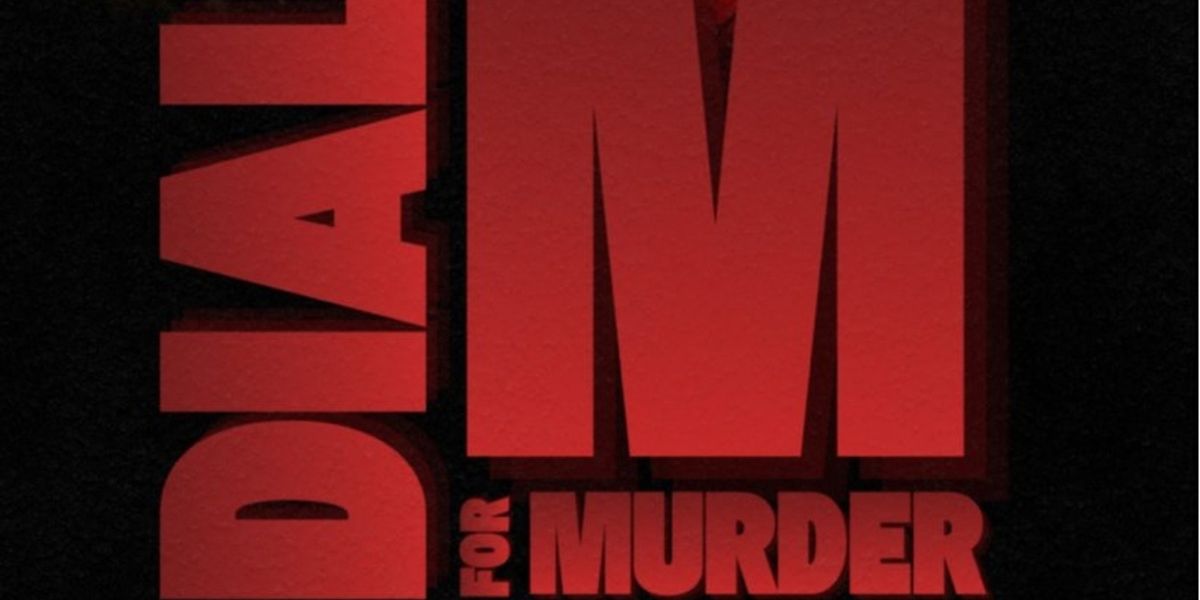
Review: DIAL M FOR MURDER at Mānoa Valley Theatre
Running now through February 8 at Mānoa Valley Theatre.
Edit: This article has been updated to properly credit Dialect Coach Sharon Garcia Doyle. This author apologizes for the oversight.
You enter the theater and see the stage: the living room of a lushly appointed London flat. The audience is seated on all sides, encircling the stage. You take your seat.
The lights dim, pre-show announcements roll.
The lights come up.
A smiling woman, lounging on the sofa in an elegant red dress, leans forward and says:
“So. How would you murder me?”
That bombshell of a question, posited by wealthy London socialite and housewife Margot Wendice (Jasmine Haley Anderson) to her husband’s New York literary client (who is also, as we will come to discover, Mrs. Wendice’s former lover) Maxine Hadley (Piper Quinn), becomes an eerie foreshadowing of the crime at the heart of Dial M for Murder. Maxine, an acclaimed writer of thrillers, laughs and proceeds to list off dozens of deadly murder methods to the intrigued Mrs. Wendice, in alphabetical order, no less. The women have a playful back-and-forth on the subject, as light-hearted as if they were discussing something as trivial as the weather. Little do they know how quickly the fruits of their imaginations will come crashing into their reality. Dial M for Murder is gripping, suspenseful, and deliciously British, a one-room crime thriller that would have Agatha Christie herself on the edge of her seat.
The spare cast and relatively small playing space belie the complexity of the plot and the intertwining relationships of the characters. Staging the show in the round adds to that intriguing and intimate feel, as we the audience somehow begin to feel complicit as bystanders and witnesses to the scene of a horrific crime and its aftermath. It is impossible to not become absorbed in the action when the line between actor and audience is blurred like this, a sensation expertly achieved by director Ixchel López-Durant. As Dial M was originally presented as a radio play, the sound design plays a crucial role in the production, and Timothy Manamtam delivers. From footsteps to door locks to police sirens, as well as interstitial music, every Foley comes as a surprise in the otherwise very quiet soundscape of the show. Moody and clever lighting choices from designer Chris Gouveia give the show a shadowy and dramatic feel against set designer Michelle A. Bisbee’s well-crafted stage. As the show is presented in the round, you will inevitably miss some stage business and facial expressions depending on where you’re seated and which actors are directly facing you. I felt that this actually adds to the fun, knowing that everyone in the audience is getting a completely unique experience in subtle ways, like a movie framed from a hundred different angles. The brisk pacing of the show was also a treat, especially as a show like this could easily grow boring or drag if taken at too leisurely a pace or relying too much on the (copious) dialogue. I was shocked when intermission came, as I hadn’t realized how much time had actually passed!
There is not a single weak link in the cast, boasting both long-time stage vets and newer artists. I was particularly impressed with the range of accent work, courtesy of Dialect Coach Sharon Garcia Doyle. From Ms. Quinn’s slightly transatlantic affection for the cosmopolitan writer Maxine, to Ms. Anderson’s and Alex Bishop’s posh Londoners, Ioane Camacho’s working-class English, and Dwight Martin’s brisk and erudite style for Inspector Hubbard, this attention to detail was much appreciated. I hesitate to provide any further commentary on the individual performances, as I do not want to give away the plot twists and surprises. I will say, however, that this is some of the best scene work I have seen from Ms. Anderson and Mr. Martin, and you could cut the tension between Ms. Quinn and Mr. Bishop with a butter knife, performances which were equal parts gripping and tense to witness. But I was especially delighted by Mr. Camacho, as this show marks his debut on the Hawai'i theatre scene! He is a welcome addition to the community, and I look forward to seeing him in future productions around the island.
Regarding the play itself, fans of the 1954 Hitchcock movie of the same name will notice a few very important changes that have been made to the story, not the least of which is the change of Mark (played in the movie by Robert Cummings) to Maxine. This gender swap creates a complicated but impactful change to the both the sexual dynamics between Maxine and Margot, as well as the professional dynamics between Maxine and Tony. It is worth noting that the play is set in 1952, the same year that Alan Turing was arrested for “gross indecency” after admitting to being a homosexual. While female homosexuality was never criminalized in the UK, it would still certainly have caused a great deal of scandal at the time if the relationship between Maxine and Margot were to be publicly known. As British social researcher Michael Schofield wrote (under the pen name “Gordon Westwood”) in Society and the Homosexual, also published in 1952: “there is a vague and unspoken idea among some people that two women who indulge in a certain amount of sex play are doing no more than day-dreaming until the right man comes along”. This attitude, prevalent at the time, would certainly have affected Tony’s perception of his wife’s “dalliances” with Maxine, and provides a unique extra layer to the storytelling that I believe will appeal to both new audiences as well as traditionalists.
But no matter which camp you fall into, just remember one thing:
Don’t open the door. Don’t answer the phone.




|
The Storyteller UHM Kennedy Theatre - Earle Ernst Lab Theatre (11/18-11/22) |
|
The Rocky Horror Picture Show Spooktacular Tour with Barry Bostwick Hawaii Theatre (11/07-11/07) |

|
Broadway on Maui Historic Iao Theatre (10/24-10/24) |

|
The Wizard of Oz UHM Kennedy Theatre (10/23-10/31) |

|
Rocky Mountain High Experience® John Denver Christmas Hawaii Theatre (12/27-12/27) |
|
The Book of Mormon (Non-Equity) Neal S. Blaisdell Center [Concert Hall] (11/25-12/06) |
|
Little Shop of Horrors UHM Kennedy Theatre (3/04-3/14) |
|
The Book of Mormon Neal S Blaisdell Concert Hall (11/25-12/06) |
|
|
The Book of Mormon Neal S. Blaisdell Center [Concert Hall] (11/25-12/06) |
|
The Curious Incident of the Dog in the Night-Time Aloha Theatre (9/04-9/13) |

Reader Reviews
To post a comment, you must register and login.