


Review: AMERICAN IDIOT at at Short North Stage
Everything isn't meant to be okay in Green Day musical ... it's damn near perfect.

In Short North Stage’s production of AMERICAN IDIOT, everything isn’t meant to be okay. The characters are disappointed, disillusioned, and defiant, and their story is depressing, dark, and disturbing.
As its 20-member cast brings to life the musical version based on the 2004 Green Day album Sept. 4-28 at the Garden Theater (1187 N. High Street in downtown Columbus), the show is not okay.
It’s damn near perfect.
With its typical panache of storytelling, SNS creates a dark diorama of Post 9-11 America as captured by the lyrics of Green Day singer Billie Joe Armstrong and then molded into a show by Tony Award winning director Michael Mayer. Whether you are a fan of the iconic album or not, you will be engaged with this two-act musical because of the troupe’s performances, presentation, and production.
The plot of the musical expands greatly on the storyline of the album. Three friends find themselves on separate dysfunctional paths as they navigate the emotional landscape of America underneath the mushroom clouds and ashes of the terrorist attacks of Sept. 11. Johnny (Dominic Young), Tunny (Sam Cusson) and Will (Eric Elson) yearn to escape the gated community of Jingletown for the Big City. Johnny and Tunny pack up their well-worn t-shirts and guitars and head off to the city while Will stays behind to live up to his responsibilities of providing for his pregnant girlfriend Heather (Sydney Webb).
“I held up the local convenience store to get the money to buy these tickets,” Johnny says in his typical bravado and then sheepishly admits. “Actually, I stole the money from my mom’s dresser … Actually, she lent me the money.”
Then the three friends’ lives follow divergent paths. Johnny becomes snared in a tug of war between a world of drugs and partying created by his alter ego St. Jimmy (Louis Contreras Hansen) and a sobriety shaped by his girlfriend Whatshername (Lisa Glover). Tunny gets caught up in a wave of patriotism and enlists, only to return a broken shell of who he once was physically as well as emotionally. Separated from his buddies, Will self-medicates himself into a neglectful relationship with Heather. After she leaves and takes his child with her, Will is left with bitter memories of what he once had.
Young, Cusson and Elson each put their own stamp on each character. Young, who has a passing resemblance to Armstrong, is incredibly effective as he wrestles with the two loves of his life, drugs and St. Jimmy going against love and freedom represented by Whatshername. Young captures the exuberance of the acceleration of his journey from beer and pot to the harder drugs like cocaine and heroin and then the struggles as he tries to break from his dependency. He knows what he needs to do, but he can’t do it.
Cusson’s character seems to be heading down the same path as Johnny but he escapes addiction by joining the military. One of the strongest visual elements of the show comes during “Favorite Son” (a song that was not on the original album but created by Green Day for the musical) as Tunny follows a local hero (Josiah Thomas Randolph) into a recruiters’ station. Other recruits are led behind a white examination curtain and emerge in military fatigues. Tunny, who has worn a stocking cap throughout most of the first act, emerges from behind the curtain with a short military haircut. It was subtle but effective.
Elson’s turn as Will is equally effective as he regresses from a spirited punk at the beginning of the show to a catatonic zombie near the end of it as he is pulled under by the expectations of being a new father. Instead of meeting Heather’s demands to be more present in raising the child, Will drinks himself into oblivion. In a clever bit of costuming, Will emerges in the second act wearing a “Return of the Living Dead” t-shirt that suits his hollowed eyed character to a tee.
Against the backdrop of the three main characters’ dull gray lives, Hansen’s St. Jimmy stands out like a spilt bucket of red paint. At first, St. Jimmy seems to be a reckless cohort of Johnny, the friend that drags Johnny, his willing accomplice, out of his apartment and into the partying scene. The more Johnny gets entangled in St. Jimmy’s world, the darker St. Jimmy’s smile becomes. Hansen’s character takes on many faces, including a brooding songstress overseeing Johnny and Whatshername’s slow slide into addiction in “Last Night On Earth” to becoming a vindictive presence bearing bad intentions and Freddy Krueger-like fingernails as he tries to manipulate Johnny.
The three main females in the show, Heather, Whatshername, and Extraordinary Girl (Israeljah Reign), a military nurse who helps Tunny recover from his battle wounds, are truly the most sympathetic characters in the show. Webb masterfully handles the complex role of Heather. Will seems to regret his decision to “do the right thing” and stay with Heather; Heather regrets having Will around to drag her and the child down with him. Glover is delightful as the flirtatious Whatshername who seems to be a pawn of St. Jimmy at first and then later, becomes Johnny’s only path to redemption. Reign expands Extraordinary Girl from being just a crutch for Will to his strongest source of support as he fights his way back from his injuries.
While the show focuses on the main three characters and their various relationships, director Edward Carignan and associate director Craig Blake create a community with the rest of the cast that weaves together the storyline. The choreography from its ensemble pieces of high school graduates rebelling against omnipresent televisions to its riotous bus riding scene to its well-manicured battle vignettes are powerful and poignant. Carignan and Blake use the show’s stage to its maximum efficiency, incorporating pillars of televisions showing everything from MTV’s REAL WORLD to news footage of the Sept. 11 attacks, graffiti covered walls and the skeletal remains of the Twin Towers to tell its story.
Musical director Dr. Malik Khalfani (who also plays keyboards), and the band of Dee Saunders (keyboards), Drew Martin (drums), Matthew West and Andy Clingman (guitars), and Marisa Moore (bass) are separated from the actors by a chain link fence but an essential part of the show. The six person orchestra smoothly recaptures the fullness of Green Day’s sound that swings between bombastic anthems and tender ballads. One of the nice touches at the ending of AMERICAN IDIOT is its closing number “Good Riddance (Time of Your Life)” from 1997’s NIMROD. Instead of having the leads take turns delivering the song, the lyrics were placed in the able hands of the ensemble cast.
In many ways, AMERICAN IDIOT is a louder, grittier version of Jonathan Larson’s RENT (1996). Both reflect how the younger generation responded in face of a social crisis (the AIDS epidemic for RENT, the Persian Gulf War for AMERICAN IDIOT), both show the bleakness and scars left on their respective generation’s psyches, and both combine rock edged anthems with softer reflective ballads. What AMERICAN IDIOT lacks is a sense of optimism of Larson’s work. RENT closes with Mimi recovering in Roger’s arms; AMERICAN IDIOT has hints of the restorations of relationships between Johnny and Whatshername and Will and Rachel but you don’t have that doe-eyed sense of hope at the end of it.
One walked away from AMERICAN IDIOT thinking everything isn’t going to be okay. And you know what? Sometimes it’s okay not to be okay.
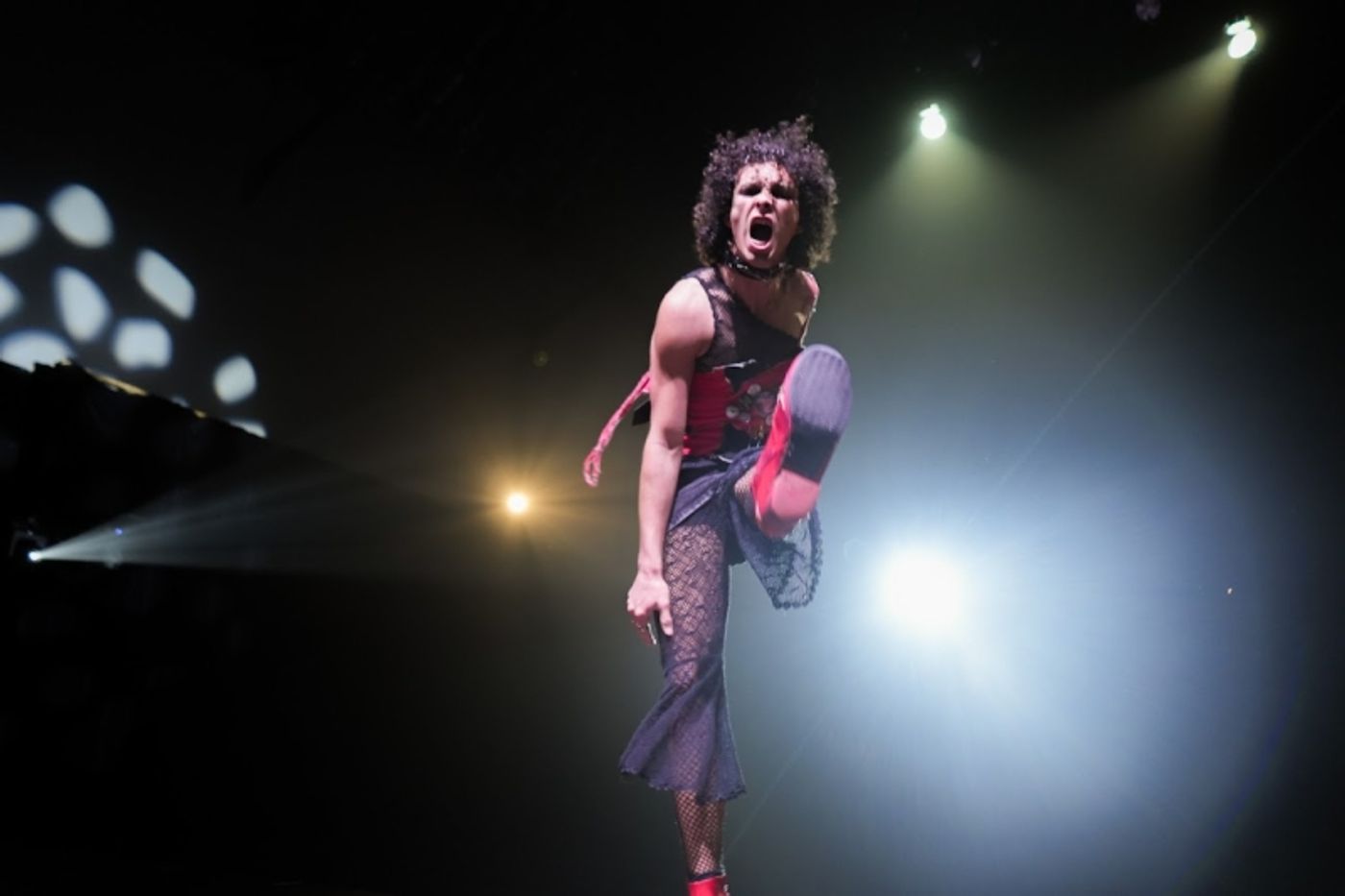

Photos: Ryan Shreve/Fyrebird Media

|
The Dinner Detective Murder Mystery Dinner Show The Dinner Detective Columbus (8/22-8/22) |
|
Beetlejuice Ohio Theatre (4/16-4/18) |
|
The Lightning Thief - The Percy Jackson Musical Abbey Theater of Dublin (8/07-8/16) |

|
La Cage Aux Folles Hilliard Civic and Cultural Arts Center (11/06-11/15) |

|
Screamers: A Nightmare-Fueled Sketch Comedy and Music Experience Shadowbox Live (9/20-11/14) |

|
Dirty Talk Shadowbox Lice (4/12-8/15) |

|
Liverpool Legends "The Complete Beatles Experience!" Marathon Center for The Performing Arts (8/15-8/15) |
|
MTP Presents: Sister Act John, James and Clara Knight Stage (7/31-8/16) |
|
Wicked Ohio Theatre (7/28-8/15) |

|
Caamp Value City Arena at The Schottenstein Center (8/29-8/29) |
Reader Reviews
To post a comment, you must register and login.