


Interview: Steve Hackett of GENESIS GREATS, LAMB HIGHLIGHTS & SOLO WORKS” at Southern Theatre
Guitarist believes in the healing power of music
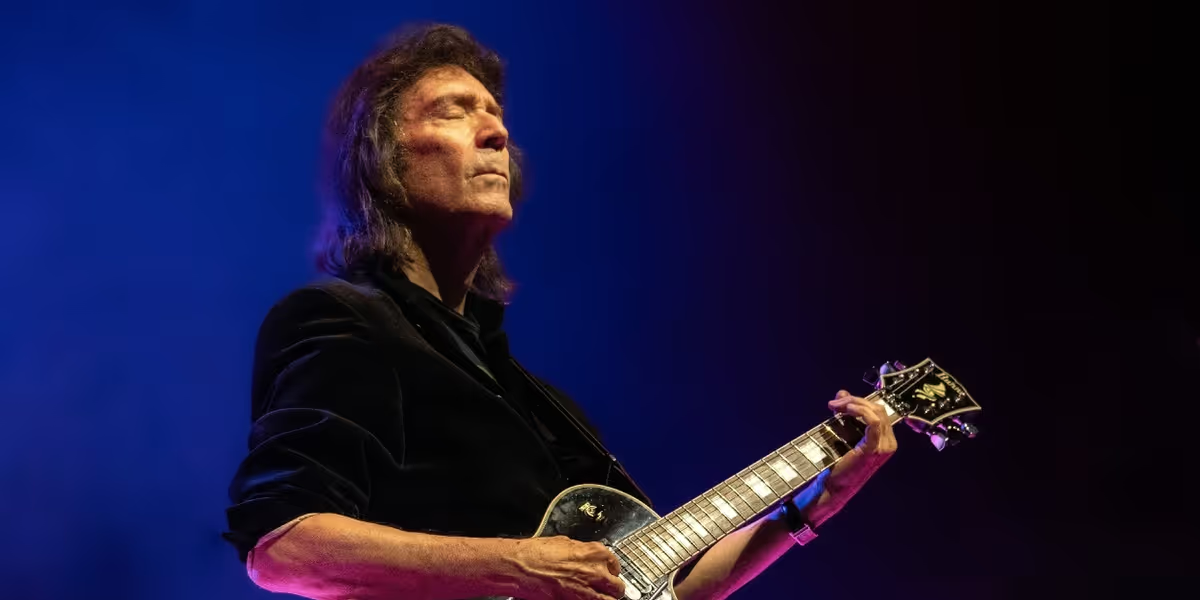

During his “Genesis Greats, Lamb Highlights & Solo Works” tour, former Genesis guitarist Steve Hackett will be revisiting selections from the iconic concept album THE LAMB LIES DOWN ON BROADWAY (1974), which celebrated its 50th anniversary last year, as well as his extensive solo career. Hackett, who will make a Nov. 3 stop at the Southern Theatre (21 E. Main Street in downtown Columbus), will also be reliving a time when he was riddled with anxiety and insecurity about his future.
“By the time THE LAMB tour was done (on May 22, 1975, in Besançon, France), we had the trauma of losing Peter (Gabriel as the band’s enigmatic frontman) and nobody really knew if the band had a future at that point,” Hackett said.
If past setlists are any indication, Hackett will divide his concert into two epochs – the solo era and the Genesis era. The first part of the show focuses on work from his 28 solo albums. The second half of the show will put a spotlight on his time with the prog-turned-pop band. Of the 12 songs Hackett plays from the Genesis era, nine are from THE LAMB LIES DOWN ON BROADWAY. SELLING ENGLAND BY THE POUND, FOXTROT and WIND & WUTHERING garner a single song each.
Gabriel’s departure didn’t come as a huge surprise. Hackett felt the double album was going to mark the culmination of Gabriel’s time with the band. Thanks to a short story he wrote for the back of the GENESIS LIVE album, Gabriel’s storytelling snagged the attention of THE EXORCIST director William Friedkin, who pressed the singer/songwriter for a screenplay. He left the band to work on the piece while the band was working on THE LAMB. Eventually Gabriel returned to the band, but by then, Hackett could read the writing on the wall.
“He already left once before, so I thought it's only a matter of time before he will leave us again,” said Hackett in a video interview from his London home. “And I was absolutely right. At some point during the tour, he said ‘I'll complete all the shows but then I'm going to leave.’ Then more and more shows got booked. No one wanted to see him go.”
Perhaps no one is more surprised Hackett is doing a retrospective on THE LAMB 50 years after the fact than the guitarist himself. THE LAMB was ranked in the top ten of Rolling Stone magazine’s top 50 progressive rock albums of all time. The BBC called it a “conceptual masterpiece.”
Hackett has another word for it: an anomaly.
When he, Gabriel, keyboardist Tony Banks, bassist Mike Rutherford, and drummer Phil Collins were working on the concept album, Hackett admitted he was a little bit tentative about THE LAMB’s direction.
“I didn’t feel it was going to be a major album when we were doing it,” Hackett said. “I felt it was kind of an anomaly for us. It was Peter Gabriel’s swan song. I think the golden period for Genesis is between FOXTROT and SELLING ENGLAND BY THE POUND. I would argue there’s not a weak track on either of those albums.
“THE LAMB was much more experimental. As a double album, there were things that got through the net that wouldn't have if we had distilled it into a single album. I’m not sure the choices would’ve been the same. We might all individually have chosen different things. But nonetheless, it's a very good album. I realize it’s terribly important to people, which is why I still do songs from it.”
The casual fan whose only exposure to Genesis is from the 1990s pop music era will find THE LAMB about as far away from INVISIBLE TOUCH as Columbus is from Mars. The Reader’s Digest version of the plot can be condensed down to Rael, a defiant teenager on the streets of New York City, goes on a harrowing journey of self-discovery and ultimately, his own redemption through a series of inexplicable yet symbolic experiences and imagery. At the end of THE LAMB, Rael saves the life of his friend John by dragging him out of a river. However, when he turns John’s body over, he sees his own face.
According to a post on ultimateclassicrock.com, Gabriel described THE LAMB as a mixture of Pilgrim's Progress, but with “this street character in a leather jacket and jeans.” Like most of Genesis’ early work, there are hints of Christian spirituality (the lamb is used as a religious metaphor for Jesus Christ while Rael is a shortened version of the name for archangel Raphael) mixed in with Zen and Taoism beliefs and commentary on the sexual revolution, consumerism, and advertising.
Hackett said THE LAMB’s message is simple.
“It's a story of redemption. The moment you imperil your own life to save someone else's, you transcend your own limits,” Hackett said. “If you wanted to call that quote/unquote religious, you could. What's the line? Man has no greater love than laying down his life for his brother? (John 15:13).”
“I don't know if I can talk for everybody else but spirituality is important to me. I believe there is a world of spirit and I believe in the continuity of life. I'm never quite sure about religion because it's a euphemism for Christianity per se. In the rest of the world, we have Jesus, they have Buddha, they have Muhammad, and the divisions are enormous, but they may well be talking about the same great spirit. At the end of the day, it's just semantics, but I believe I will see some of my extraordinary friends again. You can't kill energy. It'll be very interesting to see what happens next.”
On Sept. 19, Hackett rejoined Rutherford, Banks, and Gabriel in Soho to hear the new Atmos mix of the 50th Anniversary Super Deluxe Edition of THE LAMB LIES DOWN ON BROADWAY. Collins was unable to attend as he continues to recover from knee surgery at his home in Switzerland. Although it came out a year after the anniversary, the box set, which was released Sept. 26 through Rhino Music, contains a treasure trove of LAMB materials including:
- The original version of the album that was remastered from its 1974 analogue tapes as well as a remixed version of the album;
- A recording of the band’s entire LAMB tour concert at Shrine Auditorium including its two-song encore of “Watcher of the Skies” and “The Musical Box;”
- Three never-before-released demos;
- A digital download of all the audio tracks in the box set;
- A coffee table book with 60 pages of liner notes and pictures;
- Replicas of the 1975 tour program, a ticket stub, and a concert poster.
What the box set didn’t come with is a Genesis reunion tour celebrating THE LAMB. Hackett kept waiting for his former bandmates to do something to celebrate the 50th anniversary. When no live performances were scheduled, Hackett decided to do a tour of it himself.
“It has been a long time coming,” he said. “I thought I’d take the songs that stand alone and aren’t dependent on the (LAMB’s) concept and show some guitar activity.”
While the LAMB was the exit ramp for Gabriel, it was a restarting point for the remaining members of Genesis. Hackett said the band entered its “green” period. Green stirs up images of raking in cash by the bagful or a stoplight signaling “Go!,” but Hackett said the color has a far less positive connotation.
“I remember meeting David Bowie’s band at Victoria Station in London,” Hackett said. “I was thinking, there’s a lot of sweet guys in that band and it’d be nice to meet them and say hello. When we met them though, they all looked kind of green.
“That’s what constant touring will do to you. When you tour for nine months straight, you eat a lot of not terribly good meals and do lots of smoking and drinking. Young guys start to look like old ones … very quickly. (By the time we finished the LAMB tour), we probably looked like every other heavy metal band out there.”
While fighting through post tour fatigue, the band placed an advertisement in Melody Maker magazine for a singer for “a Genesis like band” and began weeding through over the 200 applicants who wanted to take over Gabriel’s reins. Many of the applicants showed pictures of themselves in various costumes like the ones Gabriel would wear for performances.
Melody Maker proclaimed without Gabriel, Genesis was “dead.”
When one looks at the headline with a sense of history, it’s hard to suppress a giggle here. Like Fleetwood Mac, AC/DC, and Van Halen, Genesis’ star rose even higher when Collins became the band’s second front man.
Genesis hit one of the strongest periods artistically in the wake of Gabriel’s departure. Hackett, Collins, Banks, and Rutherford put out A TRICK OF THE TAIL in February 1976 and then followed it up with WIND & WUTHERING 10 months later. Both TRICK, which reached third in the British pop charts, and WIND (seventh) charted higher in the UK than THE LAMB (which peaked at 10th).
Genesis becoming a quartet should have been a mountain top experience for Hackett, but he began to feel the need for elbow room. Hackett felt his contributions were often being overlooked under the Gabriel regime. “When they reviewed Genesis, journalists tended to review Pete's performance,” Hackett said. “People were not as focused on what the instrumentalists might come up with.”
When it was just the four of them, Hackett hoped he would have more of a voice in the band’s direction. He asked to have a certain portion of songwriting duties but was shot down as Rutherford and Banks became the primary writers. In 1976, Hackett became the first member of the LAMB lineup to release a solo album, THE VOYAGE OF THE ACOLYTE.
“You could say that the keys to the songwriting cabinet weren't always, you know, freely distributed,” he mused.
After Hackett’s departure made Genesis a trio, Collins, Banks, and Rutherford released the aptly titled AND THEN THERE WERE THREE (1978). From 1981-1993, Genesis dominated the charts. The band released three studio albums, ABACAB (1981), INVISIBLE TOUCH (1986) and WE CAN’T DANCE (1991) that hit number one in the UK. The band had its first number one hit in the United States with the single, “Invisible Touch,” captured a Grammy for best concept video for “Land of Confusion” and took the British Album of the Year and British Video of the Year at the Brit Awards.
As solo artists, Hackett’s former bandmates became inescapable on the air waves. Gabriel’s SO (1986) reached number one on the British charts and was second on the American charts. Collins’ solo work made an impact as well, with FACE VALUE (1981), NO JACKET REQUIRED (1985), BUT SERIOUSLY (1989) and BOTH SIDES (1993) all hitting number one in England. Rutherford’s side project, Mike and the Mechanics, placed five albums in the UK Top 10, including THE LIVING YEARS (1988) which was second on the UK charts.
Hackett doesn’t seem to be jealous of Genesis’ success or second guess his decision to leave.
“We're talking about a band full of great writers,” said Hackett, who has released three more solo studio albums than Gabriel (10 studio albums), Collins (eight), Banks (five), and Rutherford (two) combined. “I (wanted) to explore what I was personally capable. I had to find my own voice. This band was going places certainly, but one must invest in risk if one is to grow.”
In past concerts, Hackett featured three songs from CIRCUS AND THE NIGHT WHALE (2024) and two from THE VOYAGE, and the rest come from SURRENDER OF SILENCE (2022), SPECTRAL MORNINGS (1979), and HIGHLY STRUNG (1983).
Asked which song he would preserve in a time capsule, Hackett paused before answering “The Devil’s Cathedral,’ even though I didn't sing it.”
“I wrote it in a Genesis style, but in a way it’s a little bit darker than Genesis with some emphasis on the instrumental stuff,” he said.
Hackett is credited with creating “tapping,” a style of playing that allows the guitarist to move very quickly while using both hands. Loudersound.com described Hackett’s style like this: “Hackett trills with his left hand, pulling on and off the strings, and then, inches away, in between the notes created by his left hand, he hits the strings with the fingers of his right, conjuring up a cascade of sounds from his guitar.”
The late Eddie Van Halen, who used a similar style of tapping during his legendary solo on “Eruption,” is also credited with inventing the sound.
“I had just joined the band so I was still living with my parents,” Hackett said. “I was trying to play a phrase of Toccata And Fugue by Bach. So, you could say the inventor was neither Van Halen nor me. It goes back to Bach in 1685.”
Hackett’s guitar style on his solo albums is quite different from his work with Genesis. At times he shows audiences what the band could have been if he had been given a little more freedom.
“More than any other band I know, Genesis was very keen on turning down solos so that everything was written. The idea was that it wouldn't fall below a certain standard if you did that,” said Hackett, who said he was influenced by Belgian jazz guitarist Django Reinhardt, and Spanish guitarist Andres Segovia as much as he was by the Rolling Stones, Eric Clapton, and Jeff Beck. “I come from a Blues tradition and I thought, ‘how is this going to work?’ What it meant was we’d rehearse endlessly, going over the same thing before you add sequences.”
These days Hackett has found a comfortable groove with his touring band of drummer Nick D’Virgilio, keyboardist Roger King, bass guitarist Jonas Reingold, vocalist Nad Sylvan, and saxophonist/flutist Rob Townsend. King, who has been a part of Hackett’s live band for over 25 years, said he’s retiring from touring at the end of this year.
Even at 75, Hackett still marvels in the magic his group creates concert after concert.
“The best part of touring is the feedback that you get from an audience. The worst part of it, of course, is the exhaustion that ensues, whether you're a young man or whether you're someone in your 70s, as I am,” Hackett said. “I get the feeling that when the crowd leaves at the end of it, they’ll be transformed in some sort of way. One of the purposes of music is to heal, if not to reenergize people at the very least. That’s why I’ve made this thing my career.”
Photo credit: Michaela Ix
|
Liverpool Legends "The Complete Beatles Experience!" Marathon Center for The Performing Arts (8/15-8/15) |
|
The Dinner Detective Murder Mystery Dinner Show The Dinner Detective Columbus (8/22-8/22) |
|
Wicked Ohio Theatre (7/28-8/15) |
|
MTP Presents: Sister Act John, James and Clara Knight Stage (7/31-8/16) |
|
The Fab Four: The Ultimate Tribute LIVE in Concert in Columbus, OH Hollywood Casino Columbus (8/21-8/21) |

|
Screamers: A Nightmare-Fueled Sketch Comedy and Music Experience Shadowbox Live (9/20-11/14) |
|
Sombr Nationwide Arena (11/08-11/08) |
|
The Lightning Thief - The Percy Jackson Musical Abbey Theater of Dublin (8/07-8/16) |
|
Caamp Value City Arena at The Schottenstein Center (8/29-8/29) |
|
Dirty Talk Shadowbox Lice (4/12-8/15) |