


Interview: Playwright Vidas Barzdukas of THE WITCH OF NOVEMBER at Abbey Theater Of Dublin
Great Lakes shipwreck becomes an inspiration for Clintonville writer

Vidas Barzdukas has a sign bearing a one-word message that hangs over his writing desk: Courage.
Its message is simple. Finding it and following it, according to Barzdukas, is the hard part.
“It takes a lot of courage to believe in yourself,” said Barzdukas who lives in Clintonville with his wife Tracie and has two grown children, Vida (21) and Lija (18). “(In writing) you have to overcome self-doubt and other people’s doubts about you.”
Barzdukas admits he’s a nervous wreck as his play, THE WITCH OF NOVEMBER, gears up for its world premiere Nov. 7 at the Abbey Theater of Dublin (5600 Post Road in Dublin). The show will be performed at 7 p.m. Nov. 7-8 and Nov. 14-15 as well as a 2 p.m. matinee on Nov. 9 and Nov. 16. The themes of the play examine the three Ls: love, life, and loss. THE WITCH OF NOVEMBER is a fictionalized account of the doomed final voyage of the Edmund Fitzgerald, an ore freighter that sank in Lake Superior on Nov. 10, 1975. The shipwreck, which killed Captain Ernest McSorley and his 28-person crew, was eulogized in singer Gordon Lightfoot’s ballad “The Wreck of the Edmund Fitzgerald” (1976). The song reached the top of the charts in Canada and hit No. 2 on the American charts.
In Barzdukas’ play, McSorley (Tom Holliday) reminisces about his life and his relationship with his wife (Josie Merkle) as the ship fights for survival. The play also stars Todd Covert (as Ransom “Ray” Cundy), Dave Morgan (Jessie “Bernie” Cooper), Sean Taylor (Eugene “Red” O’Brien), and Rusty Wummel (John “Jack” McCarthy).
“We are excited to bring this world premiere play to life on the Abbey Theater stage,” the Abbey Theater of Dublin Supervisor Joe Bishara said. “We are proud to commemorate the 50th anniversary of the sinking of the Edmund Fitzgerald and honor the memory of those involved.”
“The play is about death and loss but it’s also about relationships and love,” Barzdukas said. “It blends what happened aboard the ship but it has flashbacks to the captain and his wife. McSorley wants to be home with his wife, who is an invalid. He said this was his last voyage because he felt guilty he wasn’t spending enough time with her. The information about McSorley is kind of scarce but he became an Every Man for the sailors who work on these boats.”
Like many people, Barzdukas’ first exposure to the tragedy can be traced back to Gordon Lightfoot’s ballad. However, as a Cleveland native, the playwright felt a deeper connection to the disaster than hearing some song on an oldies radio station.
“I grew up near the shores of Lake Erie and I’d watch some of these freighters pass by,” he said. “For me, the wreck of the Edmund Fitzgerald is not an event that happened long ago or in a faraway place. It's a part of our recent and local history.
“Once I started delving into the story, you read about all the events that happened, between 3 p.m. when the ship first reported damage to 7 p.m. when she finally sank. The guys were regular guys just doing their job and now they've become part of the lore of the Great Lakes. I wanted to research it, write about it, and tell other people the story.”
To research the project, Barzdukas first read as many books as he could find on the subject, spent hours in the National Museum of the Great Lakes near Toledo and the Great Lakes Shipwreck Museum in Paradise, Mich., and interviewed sailors who worked on barrages, including some who had worked on the Edmund Fitzgerald on trips prior to the last one.
The one thing Barzdukas didn’t get to do is conduct interviews with family members of those who were lost on the Edmund Fitzgerald.
“The family members were hard to reach or didn’t want to be interviewed anymore, so I had to fill in some of the blanks for my story,” Barzdukas said. “It’s funny. Some people don't like the song ‘Edmund Fitzgerald’ because they felt somebody was trying to monetize off the tragedy
“Other people were happy to talk about their experiences. I asked people who worked on the freighters, ‘What do you think would happen on board the ship in the pilot house if this happened?’ And they’d give me their two cents worth.
“When people who read the draft of the play, some went, ‘That doesn’t sound like something a sailor would say.’ I’d say, ‘That’s exactly word for word what one of the sailors told me.’ The sailors gave me some insight about what they would talk about and the gallows humor they’d use when things would go wrong.”
The playwright’s passion for writing didn’t start at St. Ignatius where he went to high school or at Loyola University where he went for college. It started in his basement with seven polyhedral dice.
“I always tell people my skill as a writer and as a storyteller came from Dungeons and Dragons,” he said. “It was a safe space to fail, which I think is really important. You have all the elements of a story. You have your exposition, heroes, background, and main characters. You've got your rising action, conflicts, and resolution. I was writing all of these ‘homebrewed’ stories nonstop and developing my storytelling technique and imagination.
“I wish I could say my English teachers told me, ‘You've got a lot of promise, kid.’ But it was nothing like that.”
Writing about a doomed freighter is a long way off from Barzdukas’ normal genre of writing. One of his first professional jobs was being a writer/editor for McGraw Hill, providing textbook content for K-12 students.
“In educational publishing, there are a lot of stipulations and guidelines,” he said. “A lot of times you’re writing stories where everyone is a winner. You can’t talk about certain things or have any violence.
“I still enjoy writing for children, but I’ve always treated it like it was my job. (THE WITCH OF NOVEMBER) is a story that I wanted to tell. I want to tackle the subjects of death, loss, and a shipwreck.”
After working at McGraw Hill for nearly a decade, Barzdukas decided to become a freelance writer, taking various writing assignments instead of working for a publishing company. One of his projects was being a writer for SUPERKIDS, a comprehensive K-2 English language arts curriculum published by Zaner-Bloser.
“I recently discovered that kids were dressing up as these characters for Halloween,” he said with a laugh. “That’s something I didn’t expect from my job. I’d write a short story or a play for clients and these things take on a life of their own. I’ve come across recordings of kids putting on my plays for school. I’ve had friends in California call me up and say, ‘My kids are reading one of your plays.’ That’s kind of neat.”
One of the benefits of being a freelancer is being able to do more creative writing on the side. He’s written screen plays for independent films, three plays, one (unpublished) novel, and was the head writer for “a critically acclaimed web series that nobody watched.”
Barzdukas’ two other plays, BEOWULF (AND THE BARD) and CAPTAIN BLOOD, were picked up by Drama Publishing and are frequently performed across the United States. In fact, Barzdukas has to split time in Columbus for the opening weekend of THE WITCH OF NOVEMBER and in Cleveland where a high school group is doing his BEOWULF (AND THE BARD).
“That’s kind of a cool problem to have,” he said.
Despite his success, Barzdukas admits there’s a little bit of fear in the pit of his stomach in the weeks leading up to the opening night of THE WITCH OF NOVEMBER.
“It’s terrifying,” he confessed. “You have no control over things once you hand it off. You trust the actors, the directors, the show designers that they’re going to realize your vision. I have to let go of it so other people can do their thing.”
During those moments of doubt, Barzdukas goes to his writing desk, looks up to see the poster with the word “Courage,” and knows everything will be alright.
Photo courtesy of Vidas Barzdukas

|
Battle of the Books Riffe Center Studio 2 (9/25-10/18) |

|
Dinner Detective Columbus Embassy Suites Columbus (12/12-12/12) |
|
The Sunshine Boys Curtain Players Theatre (9/12-9/27) |

|
Dinner Detective Columbus Embassy Suites Columbus (12/05-12/05) |
|
Dinner Detective Columbus Embassy Suites Columbus (11/21-11/21) |
|
Wicked Ohio Theatre (7/28-8/15) |
|
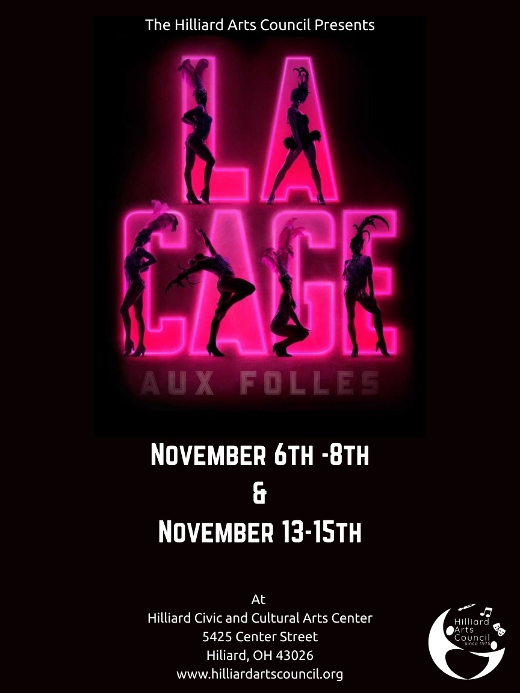
La Cage Aux Folles Hilliard Civic and Cultural Arts Center (11/06-11/15) |
|
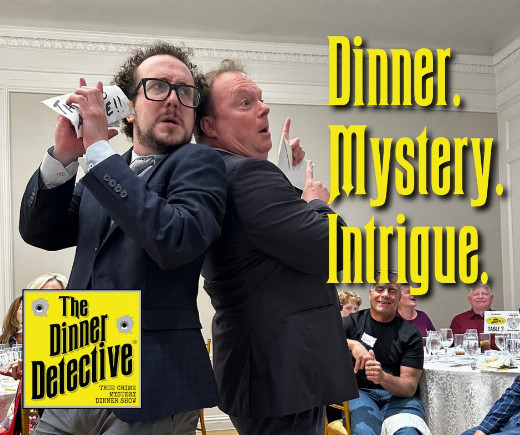
Dinner Detective Columbus Embassy Suites Columbus (10/17-10/17) |
|
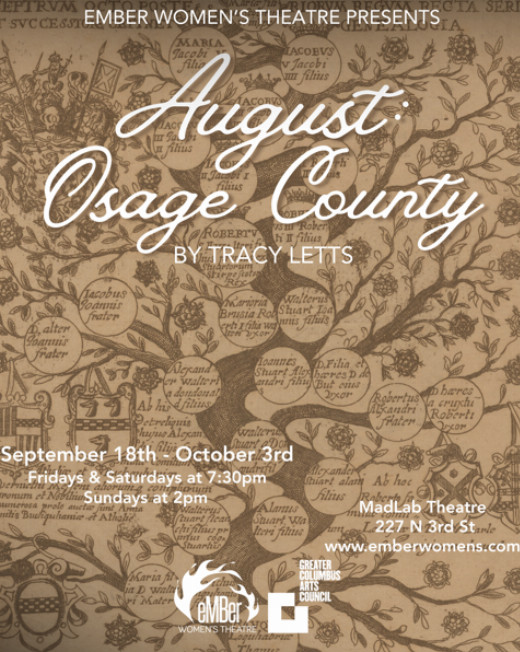
August: Osage County eMBer Women's Theatre (9/18-10/03) |
|
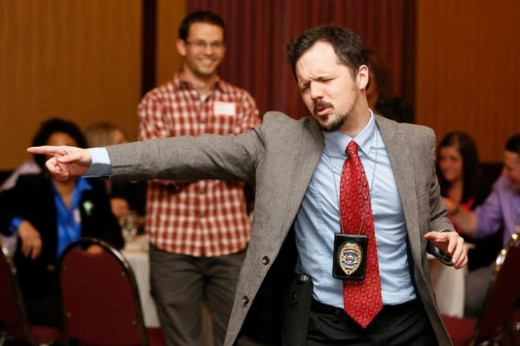
Dinner Detective Columbus Embassy Suites Columbus (11/14-11/14) |
