


Review: A Realistic and Involving STEREOPHONIC at National Theatre
It’s quite the story, indeed an overstuffed Christmas stocking full of stories.
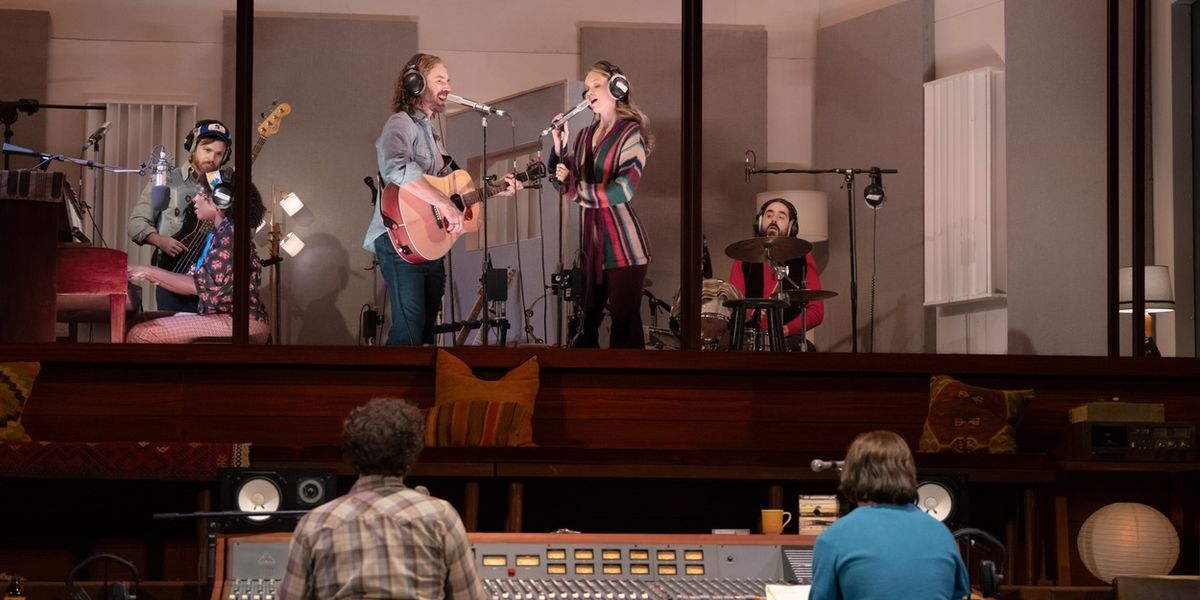
We are looking over the shoulders of a recording engineer at the controls of a huge vintage studio console, gazing up through a plate glass window at five performers singing a power ballad in what we will learn is a rare moment of concord. We will become familiar, though never exactly comfortable with, that engineer, as he becomes our avatar, our eyes and ears, as we delve into the stories of those musicians – and as we discover the stories of those singers and that engineer melding before our eyes.
History will record that in 1976, a rock group named Fleetwood Mac, three men and two women, three Brits and two Americans, congregated with an engineer and staff at a recording studio in Sausalito, north of San Francisco, to begin recording a new album. History will record that the creative process lasted for an arduous year during which the couples in the group reshuffled romantic partners and the group weathered quarrels over artistic control, used drugs casually and extensively to help with creative process, and sometimes fought with the engineer. And finally, history will record that the album resulting from all this chaos, Rumours, became a blockbuster and a landmark. We will know what history records about the crafting of the album because much of that record was written by the engineer and producer, Ken Caillat (with Steven Stiefel), in his memoir Making Rumours, an indispensable and sometimes quite absorbing portrait of a group at a creative peak amidst personal chaos.
Now we have Stereophonic, a play about an unnamed five-member transatlantic group congregating with an engineer and producer and staff at an unnamed recording studio in Sausalito in 1976, to bring forth, over the course of a year, an unnamed album in the midst of the same kind of personal and struggles that marked the making of Rumours. Was this is a case of art imitating life – or other art, in this case Making Rumours? Caillat and Stiefel thought it was the latter, and sued David Adjmi, the playwright, and various producing organizations, citing numerous aspects of the book that turned up in Stereophonic. The lawsuit was eventually settled, and from this critic’s standpoint as also being a (retired) lawyer, it certainly needed to be settled. The claim was indeed a strong one.
From the point of view of critics and audiences, though, the aesthetic issues go deeper than mere matters of intellectual property rights. You can look at this play as the adaptation of a book (which the critical consensus says the show is), or as a historical drama, which it also unarguably is. And in the latter capacity, it stands as a real-life manifestation and exemplar of how one generation deployed excess and incautious living in the cause of musical brilliance – and also of how the joint effort involved in creating that era’s signature artform, rock music, was required to work: dealing with the limits imposed by the available technology (24-track tape recorders), the structuring of the creative workplace (where the engineer became in effect part of the talent and the label’s executives ruled godlike over the resources), and the imperatives of format (especially the inherent limitations of LPs and singles) and marketing (the quest for Billboard rankings).
As such the show also works, at times brilliantly. You can see why playwright Adjmi may have thrown caution to the winds to dramatize this tale, perhaps figuring that it’s better to ask forgiveness than permission. Because it’s quite the story, indeed an overstuffed Christmas stocking full of stories, and the only reservation I’d express about that part of it is that it’s hard to follow all the action. Adjmi, in program notes, calls this version of the show “The Radio Edit,” meaning that, to accommodate the imperatives of a national tour, it has been cut down to two hours and fifty minutes, twenty fewer minutes than what he might have called the LP (i.e. Broadway) edit. (The Broadway edit, incidentally, did okay, scoring a record 13 Tony nominations, and won the Best New Play Tony.) But within these slightly narrowed confines, the play remains quite the tale, and unusually told.
The hallmark is authenticity. The setting is a recording studio, equipped with the already-mentioned vintage recording gear. The actors play period instruments; I heard some of the actors in the Broadway production give a talk about this at the annual meeting of the American Theatre Critics Association in 2024, and they assured us that they are the ones whose playing and singing we actually hear – after spending months getting their performing chops up to speed. (I’m assuming the same is true of the touring company, and to my ears they sounded like bona fide musicians.) Even the layout of the control room and soundstage look like the historical originals, as evidenced by a photograph of those areas in Caillat’s book. The songs themselves (music and lyrics by Will Butler, of Arcade Fire) sound indistinguishable from genuine Fleetwood Mac songs. Even when one of the characters flubs a note, repeatedly, that flub sounds like real life. (And as an amateur musician, I can personally attest that once you have trained hard to gain some mastery, it’s hard to screw up accidentally on purpose and be convincing; a performer’s unconscious mind rebels against it.)
Into this authentic-seeming environment, Adjmi and director Daniel Aukin pour a wealth of action largely lifted from the historical lives of the Fleetwood Mac crew. The characters Peter (Denver Milord) and Diana (Claire DeJean) are Americans, corresponding to Lindsey Buckingham and Stevie Nicks. The Brits, Holly (Emilie Kouatchou), Reg (Christopher Mowod) and Simon (Cornelius McMoyer), correspond, respectively, to Christine McVie, John McVie, and Mick Fleetwood. As the action progresses, the couples decouple for various reasons, and reassemble in other configurations. The power dynamic between the Caillat character, Grover (Jack Barrett), the engineer-turning-producer, and the members of the band alter as a side-story to the redistribution of power among the band-members (in favor of Peter/Buckingham), while at the same time the destabilization going on among the band members works its inevitable trauma on the engineering team. It’s a kind of Upstairs/Downstairs situation. And in the midst of all that authentic machinery and costuming, these punches land all the harder. (And speaking of the authentic costuming (by Enver Chakartash), I noted that Grover’s assistant Charlie (Steven Lee Johnson), is even attired in the same kind of suspenders that his historical counterpart Richard Dashut wore – per the photos in Caillat’s book.)
In short, because the production tries so hard to be believable, whatever emotional journeys these characters are taking, we in the audience will put up little resistance to coming along.
At least, by the end. The going is slow at first, and it takes awhile for the show to gain emotional traction, or even orientation. The exposition needs to be crisper. The unnamed band, and even Fleetwood Mac, were not John, Paul, George and Ringo in terms of popular awareness; neither then nor now would most of us know them as individuals, let alone who of them was in what stage of sexual liaison or marital connection with others of them, meaning that it should have been Adjmi’s Job One to teach all that to us. And I think this might have been a context in which less could well have been more. Less wildly-overlapping dialogue in the first half hour, for instance, interfering with audience comprehension and information uptake. Because the faster Adjmi allows us to get on board, the quicker we’ll fall in love with the characters and their dilemmas, with the gorgeous and affectionately period-wonky set (by David Zinn), with Will Butler’s spot-on ersatz Fleetwood Mac-style songs, and with the precise instrumental musicianship and tight singing harmonies of the cast. We will all have fallen in love by the end, no doubt. But sooner would have been better, and hence some more “radio editing” might be in order.
In any case, go while the show is still here, which isn’t long.
Stereophonic, by David Adjmi, directed by Daniel Aukin, presented through March 1 at The National Theatre, 1321 Pennsylvania Ave, N.W., Washington, D.C. 20004. Tickets ca. $49- ca. $320, at https://www.broadwayatthenational.com/show/stereophonic/ or 202-628-6161. Adult language, drug and tobacco use, sexual situations, fighting.
Production Photo by Julieta Cervantes.
Sign up for all the news on the Fall season, discounts & more...

|
La Sylphide Maryland Hall (10/16-10/18) |

|
Mama, I'm A Big Girl Now! Baltimore Center Stage (10/02-10/04) |

|
The Score Shakespeare Theatre Company (9/11-10/25) |

|
TWO TRAINS RUNNING Theatre Morgan (10/19-10/30) |

|
Billy Elliot The Musical Children's Playhouse of Maryland (9/19-10/04) |

|
Improvised Austen Maryland Ensemble Theatre (11/21-11/21) |

|
Classic Theatre of Maryland presents "A CHRISTMAS CAROL" Classic Theatre of Maryland (12/03-1/03) |
|
The Moors Maryland Ensemble Theatre (2/12-3/07) |

|
Classic Theatre of Maryland presents "DAMES AT SEA" Classic Theatre of Maryland (4/29-5/16) |
|
Appropriate Maryland Ensemble Theatre (4/02-4/25) |

Reader Reviews
To post a comment, you must register and login.