

Review: PURITANI Is Bel Canto Bliss with Oropesa and Brownlee under Armiliato's Baton
Rucinski and Van Horn Round Out Splendid Quartet in Troublesome Edwards Production of Bellini’s Final Opera
By: Richard Sasanow Jan. 07, 2026
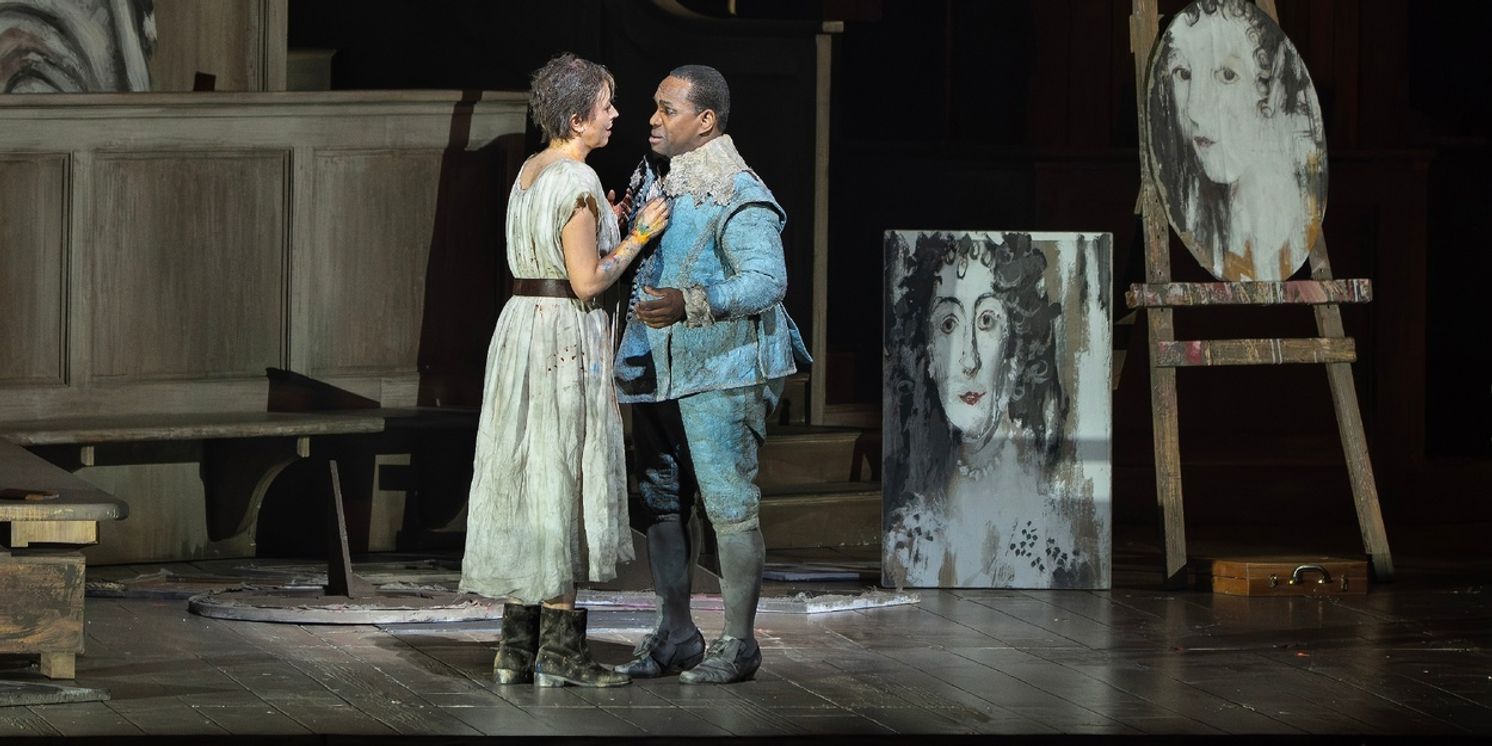
The Met’s new production of Vincenzo Bellini’s I PURITANI made its debut on New Year’s Eve, but I caught up with it at its third performance on January 6. I was glad I did--because it offered a cast with staggering singing abilities in four roles that offered major vocal demands, along with the brilliant Met chorus under Tilman Michael.
Beautiful singing? That's what the opera's style, bel canto, means in English. Simply put, soprano Lisette Oropesa, tenor Lawrence Brownlee, baritone Artur Rucinski and bass-baritone Christian Van Horn sang the pants off their roles, with Marco Armiliato conducting the fearless Met orchestra.
Let’s face it: The libretto of PURITANI makes no sense taken on its own, with its story of the Puritans versus the Loyalists, and the pairing of Elvira, a Puritan, with Arturo, a Loyalist, that has been approved by her father and condemned by the rest of their world. The holes in the story are particularly evident in the character of Elvira, sung magnificently by soprano Oropesa. (Director Edwards does everything possible to make matters even less plausible.)
In this concept, she is a budding artist, for no particular reason except to produce a series of portraits of the woman who she thinks her beloved, Arturo, has run off with and for her to be obsessed about. (The woman, sung by mezzo Eve Gigliotti, who doesn’t have nearly enough to do, is really the widow of the king, Charles I, and is in fear of death.)
Consequently, she becomes the definition of a schizophrenic, a condition of the brain that affects thinking, memories and senses. (I’d say “paranoid schizophrenic” but that subtype is considered an obsolete descriptor; however, paranoia is definitely one of her symptoms.)
She goes in and out of sanity, from the end of Act I to almost the end of the opera, which is great for the opportunity to offer showpieces for Oropesa—she sounded particularly fine in the latter part of the work—and she took advantage of every one of them. Many operas offer mad scenes for star sopranos; this one has at least 1-1/2.
Tenor Brownlee has simply no right to sound so good after so many years of singing the impossible role of Arturo in Vincenzo Bellini’s I PURITANI. (He made his Met debut in the role in 2014.) Audiences talk about the difficulty of singing “Ah, mes amis!” in Donizetti’s LA FILLE DU REGIMENT (which Brownlee did to acclaim earlier in the season), with its string of nine high-Cs. But that’s nothing in comparison to the dramatic demands that are presented by this work, right from the start with its high Cs and beyond (to F).
Oh sure, his character is offstage for a good part of Act II, which, in theory, should give him an opportunity to marshal some of the resources he needs for the string of arias and duets to come in the rest of the opera. That, however, is only ‘in theory’ when talking of this opera’s demands. Yet Brownless made it seem like child’s play.
Baritone Rucinski, as Riccardo (also in love with Elvira), starts off the evening with a gloriously sung aria and continues to match the quality of his costars, except when the director puts boobytraps in his way, with ridiculous staging that makes him seem even more of a bad guy than the libretto by Carlo Pepoli has made him. He is well matched with the Giorgio (Elvira’s uncle and confidente) of bass-baritone Van Horn, whose soothing legato is a pleasure to listen to.
Looking back at a number of my reviews of new productions, I notice a phrase in a number of them: “Close your eyes and listen.” But Charles Edwards’s new production of Vincenzo Bellini’s final opera (before his death at the tender age of 33) is much worse than that. He adds characters and pieces of stage business that are not explained yet can’t be ignored, while stalling the action.
In short: don’t expect an enchanted setting for the great cast on display here. This is not only an Edwards concept and direction but his scenic design as well, which not necessarily the worst in recent memory but caused problems for the singers—baritone Rucinski in particular—that were unforgiveable.
The unit setting, a meeting house of the Puritans of the title, had some dead spots that affected vocal production. The most noticeable one, for me, was the pulpit in the right rear of the design. Rucinski, who had been so magnificent at the start of the evening, suddenly couldn’t be heard in this corner of the stage. Topping it, was that he was forced to walk down a narrow, spiral staircase in the dark when his presence was no longer needed.
Th,e costumes were designed by Gabrielle Dalton, lighting design was by Tim Mitchell and the movement director was Tim Clayton.
So, again, listen to the singers. They’re worth hearing at any price. I PURITANI will be performed through the Sunday matine on January 18. It will be broadcast worldwide as part of the Met's Live in HD series this Saturday, January 10. For more information and tickets, see the Met's website.
Caption: Soprano Lisette Oropesa (as the mad Elvira) and tenor Lawrence Brownlee
Credit: Ken Howard/Met Opera
Reader Reviews
Videos