


Deathtrap is a two-act stage play by Ira Levin (The Stepford Wives & Rosemary’s Baby) that premiered on Broadway in 1978 at the Music Box Theatre under the direction of Robert Moore. It holds the record as the longest-running comedy-thriller on Broadway, and Tony nominations for Best Play, Best Actor (Victor Garber), and Best Direction (Robert Moore). Levin also won an Edgar Award for Best Play for Deathtrap, marking it as a standout hybrid in the thriller genre.
In 1982, Deathtrap made a successful jump from stage to screen, and its celebrated adaptation remains a cult favorite among fans of theatrical thrillers and dark comedy. In the film version, Levin adapted his own stage play for the screen, preserving the structure, dialogue, and wit that made his original script so successful. The film’s director, Sidney Lumet, leaned into the play’s psychological tension and used cinematic pacing to sharpen the plot twists. In the film, the cast included Michael Caine as Sidney, Christopher Reeve as Clifford, and Dyan Cannon as Myra. Cannon won an Oscar nomination, which was the film’s biggest award recognition.
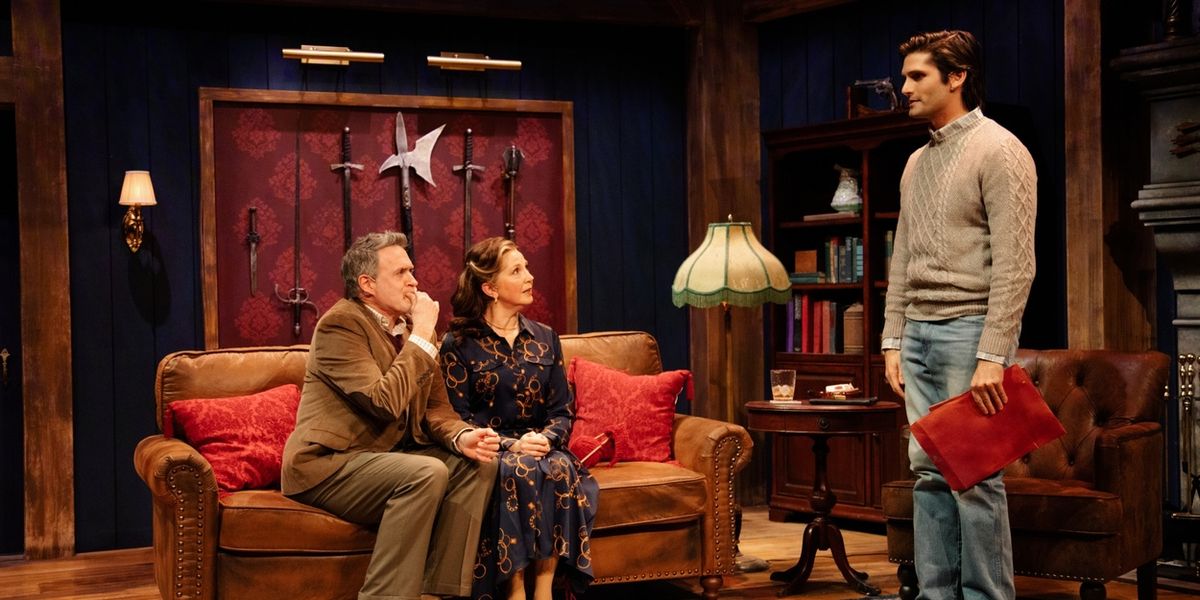
Let’s step into Studio Tenn’s staging, set in the upscale home of once-celebrated Broadway mystery writer Sidney Bruhl, now dangerously unhinged in his desperation for another hit. When Cliff, a gifted former student, arrives with a brilliant script, Sidney sees his chance to reclaim the spotlight. This raises the chilling question of just how far Sidney is willing to go to get his name back in the lights. Sidney’s wife, Myra, remains in the study, possibly to see just where this conversation is going. She begins to sense the danger in Sidney’s ambition, her anxious suggestion of collaboration revealing both her ethical guide and her fear of how far her husband might go to claim the work as his own. I won’t give away any “spoilers”, so let’s just say what ensues is a barrage of plot twists and turns that will make your head spin. Written as a play-within-a-play, Deathtrap deliberately blurs the lines, and at times the shifting alliances make it hard to tell who’s on whose side and whether the characters are writing a play or planning a real murder. The play’s success ultimately hinges on the precision of the actors, the timing of every pause, smirk, and gasp. Levin’s script thrives on verbal irony and subtle duplicity, and performers are tasked to navigate that delicate balance between comic timing and genuine menace.
Geoffrey Davin (Sidney Bruhl) Davin attacked his role with high energy and broad, theatrical gestures, which made the character’s dark humor pop. He brought polished charm, biting sarcasm, and undertones of desperation to his character. At times, it was hard to tell if Sidney was joking about murder or seriously scheming for his next play. Through no fault of the actor, since the script demanded these shifts, I found myself wishing he could have made a more definitive acting choice to show whether he was writing or plotting. Because Sidney shifts between the easy-going mentor and the calculating menace, it wasn’t always clear which role he was inhabiting. Perhaps with greater scrutiny from McIntyre’s directorial eye, the roles of Sidney, as well as Cliff, could be tweaked to portray the dual aspects of their demeanor with sharper definition and clearer distinction.
Carrie Brewer (Myra Bruhl) and Fight Director Brewer played Myra’s nervous energy as both comic relief and emotional anchor. Avoiding caricature portrayal, Brewer instead uses subtle tonal shifts to reveal her growing horror and then complicity, without losing sight of her humanity. In her role as Fight Director, Brewer staged fight scenes with skill and creativity, making brutal, prop-filled struggles feel dangerously real and thrilling theatrical.
Joe Leitess (Cliff Anderson) Cliff often walks the line between ingénue and manipulator. The actor’s choices, how sincerely he plays vulnerability or ambition, reshape audience sympathy, making early trust feel earned and the later revelations all the more shocking. He excelled in the demanding physicality of his role, delivering convincing and athletic fight sequences. Beyond the physical demands, he effectively captured Cliff’s initial boyish charm and eager ambition as a talented young playwright, then gradually revealed the character’s cunning, manipulative, and sociopathic tendencies.
Rounding off the small cast of characters, Jennifer Whitcomb-Oliva as Helga Ten Dorp and James Crawford as Porter Milgrim add a touch of comic-minded absurdity. Crawford portrayed Milgrim, Sidney’s attorney, with dignity and steady sensibility, upright, alert, and genuinely protective of his client. Yet as the play nears its end, he allows temptation to creep in, hinting at how his moral compass can waver when the lure of the spotlight might be calling his name. Jennifer Whitcomb-Oliva fully brought Helga, the eccentric Dutch neighbor with ESP, to life, commanding the stage whenever she appeared. She stole the show and drew you in with her depiction of Helga’s mysterious and brooding qualities. The audience leaned in so completely you could hear a pin drop, captivated by her every word, facial expression, and carefully measured flamboyant gesturing. By the end, she had so convincingly inhabited the role that Helga’s peculiar gifts and eye-catching presence felt utterly undeniable.
Directors of Deathtrap face a singular challenge: keeping audiences off-balance without losing coherence. Levin’s script itself is a clever machine full of twists, and the director’s job isn’t just to execute those twists, but to sustain suspense and manage tone from campy comedy to harrowing thriller and back again. Director Nat McIntyre clearly had his hands full navigating the play’s meta-theatrical tightrope, balancing characters who are plotting a murder with those who are merely writing one. A sharper distinction in the actors’ choices could have helped clarify when the danger was theatrical invention versus when it was chillingly real.
Unlike sprawling stage dramas, Deathtrap unfolds almost entirely in Sidney Bruhl’s study, a rich crucible for mood and character. While this single set might seem limiting on paper, in practice, it becomes an unsettling laboratory for tension, misdirection, and an opportunity for great theatrical craftsmanship. The setting is meticulously crafted as a well-appointed Connecticut study, depicted with beamed ceilings, a hearth, and a wall of weapons from Sidney’s past plays, that foreshadow the play’s darker impulses. I offer praise to Scenic Designer Andrew R. Cohen and Props Manager Charlie Webb for staging the set as both authentically lived-in and menacingly suggestive, with every prop hinting at the narrative’s collision between domesticity and danger. One element that did feel misplaced was a theatrical poster from one of Sidney’s plays, hung above the fieldstone fireplace and referenced repeatedly throughout the show. Unfortunately, a stage border blocked it from the view of many audience members and left us wondering about its significance. Kudos to Stage Manager Marlee Shelton for keeping the intricate pacing of Deathtrap razor-sharp, ensuring that every cue, transition, and technical beat landed seamlessly and sustained the show’s mounting tension.
Lighting Designer Darren E. Levin’s ambiance of Deathtrap isn’t particularly decorative, as much as perfectly dramaturgical. Levin’s good designs use subtle shifts in tone to reflect psychological change, warm and calm during friendly moments, and sudden darkness or sharp highlights during tension peaks. The unexpected lightning and thunder effects made several theatergoers jump in their seats.
As with any strong production, Deathtrap shines through its technical artistry, with costumes by Devon Renee Spencer thoughtfully grounding the characters in both realism and theatrical flair. Sound Design by Danny Northrup heightened the suspense throughout, supported by master electrician Rylee Hickey, whose work ensured the lighting was executed safely, precisely, and effectively - an often unseen but vital role in shaping mood and focus onstage. Assistant Director Makinley Smith also deserves recognition for supporting the director, guiding rehearsals, and helping maintain cohesion between performances, a steady hand that keeps the entire production running smoothly.
Artistic Director Patrick Cassidy continues to impress by curating a season rich in variety and depth, blending plays and musicals that challenge, entertain, and showcase the full range of the company’s artistic strengths. If you’re in the mood for a roller-coaster ride of murder, mystery, and mayhem, Deathtrap is an intricately written, twisted thriller with a plot that awakens your inner sleuth and dares you to stay one step ahead, while constantly pulling the rug out from under you.
Studio Tenn’s Deathtrap runs through February 22, 2026 at Turner Theater in The Factory at Franklin. For more information about Studio Tenn and their upcoming shows, visit www.studiotenn.com.

|
Barefoot in the Park Hendersonville Performing Arts Company (1/29-2/14) |

|
Mean Girls the Musical Playhouse on the Square (8/21-9/13) |

|
Gunhild Carling at City Winery Nashville City Winery Nashville (11/01-11/01) |

|
The Secret Garden Hendersonville Performing Arts Company (12/03-12/20) |

|
The Night Shift Before Christmas The Circuit Playhouse (11/20-12/20) |
|
ATRIUM TheatreWorks@TheSquare (1/08-1/24) |

|
The 49th Annual Art Auction Playhouse on the Square (4/24-4/24) |

|
Disney's Frozen Playhouse on the Square (11/13-12/20) |

|
Purpose The Circuit Playhouse (2/19-3/14) |

|
Playhouse Pours Playhouse on the Square (10/08-10/08) |
Reader Reviews
To post a comment, you must register and login.