


Review: COVEN, Kiln Theatre
A seldom invigorating, mostly preachy and insecure look at the Pendle witches.
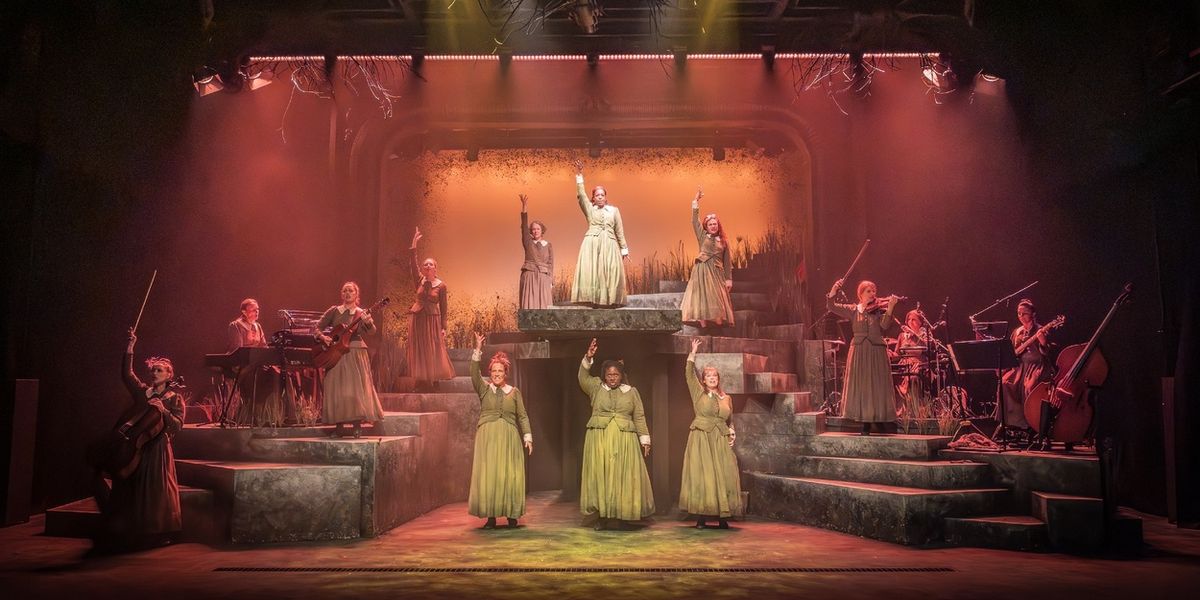
 When we think of the witch trials, our minds might instantly go to the American town of Salem in colonial Massachusetts. More or less at the same time, the same tragedy was unfolding in England, where an extensive hunt was condemning the lives of hundreds of women. The history of the witch hunts is rife with misogyny and suspicion. While the first official cases of “witchcraft” were reported in the Middle Ages (few and far between), by the latter half of the 16th century, accusations became widespread.
The start of the 17th century saw King James revisit the English Witchcraft Act, which intensified the occurrences. One of the best recorded prosecutions happened in Lancashire in 1612, when 12 people were charged. Today, it’s believed that these allegations came from a parochial standpoint and were linked to two families who prosecuted each other before they turned against themselves. The star witness was a young girl who testified against most of her household, Jennet Device.
%20Jacinta%20Whyte%20(Maggie)%20and%20Shiloh%20Coke%20in%20Coven%20at%20Kiln%20Theatre%20%C2%A9%20Marc%20Brenner%2008033.jpg?format=auto&width=1400)
This is where Rebecca Brewer and Daisy Chute team up to write a musical. 21 years later, Jenet (they dropped a letter from the name) finds herself imprisoned for the same alleged crimes that she reproached to her mother and sister. Sitting in prison with other “witches”, she must accept a reality that’s very different from what she thought to be true. Directed by Miranda Cromwell, it’s a mixed bag: invigorating and galvanising on one hand, sermonic and overly explanatory on the other.
Exquisite performances deliver generally mid songs that have a tendency to come up short on poetic narrative, but overdo it on the clichés. A more decisive tonal approach might have made the message hit harder: the continuous reiteration of the piece’s political beliefs and the doubling down on its feminist slant by telling rather than showing us slows the show down dramatically and narratively. The Pendle Witch Trial is rich with detail and lore, but Brewer and Chute opt for big statements and flourishes that merely try to extinguish the idea of “witches”. But we already know these were ordinary women.
%20and%20cast%20of%20Coven%20at%20Kiln%20Theatre%20%C2%A9%20Marc%20Brenner%2008235.jpg?format=auto&width=1400)
What the duo do well is reframe the potions as natural remedies (lavender for relaxation and so on). Once she steps into the prison, Jenet (Gabrielle Brooks) faces a seismic change. “The victim is the system’s accomplice,” states Rose (Lauryn Redding) upon realising what her cellmate did in childhood. It is obviously more complicated than that, and we’ll find out what happened to Janet. Everything in Coven can be linked back to a man.
Frances (Shiloh Coke) is an upper class woman whose husband stole common land and then accused her of killing their stillborn child, Rose is a peasant who was imprisoned with her mum Martha (Penny Layden) for standing up to them, Nell (Allyson Ava-Brown) is a midwife, Maggie (Jacinta Whyte) makes all kinds of medicinal concoctions. Their crimes are strictly connected to their gender.
%20Jacinta%20Whyte%20(Maggie)%2C%20Gabrielle%20Brooks%20(Jenet)%2C%20Allyson%20Ava-Brown%20(Nell)%2C%20Lauryn%20Redding%20(Rose)%20and%20Shiloh%20Coke%20(Frances)%20in%20Coven%20%C2%A9%20Marc%20Brenner%2009643.jpg?format=auto&width=1400)
The writers keep highlighting this, refusing to expand their circumstances without much excavation. It’s undeniable that this is a story about womanhood, empathy, and choice, but its poignant reasoning is suspended by funny farce, which unfocuses and undermines its goal. The men are depicted as guffawing pantomime characters who shout orders and demand authority regardless of their idiocy. The shackles of religion are briefly touched upon, with Jenet clutching her chest and furiously praying alongside Frances. But the insulation of Pendle and the women’s patriarchal dependency falters as a plot point.
The second act sees the shallow exegesis of the manifestation of misogyny through the witch hunts, covering the publication of Heinrich Kramer’s Malleus Maleficarum and King James’ Demonologie. Steeped in comedy, we don’t actually learn much about them (nor about the specific political context in which the Pendle case was allowed to unfold). Amidst the average takes and lack of analytical thinking, there’s plenty to like.
%20Diana%20Vickers%20(Ensemble)%2C%20Rosalind%20Ford%20(Ensemble)%2C%20and%20Lauryn%20Redding%20(Nowell)%20in%20Coven%20at%20Kiln%20Theatre%20%C2%A9%20Marc%20Brenner%2004297.jpg?format=auto&width=1400)
The sound is solid indie pop delivered with passion by the band, who take an active part in the storytelling. While the book and lyrics often err on the safe side and tend to round themselves up, the performances are outstanding. Each actor is heartbreaking in their own right, whether they’re offering a staggering character arc (Brooks and Coke) or delivering a a dynamic invective against the preclusions of their society, strong in their acknowledgement of their being an outcast (Ava-Brown, Whyte, Redding, and Layden).
Cromwell’s direction makes fine use of the space with Jasmine Swan’s design: a large, dark multi-level structure. Ultimately, our gripe is with the fact that the production tries to be too many things at once. It attempts to have explosive moments à la Morgan Lloyd Malcolm’s Emilia, whilst clawing at a tongue-in-cheek comic style similar to Mel Brooks’ works or SpitLip’s Operation Mincemeat. It wants to be a big announcement, but slips into overdrawing its modern messaging. The call to arms winks at the echo chamber of the easily pleased, live-laugh-love feminists, with numbers that grow too lateral to the core scenario and twists that are in turn a bit cringe.
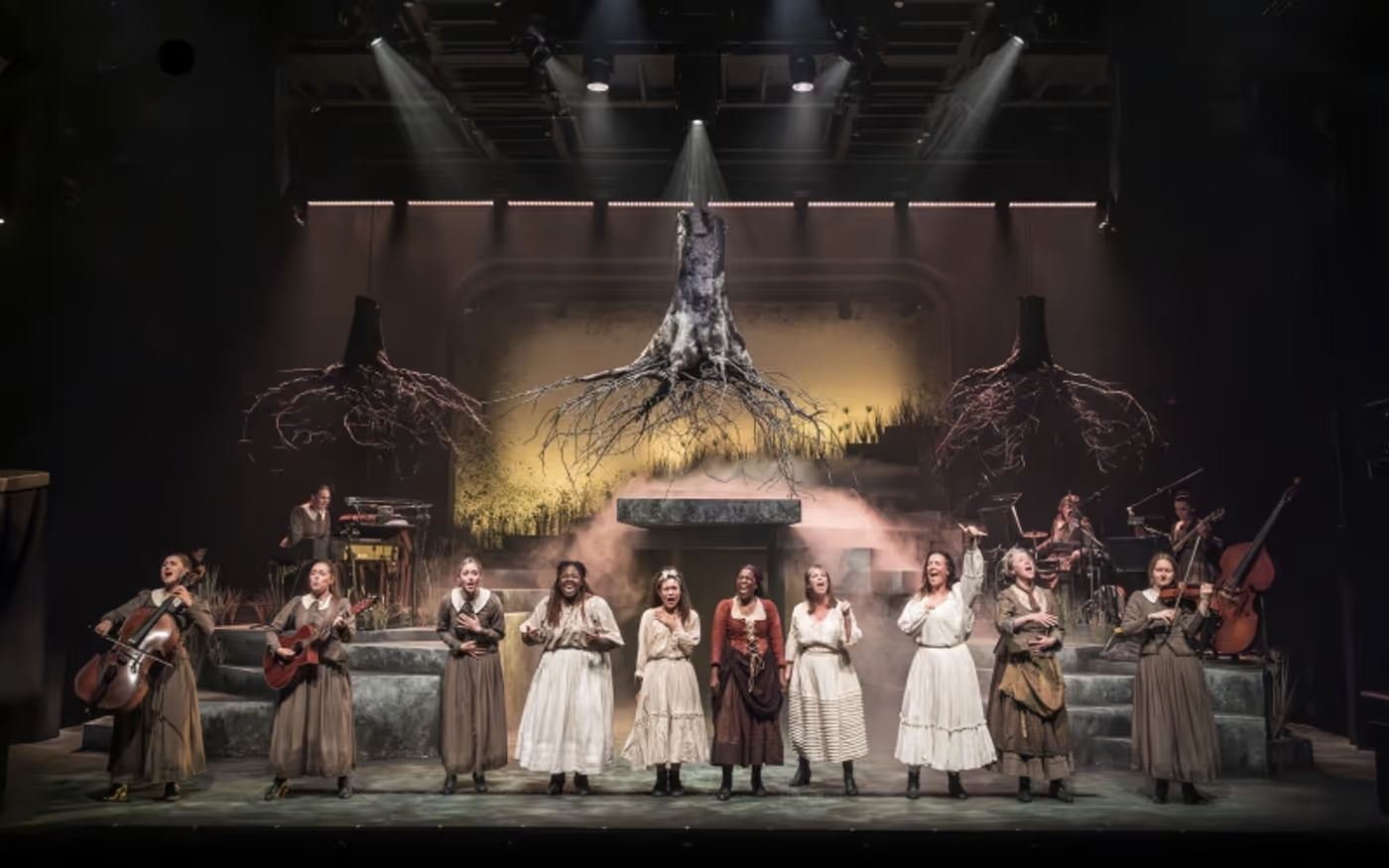
It also has a lot of gender-bending fun (the cast is all-female), and many interactions are fairly amusing even when they clash with the broader, more sombre tone. The implications of the abuse of power, religious terror, and patriarchal weight are all there, but they’re under-exploited for the benefit of a grand statement that wouldn’t look out of place in a viral TikTok. The stylistic inconsistencies shake the foundations of the musical’s identity; the language suffers in its non-committal modernity, while historical accuracy becomes a pick-and-choose situation. Though entertaining, the result is preachy and insecure.
Coven runs at Kiln Theatre until 17 January 2026.
Photo Credits: Marc Brenner






Reader Reviews
To post a comment, you must register and login.