

Review: ALL MY SONS, starring Bryan Cranston and Marianne Jean-Baptiste
An arresting, timely production.
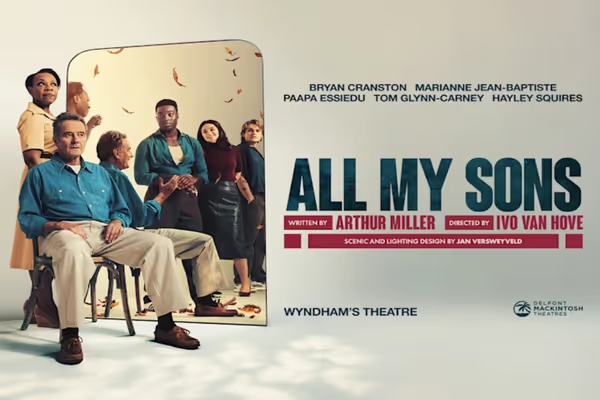
 This is Ivo van Hove’s triumphant return to the West End. He reunites with Bryan Cranston (whom he worked with on Network at The National Theatre in 2017) for Arthur Miller’s All My Sons – famously, the playwright’s last attempt at writing a commercial success.
Van Hove assembles a tremendous company (Cranston, Marianne Jean-Baptiste, Paapa Essiedu, Tom Glynn-Carney, and Hayley Squires) to dissect the exploitative nature of the American Dream, giving a jarring picture of family and loyalty. This is, on the surface, quite the stylistic departure for van Hove. The director decided that less is more here and the result is astonishing.
Two years after the end of the Second World War, the Kellers maintain appearances but teeters on the line of scandal. The conflict that made them rich also robbed them of their son, Larry. Kate (Jean-Baptiste) blindly hopes he will come back to her. Joe (Cranston), feeds her delusion. Their surviving son, Chris, is getting tired of the pretence because he wants to marry Larry’s former girlfriend, Ann (Squires). They know their engagement will put the nail in Larry’s coffin. Then, there’s the matter of Ann’s father, Joe’s ex-business partner, who’s in jail for supplying defective aircraft parts to the American air force. Joe’s involvement is gradually revealed to be more injurious than Chris thought possible.
%2C%20Paapa%20Essiedu%20(Chris%20Keller)%20and%20Hayley%20Squires%20(Ann%20Deever)_%20Photo%20Jan%20Versweyveld.jpg?format=auto&width=1400 "Review: ALL MY SONS, starring Bryan Cranston and Marianne Jean-Baptiste")
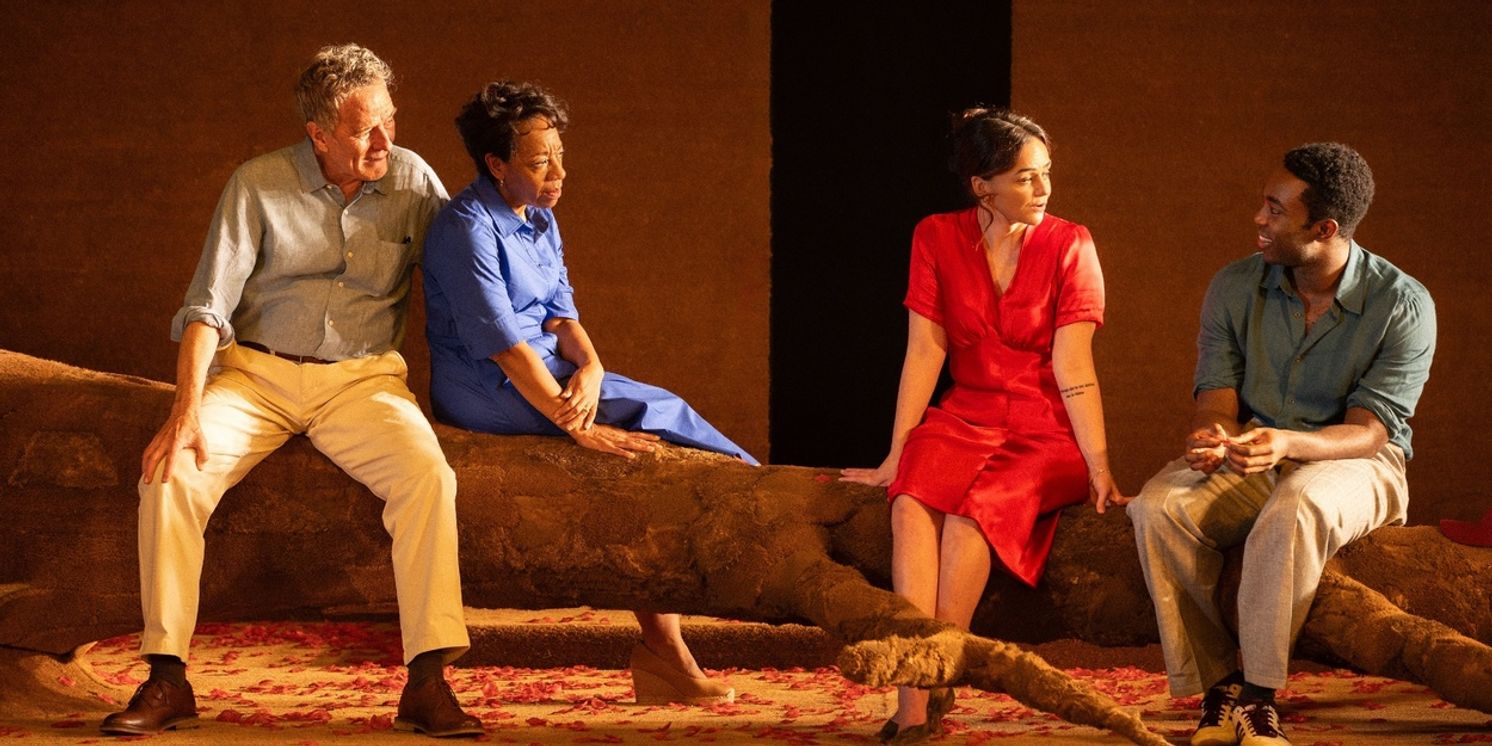
It’s a quiet, timely, still production. It burns slowly, almost imperceptibly at the start, before it explodes and shatters into a million breathless pieces. Van Hove singularly removes it from its specific time period. The cast wears ambiguous fashion (An D’Huys) that hints at late-40s trends, broadening the scope of the play to a universal tale of ethics and hubris. The direction is tightly bound to Jan Versweyveld’s visuals. He chills the scene with milky lights before having it balloon in orange heat at regular intervals, following the fluctuations of Miller’s narrative. The clean edges of the set merely project the idea of the Kellers’ garden, with its large home looming down Larry’s fallen tree.
A coarse wall of a burnt cider hue is broken by a wide circular window (that becomes, in turn, the concept of a sun and a moon) and a slim opening underneath. The earthy tones are echoed in the outfits, with only Ann’s red dress standing out in allegory as a pop of colour. Cranston and Essiedu offer engrossing, ferocious portrayals. Awkward with their emotions but expansive nonetheless, they share an affectionate relationship until the big revelation. The idol falls, Chris’ world breaks. It’s earth-shattering. In one silent wail, Essiedu delivers innumerable shades of disbelief, hatred, and disillusionment. Cranston (a stunning physical actor) rebukes with a harrowing, chilling display of shame and resentment.
_%20Photo%20Jan%20Versweyveld.jpg?format=auto&width=1400 "Review: ALL MY SONS, starring Bryan Cranston and Marianne Jean-Baptiste")
A grounded profundity settles on the stage when he descends downstage to talk about his versions of the events, staring into the stalls as if seeing a ghost. The pair match each other’s energy in a visceral performance where everybody else disappears against their shared grief. There’s so much to say about how the generational gap plays out too. Joe is part of the unempathetic old guard, a no-nonsense man who places his family above everything, even the law. On the other side, combat has done irreparable damage to Chris. Under a layer of genuine bonhomie, he is haunted by the loss of his company. His survivor’s guilt comes out in full force as Essiedu spirals into the vortex of Joe’s wrongdoings.
Jean-Baptiste is equally remarkable, swaying as a pendulum between delusion and reality with a charming personality. Everyone tries to protect her mental wellbeing to the detriment of all involved. We catch glimpses of what she must have been like before the war in her conduct with her neighbours and friends, but she alters her demeanour when Ann and George are concerned. She and Squires dance around every conversation about Larry, maybe as a coping mechanism or out of defensiveness, but the arrival of her brother forces their hand. Glynn-Carney halts the action. Versweyveld turns on all the lights unexpectedly, and he walks in from the audience like a bad omen. Fidgety, shaky, a bit greasy with vacant eyes and an unsettling aura, he’s accompanied by intense agitation and a ticking note. It’s the beginning of the end.
%20and%20Paapa%20Essiedu%20(Chris%20Keller)_%20Photo%20Jan%20Versweyveld.jpg?format=auto&width=1400 "Review: ALL MY SONS, starring Bryan Cranston and Marianne Jean-Baptiste")
Tom Gibbons’ sound design is effective in its manipulation. Atmospheric and melodramatic, it adjusts the reception of the story with fitting artfulness. Each element of the mise-en-scène works perfectly in tune with the other, delivering a simply arresting theatrical event. Van Hove adds even more misanthropy to Miller’s already bleak point of view, exacerbating the significance of Joe’s choices. He cowardly picked money over people’s safety, capitalism over life, ego over justice: it’s as contemporary as it gets. But the intent doesn’t overshadow the humanity in it. He keeps the piece strongly fixed in its genre. It can be a tragic realist drama, or it could be a microcosm of everything that’s wrong about society. It’s up to the public whether they want to look in the mirror or get lost in the fiction.
All My Sons runs at the Wyndham's Theatre until 7 March 2026.
Photo Credits: Jan Versweyveld

Reader Reviews