


Review: A BRICK AND A BIBLE Sheds Light on an Important Moment in St. Louis’ Black History
The production runs through the Weekend at the Missouri History Museum, with added performances at Metro Theater Company and St Stephen’s and The Vine Episcopal Church.
By: James Lindhorst Feb. 21, 2026
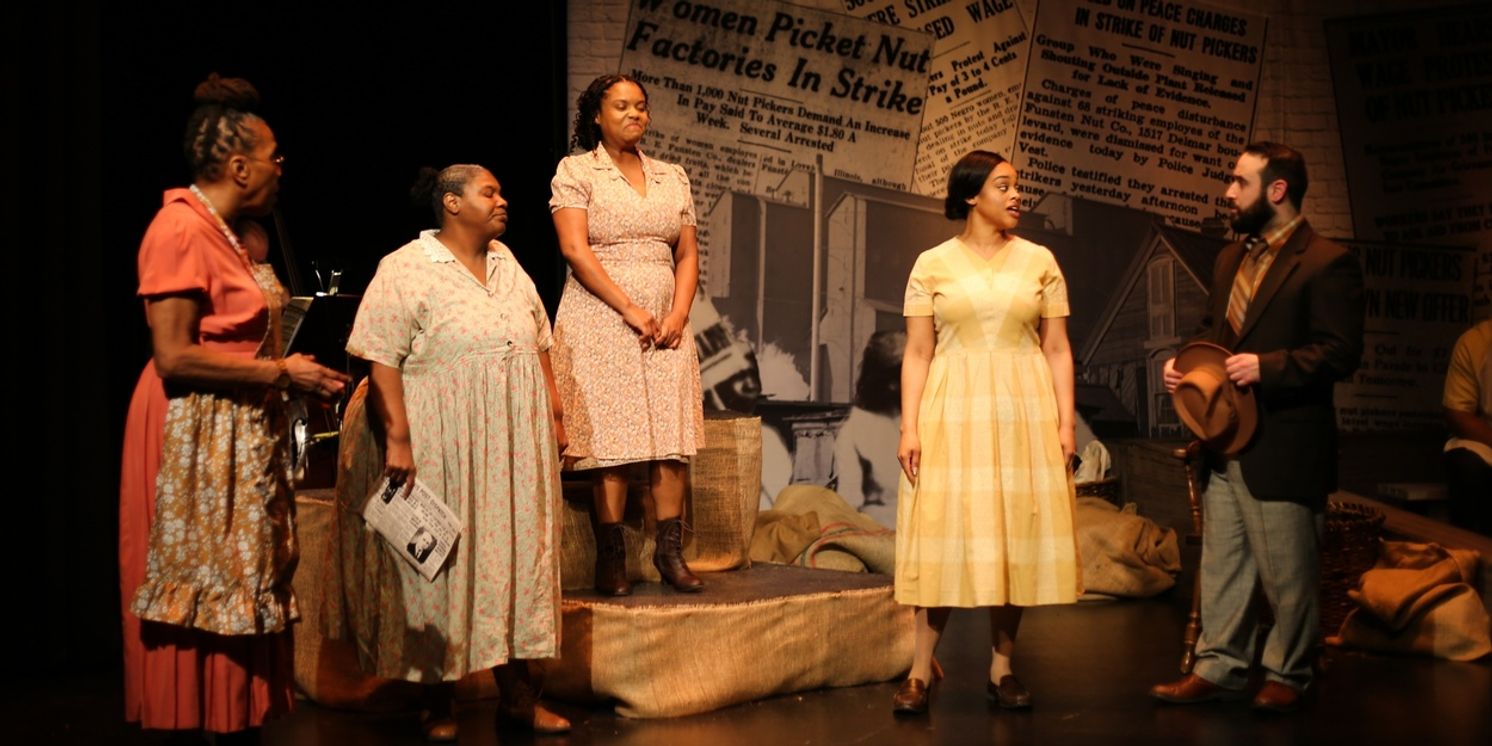

For nine days in 1933, nearly 1,000 black women working as pecan pickers walked out of their jobs in a labor dispute. The black employees of the R. E. Funsten Company were literally paid in pennies for their piece work shelling nuts in a St. Louis factory. Their minuscule compensation was a tiny percentage of what the factory owner was paying white female employees for the same work.
At that time, St. Louis was a major producer of edible nuts. The strike, supported by the local Communist Party was led by organizers Cora Lewis (Alex Jay) and Carrie Smith (LaWanda Jackson). Lewis and Smith’s activism was chronicled by historian and academician Melissa Ford in her book A Brick and a Bible: Black Women’s Radical Activism in the Midwest During the Great Depression.
Kathryn Bentley and Colin McLaughlins new play, A Brick and a Bible, opened Friday at the Missouri History Museum. The world premiere, directed by Rayme Cornell and produced by Bread and Roses Missouri, is a fictional account of the Funsten work stoppage.
Bentley and Colin’s script follows Elizabeth (Christina Yancy), a fictional 17-year-old girl who takes a job at the factory to help her widowed mother makes ends meet. Her father, a former coal miner, died from the occupational hazards and poor working conditions in the mines.
Elizabeth’s coming of age story tells of her initial resistance to take part in the work stoppage. Through the influence of factory peers, and an educator encouraging her to find her voice, she joins in the efforts to improve the pay and working conditions for the factory employees. Bentley and McLaughlin’s adaptation of Ford’s book pays homage to the historical figures of the strike while telling their engaging story through the eyes of a naïve but resilient and determined young woman.
A Brick and a Bible features original music composed by Alicia Revé Like. Her comforting score, heavily influenced by the spirituality and rhythmic pacing of field hollers and work songs, is played on just two instruments and sung by a trio of actors (Adrienne Spann, Hassie Davis, and Joshua Mayfield) billed as a Greek chorus. Music Director Anita Jackson’s work preparing the trio of singers is on full display in the soul-stirring and spirit filled vocals of Davis, Mayfield, and Spann.
Like’s score is seamlessly woven into Bentley and McLaughlin’s 80-minute narrative. The memorable score advances the narrative, but this show is not a musical. It is a play with music. The score supports the storytelling with vocals from the Greek chorus instead of the principal actors.
Cornell’s inspired leadership brought Bentley, McLaughlin, and Like’s story and music from page to stage with fervent performances from an exceptionally talented cast. The irrepressible Christina Yancy gives a moving portrayal as the fictional Elizabeth. Her arc takes her character from a frightened teen to a confident reformer and crusader. Yancy is endearing in her role as protagonist, daughter, worker, student, and activist.
Elizabeth’s transformation is influenced by her work peers, some based on real life historical figures, with socially relevant, confident, and strong portrayals from Thomasina Clarke, LaWanda Jackson, and Alex Jay. Ryan Lawson-Maeske turns in a wry performance as labor organizer Bill Setnor, the local leader of the Communist Party. The entire acting and singing ensemble draws the audience in with evocative portrayals of self-empowered change makers.
You will be entertained by Bentley and McLaughlin’s new play, but that is only one small part of why their work needs to be seen. This historical drama is an important part of St. Louis’ Black History. A Brick and a Bible is an empowerment story about women raising their voices for change, social justice, better working conditions, and equal pay for equal work. It tells of unknown events that were critical to the labor movement. The Funsten factory worker strike is part of what made St Louis one of the centers for labor activism in the Midwest.
Bread and Roses production of A Brick and a Bible will continue this weekend with three more performances at the Missouri History Museum. There are five performances scheduled from February 26 – March 1, 2026, at Metro Theater Company. The final two performances are at St Stephen’s and The Vine Episcopal Church in Ferguson on March 7th and 8th. Visit breadandrosesmo.org for more information.
PHOTO CREDIT: StudioKayMedia
Reader Reviews
Videos