
Interview: Maria Finkelmeier of DIES IRAE, DESIRÉE at Bag & Baggage
In an era where belief spreads at the speed of bandwidth and art grapples with algorithms, Dies Irae, Desirée is a satirical look in the mirror.
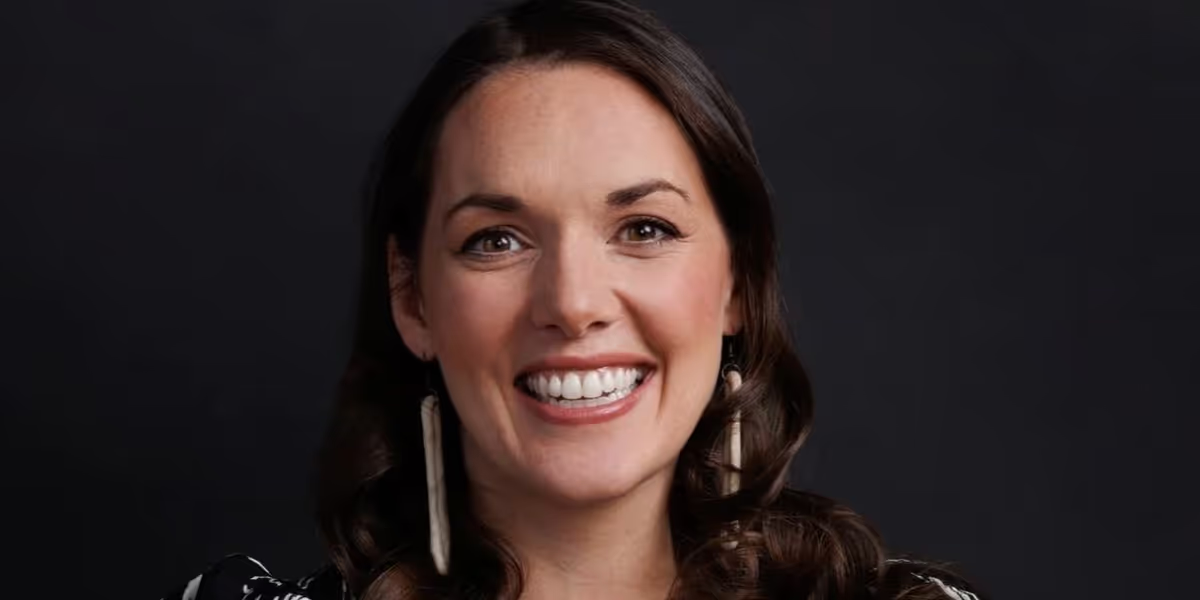
Inside the World Premiere of Dies Irae, Desirée
When I first read about this show and the Composer and Co-Director described by the Boston Globe as a “one-woman dynamo,” I knew I wanted to meet and interview Maria Finkelmeier. A classically trained percussionist turned composer turned multidisciplinary architect of experience, she is the kind of artist who builds entire ecosystems out of rhythm.
We sat down to talk about her new chamber opera, Dies Irae, Desirée, premiering at Portland’s westside suburban theater The Vault, in collaboration withThird Angle New Music and Bag & Baggage. What followed was a conversation about cults, curiosity, AI-generated pop songs, and a strangely captivating genre mashup of the internet age.
You were described as a “one-woman dynamo.” Who are you, and how did you arrive to this place in your career?
I’m a classically trained percussionist. Early in my career, I focused on chamber and orchestral music. As a percussionist, you learn to make sound out of almost anything. You’re surrounded by marimbas, vibraphones, drums, found objects. You’re constantly asking, what resonates?
That deep curiosity is what drove me. Over the last decade, that curiosity expanded beyond instruments into technology, visual art, and architecture. I became interested not just in music, but in the full experience. What you see. What you feel. Who you’re with.
Now my practice is portfolio-based experience design rooted in percussion. I still perform, I compose, and I design multidisciplinary works. I collaborate across film, visual art, and theater. It all stems from that original impulse to explore sound worlds.
Where do you call home?
Boston. I’ve been rooted on the East Coast for about 13 years. I teach at Berklee College of Music, and I’m raising my family there.
But I have a Midwestern heart. I’m originally from Cincinnati, Ohio.
Let’s talk about the premiere. What is Dies Irae, Desirée?
It’s a new chamber opera exploring cults, fanaticism, and the way the internet fosters emotional vacuums where extremist belief systems can grow.
The title plays on “Dies Irae,” the Latin phrase for Day of Wrath. In our story, Desiree begins as a single YouTube personality speaking into a ring light. She believes a god-like figure is telling her that she and her followers will be spared Earth’s suffering, lifted away before the planet burns, and returned seven years later to replenish it.
At first, what she says feels almost reasonable. The world feels fractured. There are fires, polarization, conflict. You find yourself nodding along.
Then a Silicon Valley type tech bro discovers her and treats her ideology like a startup. Suddenly she’s scaling. Followers multiply. The belief system metastasizes.
It’s satirical, and audiences will laugh. But it’s rooted in very real observations of how people we know, and love get drawn into fringe systems. It’s about how the digital age makes the extreme feel normal.
Part therapy, part opera.
You describe it as multi-sensory. What can audiences expect?
It’s about 75 minutes, structured in three acts with no intermission. Roughly 85 percent is sung, 15 percent spoken. We’ll have projected captions.
Visually, there’s a live feed camera system developed by Supreetha Krishnan. When Desiree speaks into the ring light, you’ll see that feed projected onto fabric in the space.
It begins like chamber music. Intimate. Controlled. By the end, it’s a full sensory overload. Lights, stimulation, party energy. The cult grows and the experience grows with it.
It’s chamber concert meets opera meets theater. I’m genuinely curious what audience members will call it when they leave.
How did you connect with Third Angle?
I’d admired Third Angle New Music for years. Their musicians are extraordinary, and their programming is bold.
They created a guest creative director program and put out an open call. I pitched them this chamber opera that Brady and I had already begun developing. I asked if they’d be willing to premiere something brand new, sight unseen.
They said yes, they’re co-commissioning the work and making it possible.
Tell me about your collaboration with playwright Brady Evan Walker.
We met when he interviewed me for a podcast and art blog. We kept talking and realized we shared artistic instincts.
He proposed working together and pitched several ideas. He landed on the title first. I loved the alliteration of “Desiree” and the religious undertones of “Day of Wrath.” The nod to Gregorian chant and composers like Verdi and Mozart intrigued me.
He drove the narrative and character development. He spent about a year writing the play, sending drafts, and we’d respond back and forth. Once it was complete, I began transforming it into music.
Was it challenging to adapt a full play into opera?
Extremely.
A play contains so much nuance and detail. Opera works differently. Each musical moment needs a clear emotional anchor. You can’t set every line of dialogue to music without losing clarity.
I had stacks of printed drafts marked up everywhere. My task was distillation. What is essential? What emotion drives this scene? How do I express that through rhythm, melody, texture?
Music can be abstract. It evokes mood and atmosphere. But this required deep narrative clarity. We even eliminated scenes. There was a lot of back-and-forth about what was necessary.
Trying to convey complex character arcs in 75 minutes through music is like carving sculpture from fog. But that’s also what made it thrilling.
Is the music all original?
Ninety-eight percent original.
There’s one exception. A character named Sunny Saint Cloud becomes the cult’s pop star figure. For her song, I intentionally used AI. Brady wrote the lyrics. I fed them into Suno, an AI music generator, and it produced the track she sings. It’s embedded in the narrative. The opera examines how digital tools are shaping creativity itself.
What surprised you most during the process?
How long it took.
Writing a minute of music can take an hour or more. I once posted that I’d spent two hours writing two minutes of music and promised it would be the best two minutes anyone had ever heard.
But I loved the depth of intention. For example, the tech bro character has a heavy guitar riff whenever he enters. It’s sonic branding. Electronic influence embodied in sound.
Discovering those musical identities was incredibly satisfying.
What’s next?
I’m releasing a solo album in late spring featuring marimba, electronics, and voice. My own voice. I’ve become fascinated by it lately. There’s something primal about moving from percussion into vocal expression.
I’ll also be in residency in Fort Wayne, Indiana in April, and I recently premiered a show in Miami called Chameleon about biodata and live performance.
As for Desiree, we hope she tours. The work will truly be born in Portland. Once we understand who she is in front of an audience, we’ll see where she goes next.
Do not miss the chance to experience the World Premiere of Dies Irae, Desirée on stage at The Vault for three days only March 13, 14, and 15, 2026. I suggest getting your tickets early.
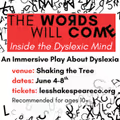
|
The Words Will Come Shaking the Tree Theatre (6/04-6/28) |
|
Souvenir: Tchaikovsky Sextet PSU, College of the Arts, Lincoln Performance Hall (7/12-7/12) |
|
Bad Seed Twilight Theater Company (10/15-11/01) |

|
A Midsummer Night’s Dream Oregon Shakespeare Festival (3/13-10/25) |

|
Food For Lane County - Turning Music Into Meals Even Steven's Bar and Grill (7/11-7/11) |

|
Sense & Sensibility 5G's Ranch (7/23-8/08) |

|
Cirque Ma'Ceo LIVE in Grants Pass July 17 - 19, 2026 Josephine Co Fairgrounds (7/17-7/19) |
|
COMMUNITY CONCERT with our Young Artist Institute Shipstad Field (University of Portland) (6/30-6/30) |
|
Universal Harmony: Schumann Piano Quintet Reed College, Kaul Auditorium (7/19-7/19) |

|
Billy Strings Matthew Knight Arena (10/06-10/06) |