

Exclusive: Kathleen Chalfant and Carolyn Michelle Smith on How FAMILIAR TOUCH Pays Tribute to Loved Ones
The movie is currently playing in select theaters nationwide.
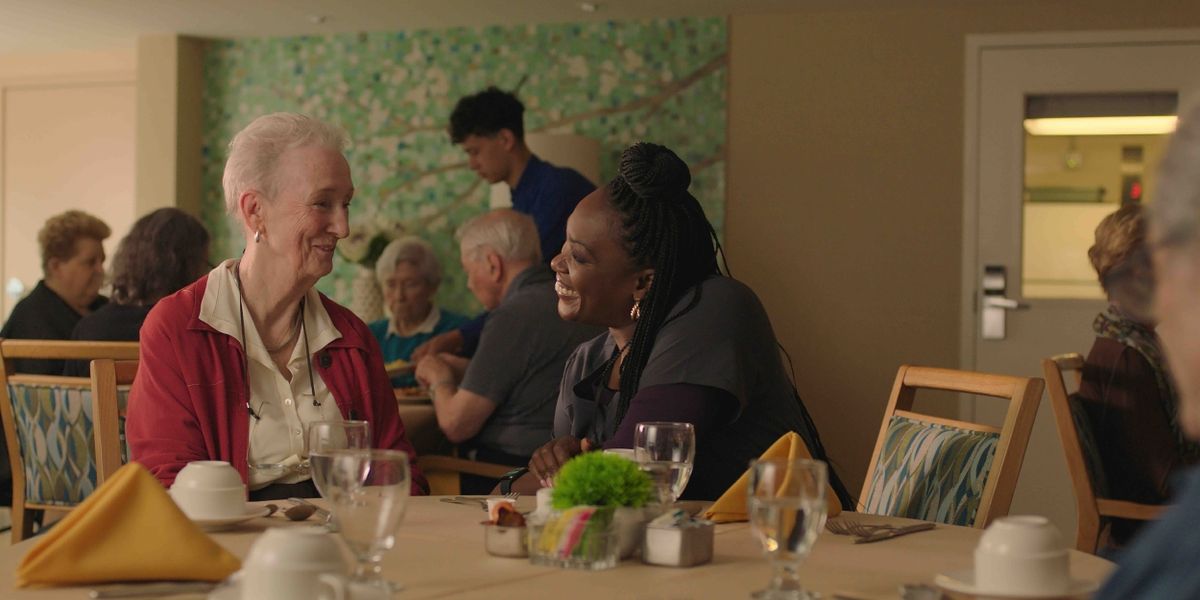
In Familiar Touch, Tony-nominee and Broadway veteran Kathleen Chalfont plays Ruth, a former cook, a mother, and an aging, but still largely independent, woman. She also has dementia, and early in the film, moves to a new home: an assisted living facility. But, as Chalfont herself says, "the movie is not about Ruth's decline. It's about Ruth's life." And this life continues to be one worth living, even when this new phase finds her in different circumstances than those in which she was previously accustomed.
Viewers of the film get to know Ruth through Chalfont's nuanced performance, which stays grounded in a reality: her reality, which is its own kind of miracle, even if others around her don't always share it. One of those is her new caregiver, Vanessa, played by fellow Broadway alum Carolyn Michelle Smith.
Like Ruth, whose personhood isn't limited to her dementia, Vanessa is more than her position at the assisted living facility. She is a fleshed-out character, with hopes, goals, and a deep understanding of what others need from her, not just as residents, but as fellow humans. In the film, Smith radiates a warmth and kindness that breaks through their shared realities and into something deeper.
Upon joining the project, both Chalfont and Smith had a personal connection to the subject material. Smith’s mother had dementia, as does Chalfont’s Best Friend and fellow theater artist, Sybille Pearson.
With the movie now playing in select cities nationwide, BroadwayWorld caught up with the two performers, discussing their appreciation for the script, their collaboration with writer/director Sarah Friedland, and what audiences can take away from the very real truth of those who live with dementia.
This interview has been condensed for clarity and length.
How did each of you connect with Sarah Friedland? I know this is her first feature as a writer/director, and I'm curious what those first conversations looked like for each of you.
Carolyn Michelle Smith: Sarah and I have known each other now for about 10 years. We met while working on a pilot for HBO that was written and directed by Steve McQueen. She was his very capable, present, earnest assistant, and also just someone that in the room he really trusted. She had come to one of our rehearsals and shared how much she enjoyed my work, but I really enjoyed her spirit. There's something about her energy and her curiosity as an artist that made me want to stay connected as friends. And we did. She had mentioned this project years and years later, and it's interesting because, in developing the script, we'd had several conversations about what the relationship between CNAs and residents can look like. She had so much expertise in her work, and I had a lot of personal experience from those who cared for my mother.
Kathleen Chalfont: I came to the project late. I first met Sarah on Zoom, and we discovered that we had lots in common, even though there was almost 50 years difference in our ages. We joke that it's a collaboration between an old actor and a young filmmaker that worked out. The biggest thing we had in common was an enormous love of Italy. Both of us had spent a fair amount of time in Rome, and a lot of our first conversations were spent speaking in Italian. The other strong connection we had was through the world of dance. Sarah’s earlier films have all been dance films, and while I don't dance, I have been involved in a whole lot of dance events.
The choreographer and filmmaker, Yvonne Rainer, is a very close friend, and Sarah had just seen MURDER and Murder. She'd also seen a dance piece that I was part of in which I didn't dance, but I ranted, which was Yvonne's Hellzapoppin. I read the script and was enormously moved by it, and particularly moved at that time because Sybille Pearson, the playwright, who is my Best Friend, has dementia. At the time that I read the script, which was exactly two years ago, was actually was about in the same place that Ruth was. In a way, this performance is a gift from Sybille to all of us, and certainly to me.
Was there a hesitation because of the gravity of the material?
Carolyn Michelle Smith: I actually wanted to dive right in. I believe that as actors, we crave opportunities to be able to have a container for truth. Sarah had come to my mother's 70th birthday. My mother had met her before and didn't remember her by that point, and Sarah was so gracious. I think that in working on this story, I was excited to be able to say, "Here's the truth of what I've watched my mother navigate, how I've learned how to care for her, and how I have allowed her to have her own sense of agency." I loved the little kid version of my mom at 69 and 70. I was really welcoming and excited for it, honestly.
Kathleen Chalfont: I was, too. I loved that what Sarah was doing was talking about Ruth's life from Ruth's point of view. As you know, most things that deal with this subject deal with it from the point of view of the people who are watching, the people who are affected by it, and family members. The movie is not about Ruth's decline; it's about Ruth's life. And what is true of all of us is that we are all living until we don't.
You filmed this at Villa Gardens in Pasadena with real residents and staff. Were there any observations or specific things that happened while shooting that made their way into the script or your performances?
Kathleen Chalfont: I don't know so much that things trickled in, but things were familiar because I am a contemporary of most of the residents of Villa Gardens. To be surrounded by people who were like those in the movie kept me honest. And there were always people there to say, “No, that isn't the way it is” or “Have you ever thought of this?” To be given a license, for instance, for the humor in the movie, was very important.
There’s such a stillness in this movie. Kathleen, I'm curious how you approached that subtlety and stillness as opposed to something like a piece of theater where you're playing for the last row?
Kathleen Chalfont: People ask this all the time, and from my point of view, there isn't a difference. The difference is that you fill the available space. It's something that we all do in life because you can get the attention of a person across the street if you need to. I don't think you have to lose subtlety in a bigger space. I don't think we do in life. Though there's always the serious acting problem of the fine line between subtlety and doing nothing at all.
Carolyn, Vanessa is so much more than her position as a caretaker. She feels like a fully lived-in person. We learn that she is a student and working toward a new career, but how did you approach building her inner life as you were preparing to play her?
Carolyn Michelle Smith: There was a lot of personal experience that I'd had. Vanessa's mother had recently passed, and with my mom having passed in 2020, all of that grief was still very present. As Vanessa, I wanted to be able to balance the real feelings of grief with the desire to offer the care that maybe she felt she could not have offered her own mother. And, also couple that with the diligence and curiosity about this community and this new resident.
Much of that was buoyed by Teepa Snow's work, who has done a lot of research around Alzheimer's and for caregivers, both professional and personal. For anyone who's navigating a loved one with dementia, I would strongly suggest researching her and looking up a lot of her work and her findings.
But it was really that personal experience buoyed by that research and understanding that it's about offering a very specific kind of care for Ruth that was coming from a very genuine place. I think we've often seen caregivers on shows or films that have a kind of nonchalance. I don't think that's the case for Vanessa because she's studying this and she wants to get it right and true.
There's a moment later in the movie when Ruth escapes, and we see Vanessa treat her as a real person and confide in her. I felt that was so moving because, like you just said, we don't often see that. People put up walls, and they don't feel they can be honest anymore.
Carolyn Michelle Smith: That behavior among caregivers and residents or loved ones is what starts to cut off the empathetic cord that is needed from human to human. Vanessa wants to make it clear that, in her lived reality, Ruth put her job at risk. It's the idea that "I know what your reality is. I'm still honoring your reality, but I need you to also be willing to receive mine with love."
The film is currently open in New York, Los Angeles, San Francisco, and more. Check out local screenings here and watch the trailer below.
Prefer BroadwayWorld in Google Search?
Add us as a preferred source so our stories show up more often in Top Stories and Google’s AI answers — for you.
Sign up for all the news on the Fall season, discounts & more...