


Review: THE UNBELIEVERS, Starring Nicola Walker
Writer Nick Payne returns to the stage with an emotional new play directed by Marianne Elliott.
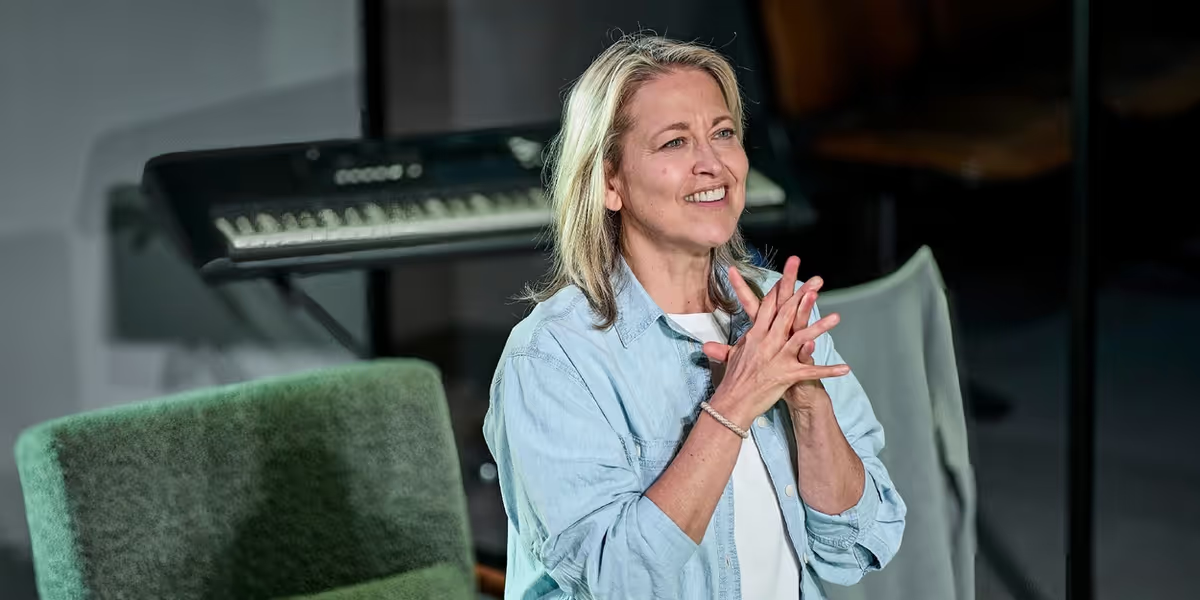
 Miriam’s 15-year-old son is nowhere to be found. How does a mother cope? This life-altering event buries in the cracks of her family dynamic and blows it up. Years on, with his case remaining an unsolved mystery, Miriam firmly believes he is still alive. Writer Nick Payne returns to the stage, debuting a play that’s not quite as groundbreaking as his Constellations was, but that brings all the excitement of a well-executed and nimbly staged time fracture.
The Unbelievers proposes three crucial moments: we see the chaos of the immediate aftermath, the lingering despair of the first anniversary of Oscar’s disappearance, and, finally, the restless hope Miriam still holds seven years later. But this isn’t a show about a missing kid.
Payne goes about it the human route, analysing the anguish that has set in. There won’t be much about the investigation or the causes. In the same spirit, he refuses to intellectualise the emotions that line the piece, opting to let his characters show how they live with them instead. It gives Nicola Walker the chance to reach a(nother) career peak, and, directed by Marianne Elliot, she astonishes even when the script falters. Alongside Paul Higgins and because of the difference in their roles, the production is magnetic.
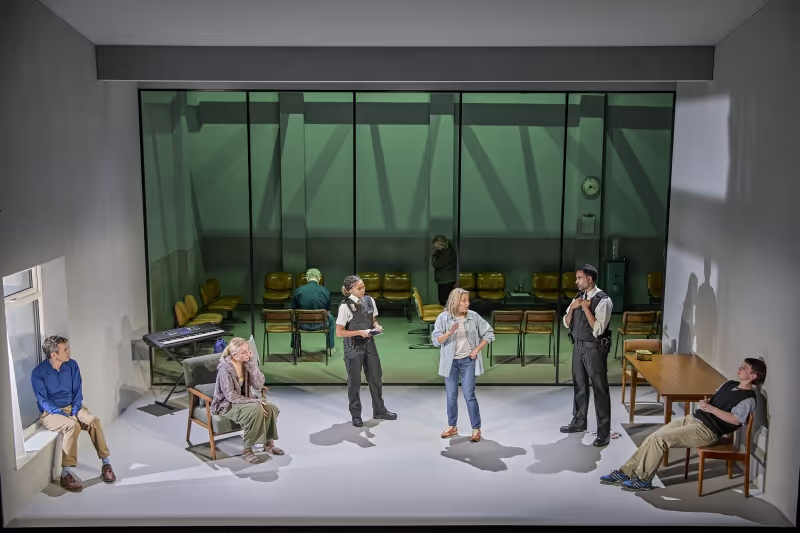
It’s extremely difficult to empathise with Miriam sometimes. Walker is dazzling, introducing a waspish woman who’s had to experience the unimaginable. Her character is antagonistic, hostile, brash, blasé even. She sees her life as utterly meaningless after Oscar’s departure from it. She buzzes and paces in a belligerent mood, damaged, and actively hurting her loved ones. Her adult children (Ella Lily Hyland as Margaret and Alby Baldwin as Nancy) are vocal about feeling left out, and her ex-husbands (Higgins as David and Martin Marquez as Karl) suffer her and her cruel outbursts in their own rights.
She fires off missiles blindly, crucifying everyone who dares to have a different angle on the circumstances. Scenes about the absurdity of grief unfold with Miriam at the centre. These aren’t big sequences where they ponder the meaning of it all; they’re more like vignettes of life. Miriam endlessly offers refreshments to anyone who comes in. David mopes. Margaret and Nancy display a united front. Then, Payne shifts something in the text, and Elliott’s direction follows suit.
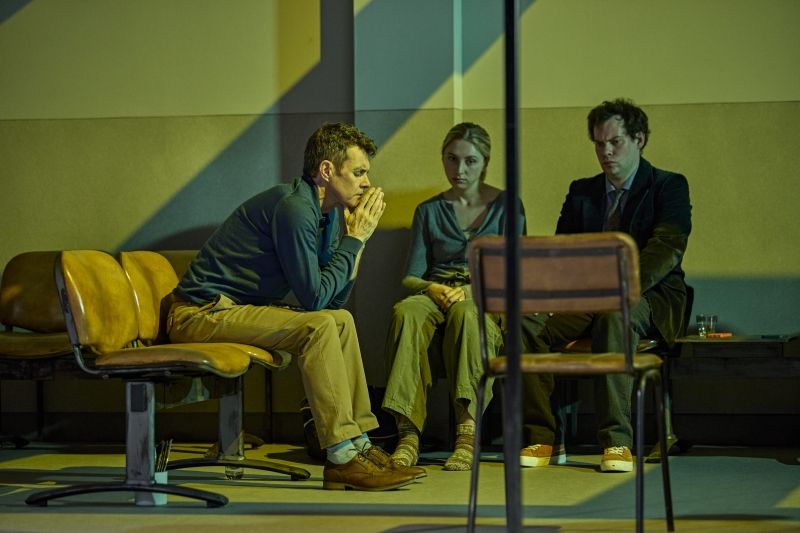
Small explosions go off; the flames are put out. The scars remain. Yet, hope, however lateral, however feeble, sneaks in and persists in a variety of ways for Miriam. Though their family ties are jagged and torn, they deeply love and support one another. Nonetheless, they don’t excuse nor forgive her erratic behaviour at all. There’s a very peculiar balance between their personalities, but most of them seem to exist in symbiotic opposition to Miriam. David, a mathematician, needs statistics and numbers to survive. He is sensitive; she pretends to be touch.
Both despair, but their pain becomes part of them contrastingly. The children (Margaret is David’s, Nancy is Karl’s), in turn, are often more mature than the adults all across the timeline. They become yet another embodiment of how sorrow can be assimilated into daily life (and in a relatively healthier way). Margaret especially shows the contradiction of acceptance. Hyland gives her best here, fully forming a sophisticated take. Each member of the cast works towards the securement of Walker’s universe.
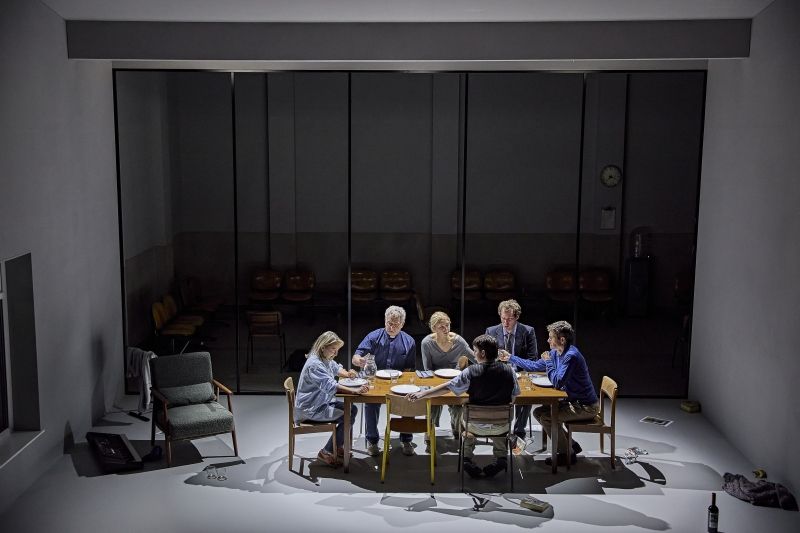
She toes the line between hope and delusion, breaking down and rebuilding herself. Walker’s performance takes no prisoners, thoroughly unconcerned with the opinion of others. The audience has to compromise to stand with her. She is unlikeable, without an ounce of sympathy of her own; but she’s lost her son, and that visceral attachment can’t be ignored. “His body used to be my body,” she wails. A staggering moment where she fantasises about what Oscar would look like puts everything in perspective, with a pure and genuine expression on Walker’s face.
Elliott’s work lives in the details. She extrapolates Payne’s fascination with the fragmentation of time and shatters it further, turning it into a unum at the end. An increasingly complex sound (Nicola T. Chang) moves the plot through the years aided by a change in Jack Knowles’ lighting, while Bunny Christie’s design expands the action to a back room where actors linger in a limbo of sorts (the handless clock is a touch of genius). It’s quite the visual allegory.
All in all, The Unbelievers has a lot to say. The only reproach that could be made to it is that it perhaps relies in its details a little too much. It also can't fully commit to a genre, as the levity in Payne's writing is often retuned by a somber lor or a side glance, confusing the tone.
The Unbelievers runs at the Royal Court until 29 November.
Photo Credits: Brinkhoff-Moegenburg
Sign up for all the news on the Fall season, discounts & more...







Reader Reviews
To post a comment, you must register and login.