


Review: THE (R)EVOLUTION OF STEVE JOBS at Kennedy Center
Washington National Opera brings tech story with local ties
It’s not so strange, really, that there’s a serious opera about Apple co-founder Steve Jobs. His life’s work is usually invoked before every production of the last decade or more, when audiences are asked to silence their smartphones.
Still, it’s notable that an art form that reached its creative peak in the 19th century is celebrating a figure of our lifetime.
The Washington National Opera premiere of “The (R)evolution of Steve Jobs” at the Kennedy Center is the 10th staging of the project, which premiered at Santa Fe Opera in 2017. But it has a warm connection to D.C., since it’s by Mason Bates, the first Kennedy Center composer in-residence from 2015 to 2020. Likewise librettist Mark Campbell was a founding mentor for the center’s American Opera Initiative.
Further, Wei Wu, the originator of the role of Jobs’ deep-voiced Zen priest and mystic adviser Kõbun Chino Otogawa, is a grad from the WNO Cafritz Young Artist Program.
And the production itself, when it does, soars on the strength of the Washington National Opera Orchestra, whose performance of Mason’s innovative score was crisply guest conducted by Lidiya Yankovskaya, and a strong underpinning of the WNO chorus.
Still, owing to the fortunes of the opera world, this “Jobs” is a shared one — a co-production of four different collaborating companies where it has previously played — Atlanta, Austin, Kansas City, Calgary and Salt Lake City. Tomer Zvulun’s production is directed by Rebecca Herman.
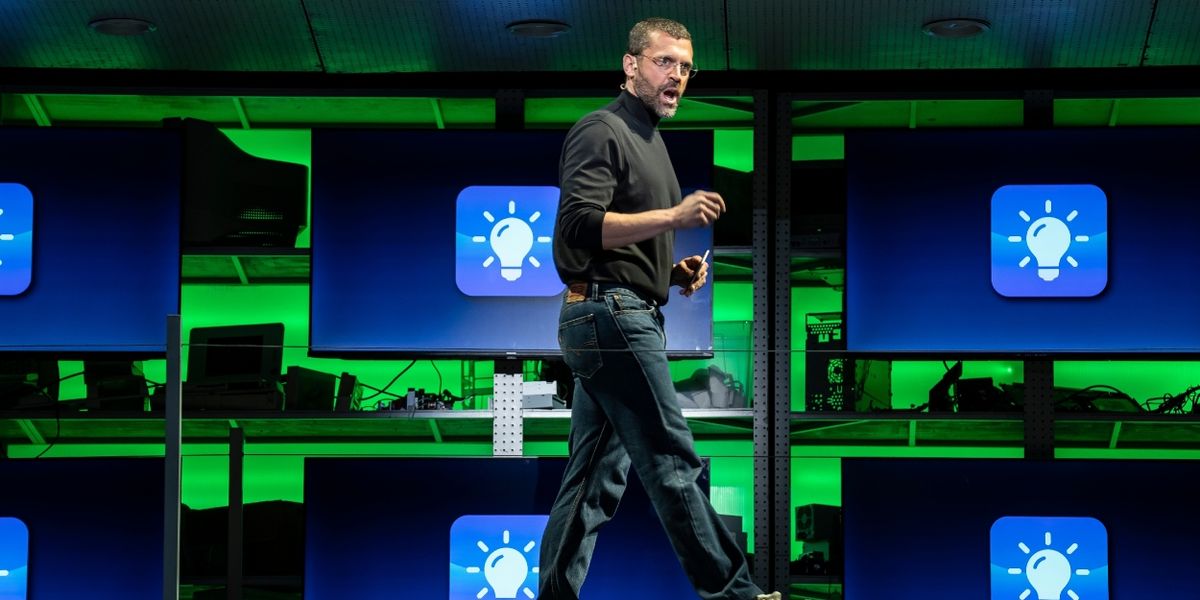
The scenery, for example, is costructed by the Lyric Opera of Kansas City and that’s what first strikes you — 28 big video screens - backed by a stage-wide JumboTron. It almost looks like a Best Buy TV display than an incubator for computers and smartphones.
But Jacob Climer’s set is versatile for quickly setting scenes visually as the story jumps around in time (luckilly there are projected titles to help determine the timeline). It begins for example, with young Steve’s 10th birthday, in which he gets his first workbench, then it quickly jumps to the 2007 presentation where Jobs is extolling the virtues of the “one device” that will make its name.
Normally, this is the kind of anthem to denote the climactic moment of achievement after years of struggle. Instead, it’s a precursor for a bio that still jumps around in time. it’s meant to add a circularity to the narrative, librettist Campbell says — the circle also being an important lesson in a Japanese calligraphy that inspires the form of his many inventions (anyone remember the iMac G4?).
The story of Apple and its products is in many ways the story of modern culture, and I’m sure I’m not alone in having followed its every iteration for decades. Yet we see very little of these devices, or even hear the word Apple, because the company never approved the work. At any rate, the focus is turned on Jobs himself.
The baritone John Moore in the title role is on stage for nearly every scene — and in the trademark black turtleneck a, beard and glasses. And while he acquits his role well, it’s not as if he’s given many musical moments that would provide a standout moment.
Rather, the singing seems to operate on a separate level than the music, which frequently stands out for its sparkling originality. Bates, who also takes the name DJ Masonic when spinning, is known for mixing electronic music with classical instruments, but there’s surprisingly little of that in his score (which has already won a Grammy for best opera recording).
(I for one was ready for a medley incorporating identifiable iPhone ringtones, but maybe that’s something for the musical comedy version).
Instead, a well-amplified acoustic guitar can be heard among the usual orchestral voices, where a percussive ring brings a certain modernity to the approach.
The circular approach to the storytelling means there is less of a narrative shape one might expect in opera or in theater in general. The mood isn’t helped by the fact that Jobs himself became a jerk — mistreating workers, his collaborator Steve Wozniak (a gregarious tenor Jonathan Burton) and particularly a girlfriend Chrisann Brennan (soprano Kresley Figueroa), whom Jobs turns away when she becomes pregnant (but names a pre-Mac computer after the child he denies, Lisa).
We don’t see the Apple Lisa, by way, any more than we see other user-friendly creations in their sleek designs and impossible-to-open constructions. More often, he’s tinkering in the garage with Woz, delighting in the disruption he’s making in the industry before becoming the kind of overbearing corporate taskmaster he once loathed.
It is his eventual wife Laurene Powell Jobs (mezzo-soprano Winona Martin) who pulls him out of this funk and delivers the most memorable line near the end of the work, where she notes that in a few moments, everyone in the room will soon be turning back on and breathlessly consulting the device.
The end comes quickly — it’s astounding in a form that routinely has two intermissions, that there are none at all, an other aspect of the 21st century, I suppose.
And while there are pauses for calm, usually led by the strong, contemplative bass of Wu, neither are any Sir Isaac Newton aha moments about his company name, even while lolling in an orchard.
It’s a difficult in the DOGE era to celebrate in song any supposed wizard inventor billionaire (spare me the Musk, Bezos or Zuckerberg operas). Especially in a venue already shrunken by the hostile takeover of the current administration. .
But “The (R)evolution of Steve Jobs” has a sound that's mostly as sleek and consumer-friendly as the products he devised.
Running time: About 1 hour and 40 minutes, with no intermission.
Photo credit: Baritone John Moore as Steve Jobs. Photo by Scott Suchman.
“The (R)evolution of Steve Jobs,” in English with projected English titles, continues through May 10 at The John F. Kennedy Center for the Performing Arts, 2700 F St NW. Tickets at 800-444-1324 or available online.
|
Misery Aldie Mill Historic Park (8/20-8/30) |
|
The Dinner Detective Murder Mystery Dinner Show The Dinner Detective Washington DC (9/26-9/26) |

|
BAD KREYÒL Mosaic Theater Company (5/20-6/13) |
|
Commedia Christmas Carol (2024) Streaming Traveling Players Ensemble (12/23-12/23) |
|
Josh Groban Wolf Trap (8/22-8/22) |
|
Harry Potter and the Sorcerer's Stone in Concert Wolf Trap (8/27-8/27) |
|
Rockville Little Theatre presents "The Game's Afoot" F. Scott Fitzgerald Theatre (9/25-10/04) |
|
The Jersey Four A Tribute to Frankie Valli and The 4 Seasons, featuring original member Gerry Polci F. Scott Fitzgerald Theatre (9/13-9/13) |
|
Rockville Little Theatre presents "Lettice & Lovage" F. Scott Fitzgerald Theatre (1/29-2/07) |
|
The Dinner Detective Murder Mystery Dinner Show The Dinner Detective Washington DC (8/15-8/15) |
Reader Reviews
To post a comment, you must register and login.