


Review: NOTHING UP MY SLEEVE at Round House
Master illusionist Dendy gives you the gift of a stone in your shoe
 Click for Tickets!
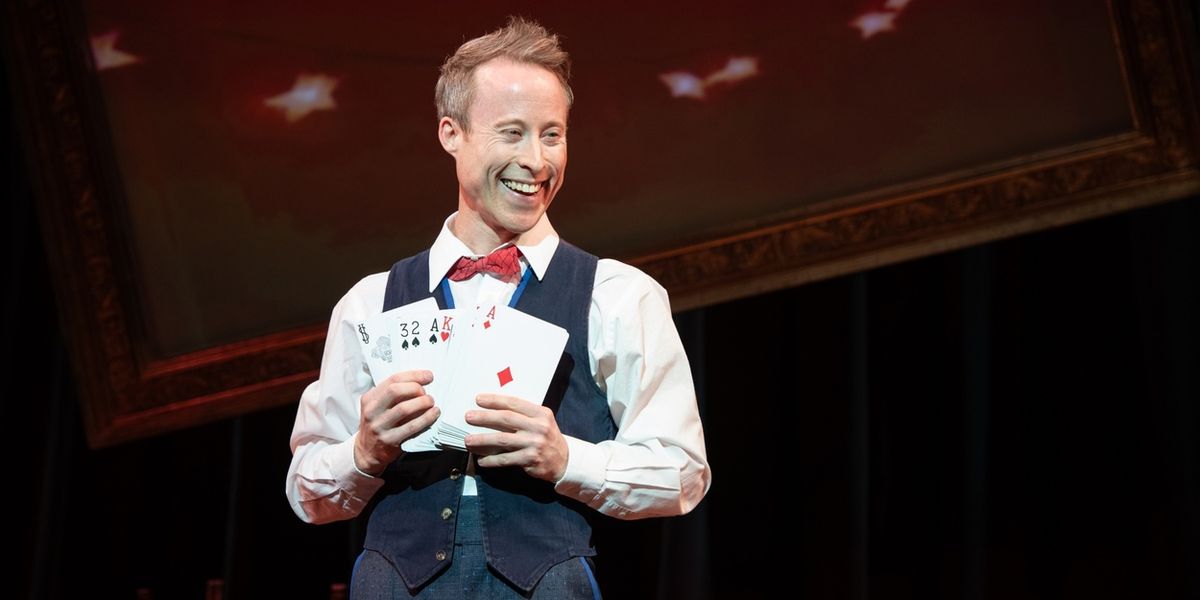
The quote “a magician gives you the gift of a stone in your shoe” is one of a few on the subject of magic that greet you as you enter the theater for Nothing Up My Sleeve…Simple Deceptions for Curious Humans starring Dendy.
Round House audiences may likely remember Dendy as Ariel in Aaron Posner and Teller’s magic-heavy adaptation of The Tempest that played at the theater in 2022. Now, Dendy and Posner are reunited on the same stage with a smaller, more intimate, one-man show in which Dendy maps out his path of becoming a magician, all while performing a series of set-piece illusions escalating in complexity from straightforward prop trickery all the way to the downright miraculous. Even Teller makes an appearance; albeit a short one via video projection.

Some may be averse to the showiness and over-the-top cheesy spectacle that often goes hand in hand with magic. Fear not — Nothing Up My Sleeve is an altogether completely different kind of affair. Just from walking into the theater and glimpsing the set, everything about this production has that trademark Posner quality to it, rich with a quiet but steadfast confidence in its highly-coordinated simplicity.
Daniel Conway’s set is satisfyingly busy with various odds and ends, assorted paraphernalia and off-kilter angles, while maintaining a perfect sense of clarity that keeps the focus tightly on the magic. Same with Sartje Pickett’s soloistic, breathy woodwind-heavy original music which wistfully enters and exit without fanfare, underscoring and emphasizing but never upstaging. Thom Weaver’s lighting is often broad and warm, providing a large uninterrupted platform for the magic to take place, until it turns on a dime into something harsher and more angular to highlight a perfect dramatic pose or silhouette.

You could sum it all up as hipster parlour magic, if you so wanted, all the way through to Jeannette Christensen’s costume design which sees the dandy-ish Dendy donning dusty, high-waisted trousers with old-timey waistcoats and silly bowties. To mark the passage of time, he slips in and out of different pairs of shoes, à la Mister Rogers.
All of this stuff, the stuff of sets and scoring and such, elevates the work to the properly theatrical. It’s not just the tactile flourishes; the dramaturgical fingerprints of Posner are felt all over in precisely accented emotional beats, honed and sharpened line deliveries, pretty little structural parallels and so forth. And yet, all this tremendous accumulation of talent and ingenuity from every director, designer, and crew member in the building would amount to nought if there wasn’t a central star worthy of that elevation.

Let’s put the cards on the table. You’d watch Dendy perform close-up magic under a bridge or in a back alley. You’d watch Dendy pull coins out of thin air in a poorly lit room, you’d watch him find a card, any card, in a hospital’s waiting area — heck, you’d likely listen to Dendy read the phone book front to back without much complaint. It’s difficult to overstate that indescribable x-factor the man possesses, but with no airs or grandeur he lands every sneaky sleight of hand, every little off-hand joke in a truly mesmerizing manner.
Perhaps what’s most special is the kindness of the whole thing. Nothing Up My Sleeve confronts this element of magic directly; the asymmetry of the relationship between the one doing the tricking and the ones getting tricked, the tension between being on the inside and the outside. Dendy revels in that tension, but in a fashion quite unlike many in the lineage of performers who precede him. He doesn’t act superior or abrasive towards the audience — quite the reverse, he spends much of the show essentially bonding on common ground with the audience by revealing and revelling in his own discover and love of magic, of magicians he idolized, and of seeing tricks and wondering how they were done.
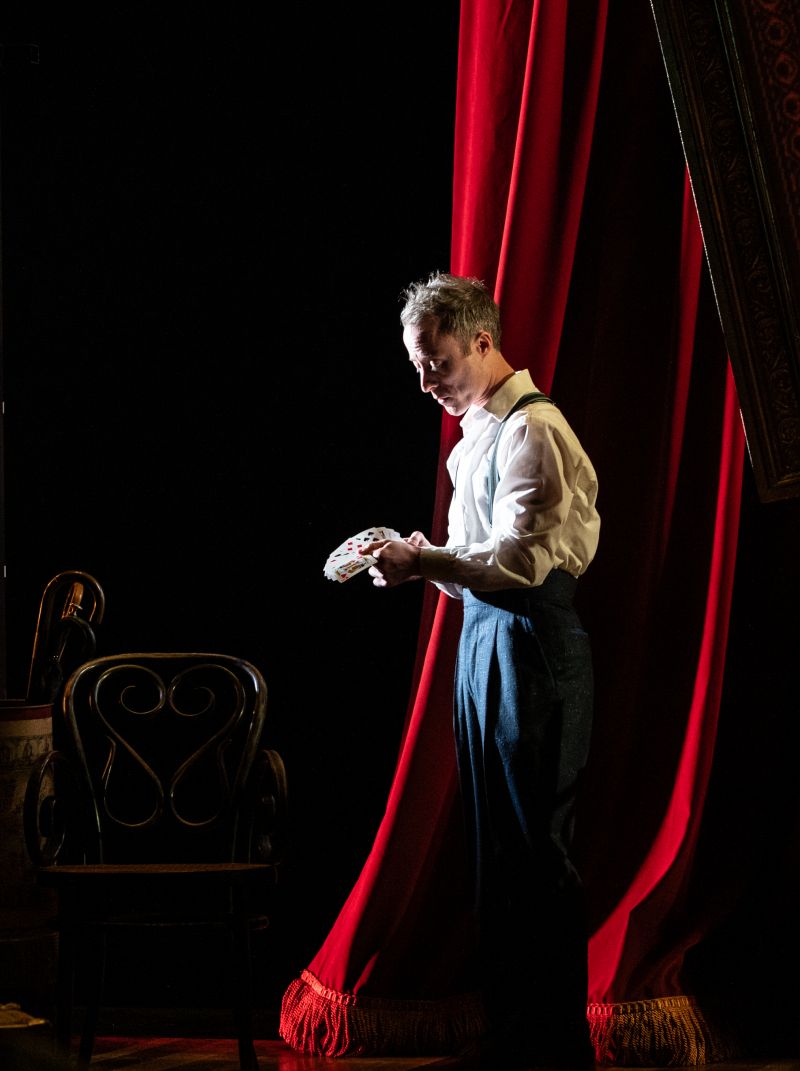
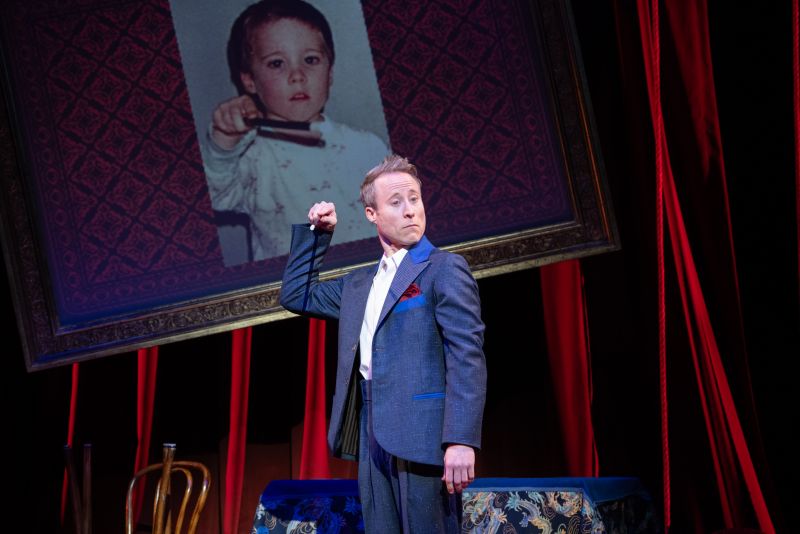
Because Nothing Up My Sleeve is more than just a magic show, it’s the story of Dendy’s life, tracing his relationship with magic all the way back to his rural childhood entertaining family members close and distant with prop magic at gatherings, to his first professional gig, an extended falling out and then falling back in love with magic, all leading eventually to his breakthrough moment with The Tempest. And throughout every second, Dendy has you in the palm of his hand. His technique: effortless and flawless. Truly magical.
Which is almost enough to sufficiently misdirect you from what is missing in Nothing Up My Sleeve — nothing. There truly is nothing up Dendy’s sleeves. There’s no there there, no last secret ingredient to give it that final push from incredibly well-produced magic show to a genuine, fully-rounded play.

One is put in mind of the late, great card magician Ricky Jay who collaborated with acclaimed director David Mamet on similar one-man shows such as 1994’s Ricky Jay and His 52 Assistants. There certainly are many parallels. 52 Assistants was also a theatrical take on close-up parlour magic, and also one with a set of various odds and ends and assorted magical paraphernalia, and also one in which its star lovingly waxes lyrical about the history of magic, important texts, and the greats of the craft that he idolized.
Even the tricks of these two productions feel like part of some long-distance rapport between each other. The placement of Dendy’s coin magic rhymes somewhat with Jay’s shuffling sequence, Dendy’s “No Touch ACAAN” echoes Jay’s horoscope reading, Dendy’s five senses feels like Jay’s “Everywhere and Nowhere” on steroids, and Dendy’s finale, a touching rendition of a concept passed down from magician to magician and eventually to Teller and from Teller to Dendy, shares the spirit of Jay’s finale, “The History Lesson,” in which he weaves together a montage of how different magicians throughout history performed the famous cups and balls routine.
This is far from a weakness or flaw in Nothing Up My Sleeve — in fact, it feels like an important part of the point. If there is any defining factor shared between Dendy and preceding greats like Teller and Jay—beyond their obvious skill for close-up magic—is their deep reverence for those that came before, their genuine desire to be in commune with this special thing taught from master to student and on again. But the trick Nothing Up My Sleeve misses is in differentiating itself.
No one would accuse Ricky Jay and His 52 Assistants of being autofiction. Jay clearly plays a character, his exaggerated, sardonic stage persona, and doesn’t drop it for a moment. He reveals nothing of himself, most of his anecdotes sound obviously made up.

Nothing Up My Sleeve feels like it’s wanting to be a completely different kind of thing altogether. Dendy talks a lot about what it is that magic actually does to you — blur the line between the known and the unknown, the true and the impossible, the real and the fantastical. That the true magic is in casting that seed of doubt in the audience’s mind, that lasting, needling fixation that asks “but what actually was that?”
In this respect, pairing a magic show with a one-person autobiographical play is, on its face, ingenious. Autobiographical fiction can often produce very similar reactions. A storyteller heavily abridges, dramatizes, and maybe even wholly invents a story presented to us as true and leaves the audience to wrestle with those thoughts of “what actually happened?”
Numerous works deal with this exact question. The book-cum-movie-cum-musical Big Fish tackles the ways untrue stories can somehow be truer than we thought, while the mindbending television show The Rehearsal (created by Nathan Fielder, also a magician) pushes the concept of unreality in reality TV to its absolute edge and its efforts to test our ability to keep hold of that magical line between what’s real and what’s not. When Mike Daisey's monologue The Agony and the Ecstasy of Steve Jobs turned out to have stories in it that were not entirely true, it caused enough controversey to warrant a public apology from Daisey and a revised, redacted version of the show — raising critical questions as to the responsibility of the tellers of supposedly true stories.

Nothing Up My Sleeve, on other hand, keeps its feet firmly planted on one side of that line. Dendy’s magic is incredibly impressive to be sure, but it’s not particularly unique, and Dendy’s story is entertaining and captivating enough because Dendy as a performer is entertaining and captivating, but it doesn’t trick you the way it feels like it should. It’s all fairly straightforward, in the end. It’s safe to assume some bits are exaggerated or even wholly made up. Or maybe they aren’t, it doesn’t really matter either way. It’s not like you’re going to wake up the next day scratching your head, wondering “did Dendy really work in a restaurant?”
And that’s a shame, because there’s so much potential in the idea of a part-magic show, part-memoir, that’s tricking you two ways at once. It’s especially surprising coming from Aaron Posner, a writer/director who has specifically wowed DC-area audiences over and over again with his metatextual takes on classic works and their magical ability to deconstruct and breathe new life into something familiar — familiar as a card trick.

It comes across in one more area: the audience interaction. It should be highlighted that for the amount of audience interaction that there is, and there is a lot of it, a lot of effort has clearly been made to make it feel safe, comfortable, and kind. This is far from a given in the world of magic shows, but Dendy never comes off as pressuring or antagonistic towards the crowd.
This element, too, feels like it should be right up Posner’s street. His plays have been uniquely daring in their desire to truly engage with the audience. In Life Sucks, Posner went so far as to let the audience have the last word in the play, and the brilliant No Sisters empowered its actors to thoroughly exist alongside and converse with their audience that rather than break the fourth wall it instead dared to imagine a kind of theater in which such a wall could never, would never exist. It was exactly this approach that made every performance of those plays completely unique, one of a kind. You could even be fooled into wondering if this or that beat was actually even scripted, or whether you truly were witnessing something that had never happened before.
It can’t not be something of a letdown, then, that the audience interaction in Nothing Up My Sleeve is just the bog-standard magic show interaction. Cards are picked, cards are found, and the show goes on. Dendy is polite and charming and kind to his temporary assistants, but nothing deeper or more surprising is ever allowed to take place. Again, like with its approach to storytelling, Nothing Up My Sleeve opts for the less magical route.
And still, what’s left after all that is a beautifully produced evening of some of the best magic you’ll see, performed by a true master of his craft. Even if it leaves you with some stones in your shoe.
Nothing Up My Sleeve plays at Round House Theatre through March 15, 2026 and runs approximately 2 hours with one intermission. It is recommended for ages 10+. The production contains haze and flashing lights.
Prefer BroadwayWorld in Google Search?
Add us as a preferred source so our stories show up more often in Top Stories and Google’s AI answers — for you.



Sign up for all the news on the Fall season, discounts & more...
|
Brian Henson's Puppet Up! Lincoln Theatre (9/30-9/30) |
|
GARBO: EL ACTOR QUE SAVÓ AL MUNDO (Garbo: The Actor Who Saved The World) GALA Hispanic Theatre (9/03-9/27) |

|
Mr. Burns: A Post-Electric Play Clarice Smith Performing Arts Center (10/09-10/18) |

|
Special Event: ARTS By George!: Jeff Goldblum and the Mildred Snitzer Orchestra Center for the Arts (10/03-10/03) |

|
The Second-Best School Shooting NextStop Theatre (9/17-10/11) |

|
Coming to America: An Immigrant Cabaret ExPats Theatre (9/30-10/18) |

|
Some Like It Hot Bernard Family Theatre, Olney Theatre Center (9/18-11/08) |

|
Stonewall's Bust The Writers Center (10/09-10/25) |
|
Rockville Little Theatre presents "Lettice & Lovage" F. Scott Fitzgerald Theatre (1/29-2/07) |
|
The Dinner Detective Murder Mystery Dinner Show The Dinner Detective Washington DC (9/26-9/26) |

Reader Reviews
To post a comment, you must register and login.