


Review: AN ENEMY OF THE PEOPLE at Theater J
Ibsen's classic; readapted and reimagined.
 Click for Tickets
In keeping with American tradition, Theater J has brought Henrik Ibsen’s An Enemy of the People to the Edlavitch DCJCC not in the form of a translation, but in the form of another American adaptation; this time a new version by Amy Herzog which had its Broadway premier last year.
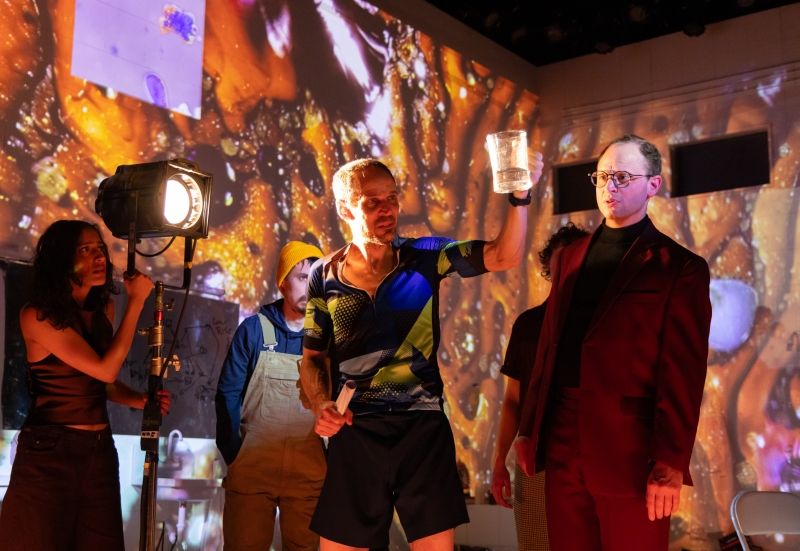
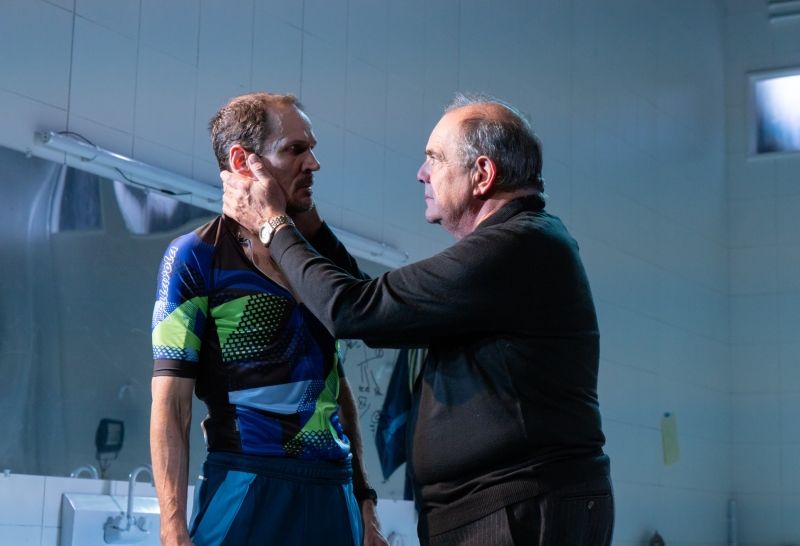
This version, like Arthur Miller’s before it, largely sticks to the beats of the Danish original. Thomas Stockmann (Joey Collins) is a small town doctor who discovers that the water in the town’s recently opened spa contains harmful bacteria causing illness and possibly even death. Naively believing he’ll be celebrated for this discovery, Thomas brings the evidence to the mayor/chairman of the spa, his brother Peter (Edward Gero).
Far from celebrating the news, Peter scolds the doctor for having undertaken the investigation in secret and makes clear that the local economy cannot withstand the expensive closure and renovation of the spa, and that the news must be suppressed.
Thomas is understandably appalled and, still under the impression that the majority of people will back him on the issue, writes up an exposé for the local newspaper and brings it to editor Hovstad (Aaron Bliden), his underling Billing (Jeremy Allen Crawford), and the printer Aslaksen (Dylan Arredondo). Each is on board to publish the explosive document for their own reasons: leftist Hovstad wants to talk truth to power, conservative Aslaksen wants to protect his financial interests as a homeowner, and anarchic Billing just wants to watch the world burn.
A visit from the mayor changes their tune, however, as Peter lays out how the full potential ramifications of printing his brother’s article—higher unemployment and higher taxes at the very least—will specifically hurt the working and property-owning taxes men like Hovstad and Aslaksen see themselves as champions for.
With no further recourse either with the relevant authorities or the press, Thomas calls a hearing to explain his findings to the public in person, but after Aslaksen and Peter do their best to stifle him, he loses his temper and raves against the town and its people, who jeer him and brand him an enemy of the people.
There’s no denying the play’s relevance. Ibsen based the details of his plot on then-recent events, including a cholera outbreak, that bear more than a superficial resemblance to more recent events like the Flint water crisis and the COVID pandemic, but its true catalyst was the critical uproar over Ibsen’s scandalous Ghosts, which was rife with taboo topics such as incest, venereal disease, and euthanasia.
It’s ironic, then, that Ghosts had its 1882 premier in the United States as no European theater would have anything to do with it, and yet 143 years later America still seems reluctant to accept its successor in its original form. Arthur Miller already “Americanized” the work in 1950 by fairly cohesively reimagining the protagonist as a more sympathetic people’s champion, as opposed to a stubborn, vain, anti-democratic eugenicist.
Although she still manages to find the sap in sapless Ibsen, Herzog’s Dr. Stockmann is less romanticized than Miller’s, but critics of last year’s Broadway production already noted that the adaptation continues the practice of making Ibsen more palatable for the current American theatergoer, this time by exorcising Thomas’ virulent attacks on party politics, the working class, and democracy. And so the great contradiction: An Enemy of the People mercilessly caricatures and satirizes those cowards who would seek to moderate and temper all the rough edges of life and its inconvenient truths, all while modern productions of An Enemy of the People are mercilessly moderated and tempered until the spirit of Ibsen winds up as dead as a doornail.
Herzog’s text isn’t the only thing working against that spirit. Theater J’s production, directed by János Szász, dives headfirst into expressionism. The result is electric and colorful, highly emotional and physical, dripping with energy — so much so that the first half is largely successfully carried by the curiosity of Szász’s choices. Szász’s many, many choices.
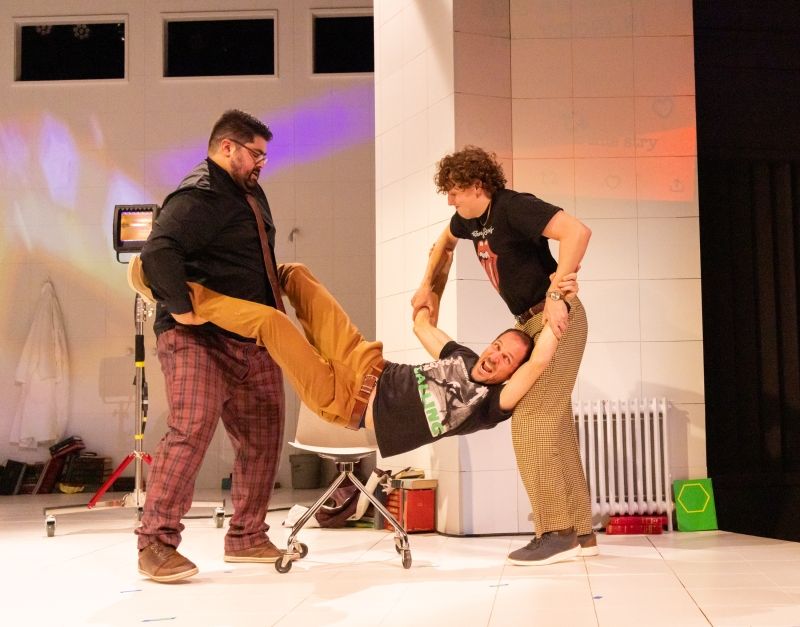
From odd costumes to odder characterizations to visual projection on top of visual projection, Szász’s An Enemy of the People plays like a never-ending parade of wild ideas that are fascinating to witness until they start to really pile into and over each other, culminating in an eventual cacophony of unmotivated choices showing no regard for the text.
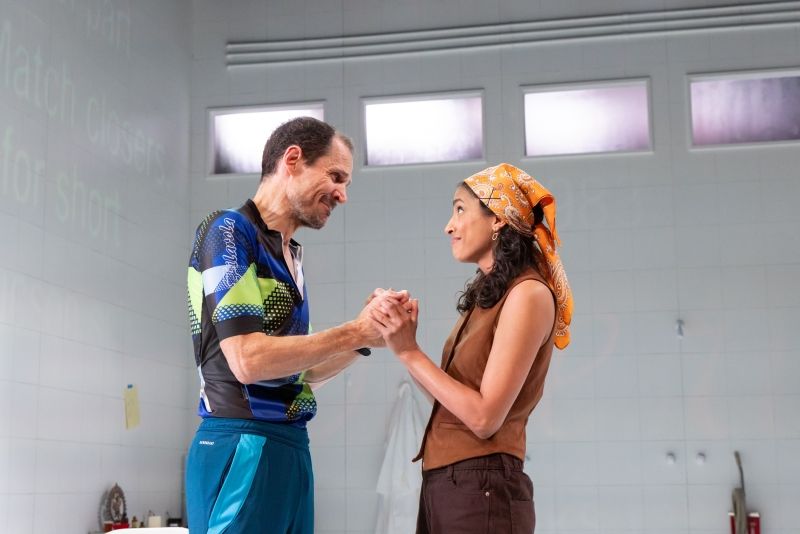
The execution isn’t the matter here. On the production side, Maruti Evans’ clinical, asymmetrical set is striking and its verticality makes great use of the space while creating the perfect canvas for media designer Mark Costello’s vibrant work to play on, and Costume Designer Cody Von Ruden crafts memorable look after memorable look.
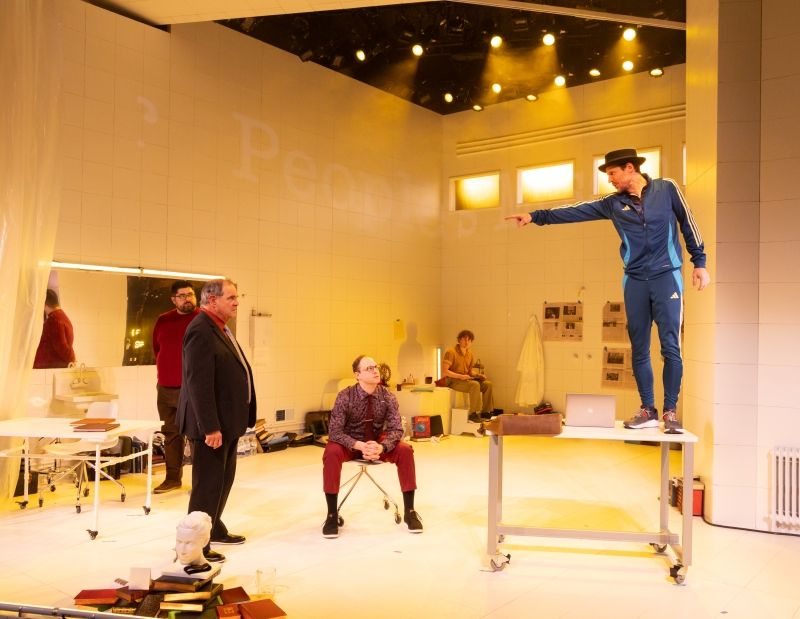
It’s not particularly clear what the reasoning is behind Billing’s portrayal as a cocaine-snorting predatory golfer, of all things, but if anyone is able to make it work it’s Crawford. Gero brings gravitas and surprising restraint to Peter Stockmann, while Reese Crowley’s grounded, naturalistic performance fleshes out the doctor’s daughter, Petra (a sort of dual role resulting from Herzog having abridged the two female characters in the original Ibsen into only one).
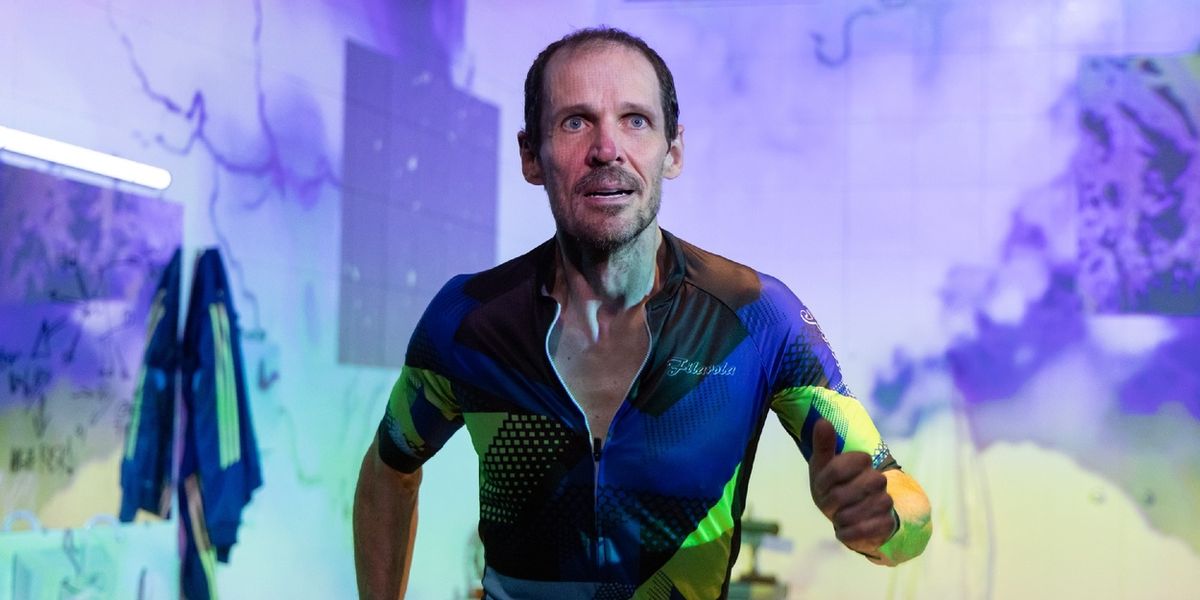
As for the doctor himself, Collins is relentless in the tiring role. In one of Szász’s more inspired choices, Collins’ Thomas is a fitness nut clad in highly saturated exercise clothes, wearing a smartwatch, and frequently running for long periods of time. There’s a real manic wildness to Collins’ performance that contrasts sharply against stodgier depictions of the character (Steve McQueen comes to mind).
But no amount of talent will save that second half. During the intermission (which the production very optimistically allotted only ten minutes for) audience members are encouraged to pick up groggers/noise makers from the lobby to be used during the town hall scene. (Thus, the long and melodramatic final scene is doomed to be interrupted every two minutes or so by a rogue grog or some unintended krechkt!)
The present state of An Enemy of the People’s famous town hall scene is partially the result of some international, longwinded game of chicken played by directors and designers eager to push the scene so far it ends up in the first act of The Wild Duck. All that noise and spectacle only further buries that pivotal, climactic moment of the play: when Thomas belts out his attack on the townspeople, on all common people, on democracy, and on the world itself. This is the moment where he becomes the enemy of the people.
Szász goes all in on the contemporary clichés of the town hall scene: encouraged audience participation, a live video feed, a half-hearted attempt at a cringey Twitter feed, and lots of yelling into microphones.
The audience grogs their groggers, as should be expected, at the mayor or Aslaksen or Hovstad whenever they attempt to silence the doctor — but this just spins the scene into utter chaos. Thomas has no support, that’s the point. The townspeople are aligned against him, that’s the point.
That complete and total disregard for the truth of the scene or the characters was there from the start of the show. Dialogue is often recontextualized to be about something other than its original intention. Scenes are often recontextualized to feel part of a different sense of place than they literally are. Characters are often physically carrying out actions that explicitly contradict lines they are about to recite.
This approach can revitalize classic, ubiquitous, over-performed works, but it is just confounding when imposed on a wordy, droll political satire. No amount of Norwegian wit stays funny when every interaction spirals into the characters just yelling at each other. Simply following the thread becomes a burden when the director inexplicably sets the dining room scene in a dance club that’s still a dining room somehow. Szász repeatedly invents cartoonishly over-the-top displays of violence that actively work against even Herzog’s characterizations.
It’s big and it’s bold and it’s loud, and by the end it’s collapsing under the weight of its own self-inflated pacing and untenable assortment of ideas — so many ideas and choices and so many of them conflicting such that in the end Szász’s An Enemy of the People is almost everything.
Well, it’s not Ibsen, at least.
An Enemy of the People performs through November 23, 2025 at the Edlavitch DCJCC. Run time is approximately 2 hours and 45 minutes including one intermission. The production includes strobe lighting.


|
Misery Aldie Mill Historic Park (8/20-8/30) |
|
Josh Groban Wolf Trap (8/22-8/22) |

|
Come From Away Ford's Theatre (9/10-10/18) |
|
The Jersey Four A Tribute to Frankie Valli and The 4 Seasons, featuring original member Gerry Polci F. Scott Fitzgerald Theatre (9/13-9/13) |
|
The Last Victorian Washington Stage Guild (11/19-12/13) |
|
Measure for Measure Folger Shakespeare Library (9/22-11/01) |
|
The 25th Annual Putnam County Spelling Bee Ford's Theatre (3/12-5/15) |

|
Rockville Musical Theatre presents "Caroline, or Change" F. Scott Fitzgerald Theatre (10/31-11/15) |
|
Gershwin, Bernstein & American Mosaic Wolf Trap (8/15-8/15) |

|
Brontë Sister House Party Van Ness Main Street (8/14-9/12) |
Reader Reviews
To post a comment, you must register and login.