


 The bite of winter, barely registering these past months in London, snapped at my cheeks on arriving at Leeds Railway Station. It was a reminder that while a metropolitan complacency can be comforting, the sting of pain can be a restorative, a jabbing alarm from a dreamy ease in the capital’s embrace.
I suspect many streaming out after the rollercoaster ride provided by Headlong’s Holly Race Roughan (with co-direction from Naeem Hayat) may be assembling similar thoughts after A Midsummer Night’s Dream’s madcap comedy became something closer to an icy tragedy.
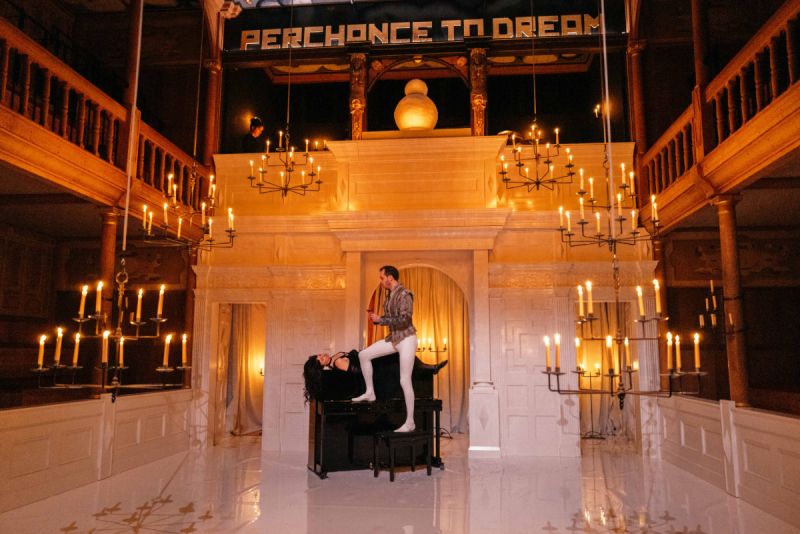
We open on Puck playing power games, slowly eating a banana in the kind of bleak, bright white palace beloved of those who dream of a thousand year Reich rooted in a classical Eurocentric culture. There are no sylvan scenes, no forests in which fairies may frolic, no messy, mulchy verdant nature, just its scrubbing away to a hard, artificial whiteness.
Puck, in clownface, has the malevolence dialled up and the playfulness dialled back and we’ll just have to wait until he’s quite ready, thank you very much. Like Cabaret’s Emcee, he is a messenger from a cynical world about to stamp down on innocents, eventually to incorporate them as fellow travellers in a murderous fascistic patriarchy.
So this is decidedly not the play you studied at school, nor the one you saw in an Am-Dram production on a balmy evening outside the church hall, sipping a gin and tonic, sat in a deckchair. The text is chopped up shamelessly, borrowing lines from Romeo and Juliet, the donkey has no ears and Helena and Hermia are the same height, rather cutting the ground away from the “little but fierce” crowdpleasing catfight. Some will cavil at such liberties but, in a time of bad kings making the weather with impunity, helped by their pet shadowy oligarchs, this chilling ruthlessness in the play's creation mirrors the production’s chilling message about power’s tendency to corrupt.
That startling denouement is still a couple of hours off when a blazingly angry Egeus demands that his daughter, Hermia, marry Demetrius, his chosen one, and not Lysander, her choice, on pain of death. Duke Theseus, in a Ruritanian military uniform bedecked with medals and brandishing a (Chekhovian) pistol, is to be married too, his bride a frightened Hippolyta, whose disgust at this schoolboyishly violent regime never leaves her face, until it twists finally into horror.
Escape, literally and metaphorically, is offered to us as Hermia and Lysander, fur coats against the cold, head out of Athens and are followed by Demetrius and Helena. Bewitched confusion at the hands of Puck and his herbal eyedrops eventually does its thing and couples (sorta) work out.
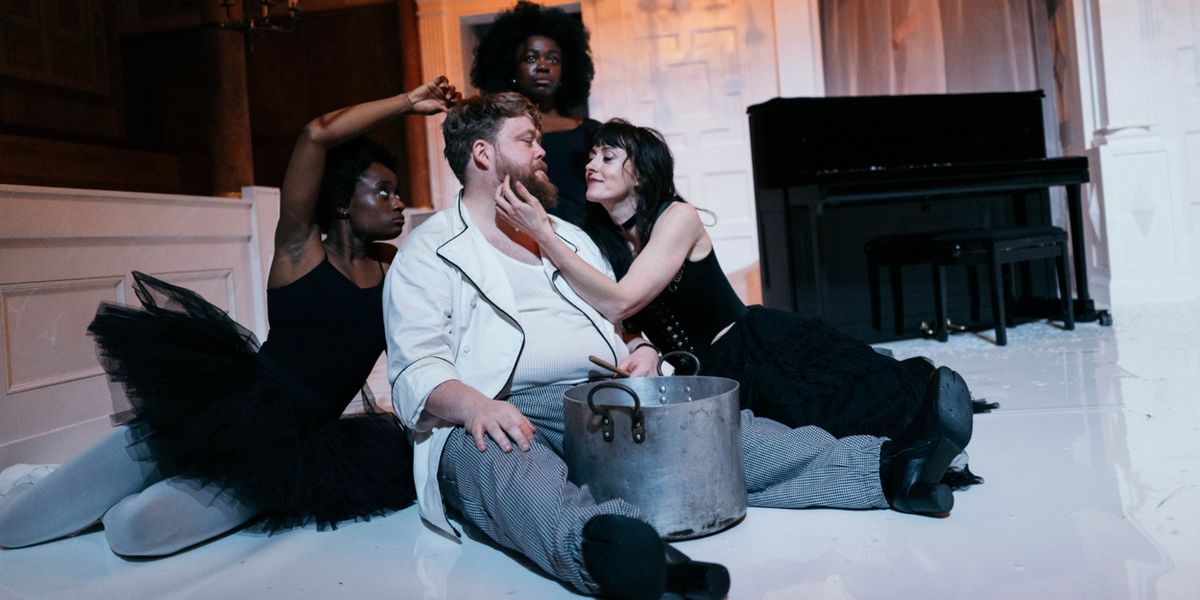
Also seeking solace beyond the city walls are the catering staff, whose carefully set table and suckling pig had been flung to the floor by Theseus in a tantrum. Nick Bottom is the executive chef, a little of the Colombian marching powder fuelling his bravado in suggesting to play so many parts in Peter Quince's, the maître d'’s, execrable play. But Bottom knows Pyramus and Thisbe is rubbish, knows his masters are bastards and that his laughter is very much in the dark. There’s a melancholy that clings to him.
In the fairyworld, Oberon (Michael Marcus) and Titania (Hedydd Dylan, both pictured above) squabble over the Indian child she loves and he desires, but this feels like a proxy for deeper discontent between them. When Titania wakes and realises her error in falling for Bottom, transformed into a donkey, she is less angry and dismissive and more compassionate towards the man-beast, having felt something akin to love from him, something we suspect that she has not felt in years from the haughty Oberon.
As the lovers, Tiwa Lade, Tara Tijani, David Olaniregun and Lou Jackson deliver all the dashings about and misapprehensions, but the chemistry (they’re risking their lives for love after all) never really flares. Once sat at the wedding feast's top table , their co-opted cruelty is demonstrated with an icy understatement.
Danny Kirrane lends a likeable quality to Bottom, not as a result of his usual puppyish enthusiasm, but from his stoical acceptance of his lot in the social hierarchy and his commitment to getting the job done. It’s hard to begrudge him his wild night of passion with Titania once he realises that she believes what she says, albeit under the spell of Puck’s potion for the eyes.
It is Sergo Vares’s sprite who tops and tails the evening, possessing not just his magical herbs, but a supernatural power to freeze the mortal world as his fancy takes him. Amoral and detached, he helps and hinders on a whim, in service to Oberon but highly autonomous, seldom with a smile, more with a social media troll’s perverse pleasure in sowing instability.
Not all of it works - you can’t throw so much stuff at the fourth wall and expect everything to stick - and sometimes you long for the directors to step back for a moment and just let the words breathe. But it’s February not June, we’re across the road from a multistory carpark not a leafy glade and things, after a change of government fast receding in the rear view mirror, do not seem to be only getting better.
Perhaps it’s not The Midsummer Night’s Dream we want, but it may be the one we deserve.
A Midsummer Night's Dream runs at Leeds Playhouse until 28 February and is then on tour





Reader Reviews
To post a comment, you must register and login.