


Review: CHILD-ISH at Tarragon Theatre
Verbatim play puts kids' words in adult mouths
If you watch anything on broadcast television these days, you’ll be bombarded with a set of ads for gummy bears featuring adults talking like children as soon as they think about the candy. Hockey players and businesspeople all speak in the strangely cloying voices of children, talking about what tastes “more gooder” to them.
But what if the adults spoke in their normal tones, just with the words of children? And what if the words of children weren’t just about candy, but about the huge topics affecting their futures: love, racism, work, the environment, mental health?
But also, candy? And unicorns?
That’s the premise of Sunny Drake and The Childish Collective’s CHILD-ISH, a verbatim play now at Tarragon Theatre that uses hundreds of hours of interviews with children and coalesces them into a 65-minute meta-performance that also explains the process of collecting and shaping the thoughts as a cohesive experience.
Under Andrea Donaldson’s direction, the adult actors speak the words of the children, and let the words shape their performances, but they’re not pretending to be children or affecting children’s voices. It’s child…ish. It’s also a fascinating window into how children think, and how their childhoods are in some ways very similar and in others completely different from their parents’ and grandparents’.
Are the kids all right? It’s hard to say, but it’s easy to leave the show with hope for the future, and an appreciation of intergenerational artistic collaboration.
Throughout the piece, project deviser Drake explains his goals; similar to how the children’s voices are translated, he’s played by Asher Rose with Drake’s Australian idioms but not his accent. The aim of the show evolved as its reach extended, the series of adult-led interviews turning into giving children agency to interview each other, to bringing children in to react to drafts of the script, and then inviting Young Collaborators to become active participants in dramaturging the work.
As children became more and more involved, their interest increased and their contributions deepened; however, most seemed excited just to have their opinions asked—and at the thought that those opinions would be spoken by adults, so maybe other adults would actually listen to what they have to say.
Hearing children’s language and speech patterns delivered with playful dignity by adults has the effect of recontextualizing and highlighting the statements. Even the opening land acknowledgment is filtered through children, who seriously state what they know about the land and its earliest caretakers.
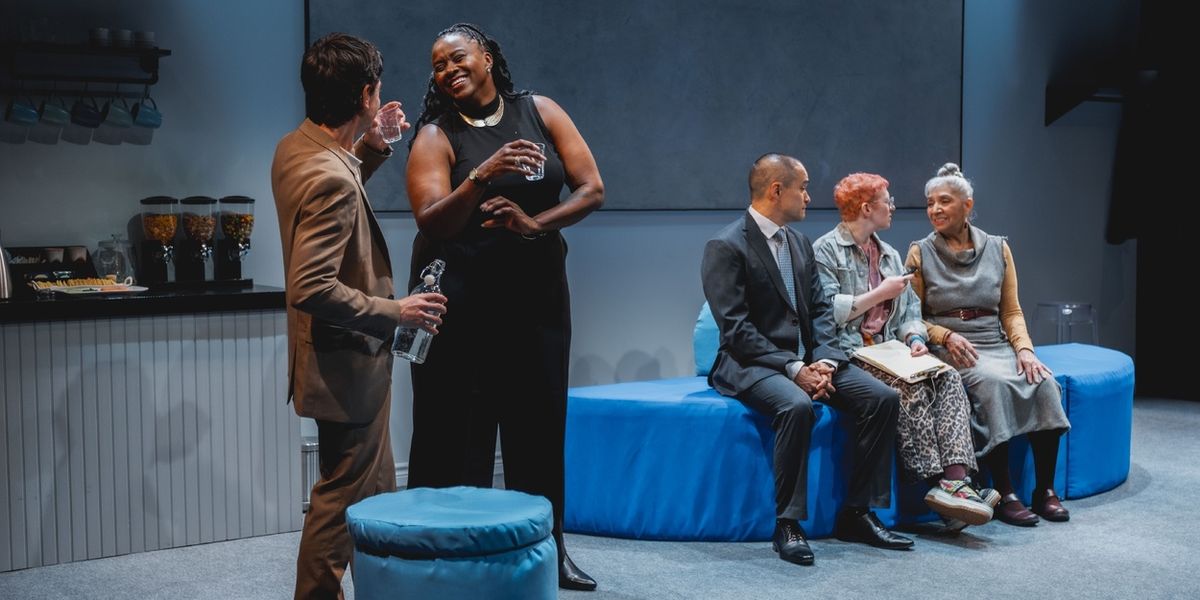
The child-portraying ensemble of Karl Ang, Janelle Cooper, Monique Mojica, and Jordan Pettle seems to have as much fun getting to say the outlandish things kids said as the kids had fun saying the darndest things for adults to voice. Ang takes particular glee in “bad boy” moments, as when he tells the indignant Cooper and Mojica that sexism is a good thing; Pettle contrasts the eyes of a middle-aged accountant with the grin of a six-year-old. They lounge on Amanda Wong’s office breakroom set of soft, moveable furniture and kitchenette with tempting snack dispensers, an environment that sets these childish words squarely in an adult realm.
Meanwhile, Laura Warren’s projections highlight the sections’ topics, occasionally underscoring an important idea by displaying a relevant word or funky image.
It’s intriguing seeing what children are learning from the people and media in their lives and how they’re processing these thoughts. Their ideas about the definitions and impacts of racism and sexism are naturally reductive, but hearing them out of the mouths of these distinguished actors, one realizes that they’re often no more reductive than what you see on social media from putative adults, reminding us that often our concepts of right and wrong and justice are rooted in the experiences we have in childhood.
As much as some people want to protect kids from these big, scary ideas, the play shows the reality is that children are living in a world steeped with the effects of them, and some have already been through a lot of loss. A touching section features a child who came to Canada as a Syrian refugee. He doesn’t talk about the larger issues of global conflict, but he does know things were bad for his family due to the war. His loneliness is palpable as he talks about not having many real friends in a cold country.
This generation experiences anxiety at a nearly unprecedented rate, worrying about the future we’re leaving them. A scene where the kidults beg the audience to stop destroying the environment hits hard; one where they ask with similar fervour for adults to put down their phones and pay attention to their families seems to put the lie to the notion that technology addiction is the purview of youth.
The only difference is that, for the most part, the kids see options that previous generations may not have. This is particularly obvious in the section on love, romance, and sexual and gender identity, all of which are seen as fluid in a kind of matter-of-fact way. They don’t necessarily know what love is yet, but they know they want it someday in some form; the only issue is that there’s a limit to how many people you can marry in the schoolyard, which seems to be about three.
There’s an overall sense of optimism and resilience, and to that end, there’s always time for a unicorn dance party (and a bit of low-stakes audience participation that doesn’t single anyone out). These moments of simple joy also distinguish the production, which in its last moments fully reminds us of who we’re watching this for.
The magic of CHILD-ish is that it treats its subjects with dignity; not with reverence, but not with dismissal either, just as people. We’re laughing with the kids rather than at them, or, if we laugh at an outlandish statement, it’s a gentle laughter that reminds us of our own childhoods, recent or…less recent.
Maybe, CHILD-ish says, children will finally be seen if they’re heard.
Photo of Jordan Pettle, Janelle Cooper, Karl Ang, Asher Rose and Monique Mojica by Jae Yang

|
HYPROV: The Hypnosis & Improv Comedy Experience – Live in Ottawa NATIONAL ARTS CENTRE - SOUTHAM HALL (11/12-11/12) |

|
The Hobbit Stratford Festival (4/21-10/23) PHOTOS |
|
Jane Austen's Northanger Abbey Guild Festival Theatre (8/06-8/23) |
|
NORDIC GLORY Meridian Arts Centre (5/15-5/15) |

|
Not Dead Yet! - John Cleese and the Holy Grail at 50 The Elgin & Winter Garden Theatres (10/02-10/02) |
|
her. Red Sandcastle Theatre (9/01-9/06) |

|
The Roll Players Comedy Bar Danforth (6/30-12/29) |

|
Ed Sheeran, Myles Smith & Lukas Graham at Rogers Centre Rogers Centre (9/20-8/22) |

|
SYMPHONY UNDER THE STARS Collingwood Music Festival (7/11-7/11) |
|
Mean Girls Oakville Centre for the Performing Arts (9/24-9/27) |
Reader Reviews
To post a comment, you must register and login.