


Review: THE WANDERERS at New Jewish Theatre is a Bittersweet Look at Fracturing Marriages
What did our critic think?
Anna Ziegler’s drama The Wanderers follows the marriages of two Jewish couples. Schmuli and Esther reside in the Williamsburg area of Brooklyn. The Hasidic Jews live according to strict Jewish law as members of the Satmar sect. The second couple, Abe and Sophie, live a secular lifestyle far removed from the traditions of Judaism. These couples, who seem to have little in common, are connected by more than just their faith.
Outside influences challenge both couple’s commitments to one another. The arranged marriages are complicated, deeply troubled, and messy. Schmuli, Esther, Abe, and Sophie struggle with societal pressures and an intrinsic sense of duty to their parents and their faith while balancing their individual wants for happiness.
Esther’s only friend, who has been ostracized by the Satmar community, introduces Esther to secular ideas. She awakens her friend’s buried independence. Schmuli’s devout and unquestioning commitment to his faith makes him fearful that Esther’s newfound wants will bring shame on their household.
Abe and Sophie’s relationship is strained from the outset. Communication has completely broken down and their attempt at finding love has failed them. Duty to honor their mothers, their devotion to their children, and their common careers as writers have kept their marriage from crumbling. Abe’s greater literary success fuels the competitive Sophie’s resentment, and his recent online attachment to a stunning actress named Julia has widened the chasm in their relationship.
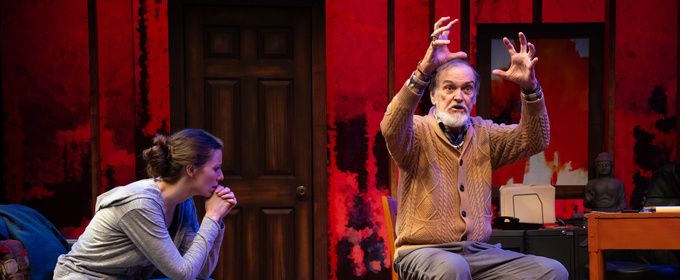
Director Robert Quinlan has staged a thought-provoking and intriguing production of The Wanderers at New Jewish Theatre. His evocative direction creates emotional bonds that are tested by simmering tensions in brokered marriages. Quinlan and scenic designer Reiko Huffman’s choice to use traverse staging serves as a metaphor for the widening gaps in the fracturing relationships.
Bryce M. Miller and Jade Cash are charming as the young Schmuli and Esther. They exude virginal naivete and blushing awkwardness on their wedding night. Their unworldliness and innocence turns to conflict as they mature alongside one another. Miller and Cash’s portrayals capture the turmoil stemming from the religious dilemma they face when Esther’s desires go beyond what their faith allows. Their revelatory melancholic performances are steeped with depth, authentic emotion, and explosive expression.
Miller and Cash exhibited commendable composure during a missed lighting cue. They continued the scene in the darkness for the short duration. Both experienced actors exhibited outstanding professionalism.
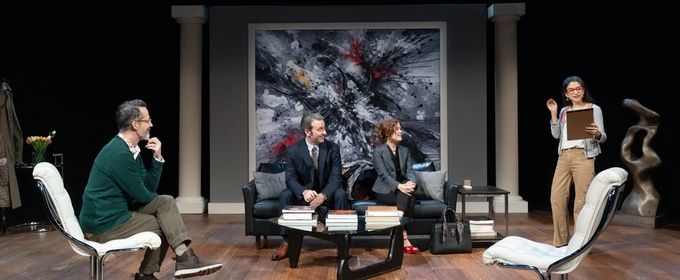
Joel Moses, Wendy Renée Greenwood, and Maggie Wininger make up the love triangle of Abe, Sophie, and Julia. Moses and Greenwood exhibit strong emotional disconnectedness as a settled but unhappily married couple. Both are equally complicit in the failing relationship, but Moses’ portrayal of Abe’s palpable attachment to Julia destroys any potential for reconciliation.
Moses and Wininger’s online flirt smolders as the two actors’ mutual attraction turns to combustible sexual chemistry. Moses’ Abe is entranced and obsessively infatuated with the beautiful actress. Their intimate virtual exchanges are heightened by the physicality in Quinlan’s blocking, Jason Lawshee’s lighting design, and Amanda Werre’s sound design. Quinlan, Lawshee, and Werre transport the audience into the virtual space that houses Abe and Julia’s emotional affair.
Costume Designer Michelle Friedman Siler provides visually illustrative differences between the strict orthodox and secular couples. Abe’s traditional masculine orthodox attire and Esther’s modest wedding gown, long skirts, and thick nylons are juxtaposed by Abe and Sophie’s casual and modern street clothing. As a designer, Siler’s keen eye for detail consistently enhances the narrative.
The performances in The Wanderers are first rate, but it is Quinlan’s expertly crafted, immersive, and precise storytelling that ensnares the audience. Ziegler’s nonlinear bittersweet script is laced with humor and several unexpected turns. The conclusion may be a bit overwrought, but Quinlan’s vision, direction, and staging overcomes the too full ending.
The Wanderer continues at New Jewish Theater through September 28, 2025. Click the link below to purchase tickets. More information can be found on the New Jewish Theatre’s website
PHOTO CREDIT: Jon Gitchoff

|
Guys And Dolls Kirkwood Pac (7/24-8/23) |

|
JOB New Jewish Theatre (NJT) (8/06-8/23) |
|
Wicked Fox Theatre (5/12-5/30) |
|
Ballet Hispánico New York Touhill Performing Arts Center (11/14-11/14) |
|
The Book of Mormon (Non-Equity) The Fabulous Fox Theatre (2/02-2/07) |
|
Rob Zombie & Marilyn Manson Morton Amphitheater (9/10-9/10) |
|
Parsons Dance Touhill Performing Arts Center (4/10-4/10) |
|
Ludo The Pageant (10/24-10/24) |

|
REMI GOODE, ABIGAYLE OAKLEY, AND THE SHANDIE Kirkwood Performing Arts Center (8/14-8/14) |

|
The Big Bad Business of Murder Robert G. Reim Theatre (8/20-8/23) |
Reader Reviews
To post a comment, you must register and login.