


Review: ELSINORE is a Hamlet Prequel filled with Envy and Bloodlust
 Click for Tickets
From the creative minds of playwrights David Nonemaker and Eric Satterfield comes Elsinore. Staged by the up-and-coming theater company Chorus of Fools, Elsinore is a prequel to Hamlet that envisions the events leading up to the murder of Hamlet’s father by his Uncle Claudius.
Originally produced in 2021 by Prison Performing Arts, Elsinore is getting a streamlined staging at The Greenfinch Theater and Dive Bar through October 19, 2025. Playwright David Nonemaker said, “We’ve streamlined and tightened the narrative a bit to improve our storytelling.”
Nonemaker and Satterfield have enjoyed quick successes as playwrights. One of their early works, The Privilege of Being Second, an edgy story with an unexpected twist notched them a St. Louis Theater Circle Award nomination for Best New Play. Satterfield, working alone and with other playwrights, has written multiple new plays that received impressive stagings this season, including Heavy (with Hazel McIntire) and The Bigfoot Diaries.
In recently staged local productions of Hamlet, the Prince of Denmark has been portrayed either as completely mad or more connivingly vengeful. Nonemaker and Satterfield’s script imagines the prince as the latter, filled with ire driven by his uncle’s fratricide, ready to avenge for his father’s murder. The two playwrights speculate about Hamlet’s relationships with his stoic father and caring mother, his friendship and budding feelings for Ophelia, and his evolving relationship with his once beloved uncle.
Elsinore is set when Hamlet is a young teenager. The story opens with Hamlet seeking solace from the castle at his uncle’s estate. Hamlet looks to Claudius as a trusted relative, confidant, and mentor. The teenager finds his Aunt and Uncle’s home a safe place of refuge to escape his controlling father’s overbearing parenting.
While their script is not written in The Bard’s Early English or Iambic Pentameter, Satterfield and Nonemaker’s dialogue is formal enough to sound a bit Shakespearean. Their chosen vernacular adds to the plausibility of their narrative and the believability of the borrowed characters. Creative adaptations based on Shakespeare’s plays can vary from entertaining to muddled confusing messes. Nonemaker and Satterfield’s Elsinore is the former, a well written, imaginative, and entertaining three acts.
Satterfield directed and is credited with set and sound design. His brisk story telling benefits from his and Vickie Delmas’ static set with a handful of moveable set pieces to move the action between varied locations. There is minimal downtime in blackouts between scenes. It keeps the dialogue heavy play moving thanks to the cast’s work moving set pieces expediently.
Elsinore features engaging performances from the wide-eyed Andre Eslamian as the youthful handsome prince, Joe Garner as the murderous Claudius, John Wolbers as the stoic King, and Hannah Geisz as the lovely and winsome Ophelia.
Eslamian and Garner are magnetic as the protagonist and antagonist with evolving relationships. Their well-written character arcs allow the two skilled actors to show varied emotions ranging from love and admiration to angst and rage. Each deliver Nonemaker and Satterfield’s Shakespearean-like soliloquies with expressive believability. Eslamian’s yearning for Ophelia and his rage for his uncle’s crime is palpable, as is Garner’s desperation, envy, and bloodlust.
Geisz charms as the younger Ophelia. Her likeable characterization and naivete was a perfect match for Eslamian’s smitten Hamlet. Their enchanting scene work bubbled with infatuation that bordered on smoldering. Their charisma, infatuation, and desire were steeped in sincerity.
Wolbers’ tough-minded King conveyed strong decisive leadership both as father and ruler. His King was a strict father-figure and an authoritative leader with a volcanic temper. Wolbers’ portrayal expressed sovereign and dominant control, even when rejecting the romantic advances of his wife Gertrude (Jocelyn Padilla.) His resolute authority was never in question despite the defiance of his son and brother.
Xander Huber and Zach Pierson give broadly comedic performances as Hamlet’s jovial friends Rosencrantz and Guildenstern. Both clown in a buffoon-like manner with silly physicality. Huber and Pierson’s work is good; however they are more outrageously bumbling, clumsy, and inept in Elsinore than in Hamlet. It was a narrative choice that made Rosencrantz and Guildenstern feel too farcical and less authentic than the other characters.
Elsinore is a bit of a coming-of-age tragedy peppered with romance, envy, and bloodlust, setting the stage for the beginning of Hamlet. It written with formal vernacular to enhance the story’s credibility. Nonemaker and Satterfield’s storytelling relies on many Shakespearean conventions including the use of soliloquies and asides, ghostly visits, a mix of comedy and tragedy, conflict, and one murder most foul. The one thing that is missing is a resolution. Elsinore is a bit like episodic television. It ends with a cliffhanger, but audiences already know the rest of the story.
Elsinore, presented by Chorus of Fools, continues at the Greenfinch Theater and Dive Bar through October 19, 2025. Visit chorusoffools.org for more information or to purchase tickets.
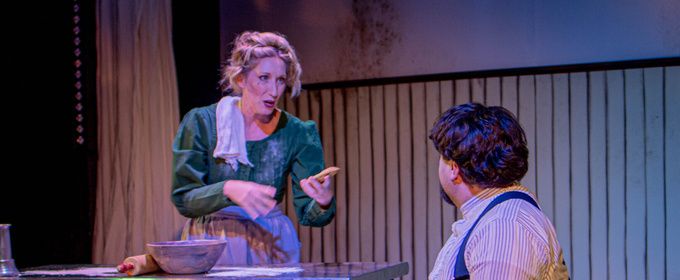

|
Guys And Dolls Kirkwood Pac (7/24-8/23) |

|
JOB New Jewish Theatre (NJT) (8/06-8/23) |
|
Guns N’ Roses at Busch Stadium Busch Stadium (8/16-8/16) |

|
The Great American Trailer Park Musical Rehab Bar & Grill (8/19-8/26) |

|
AMY SPEACE & BETH BOMBARA: WOMEN OF AMERICANA Kirkwood Performing Arts Center (KPAC) (8/15-8/15) |
|
Wicked Fox Theatre (5/12-5/30) |

|
Ludo The Pageant (10/24-10/24) |

|
Ballet Hispánico New York Touhill Performing Arts Center (11/14-11/14) |

|
REMI GOODE, ABIGAYLE OAKLEY, AND THE SHANDIE Kirkwood Performing Arts Center (8/14-8/14) |

|
Gateway Dirt Nationals – 3 Day Pass The Dome at America's Center (12/03-12/05) |
Reader Reviews
To post a comment, you must register and login.