Reviews by Steven Suskin

School Girls; Or, The African Mean Girls Play: Jasmine Amy Rogers and Denée Benton Battle It Out
It has become customary for Broadway nonprofits to spotlight important non-Broadway offerings from prior seasons, affording the plays and their authors the opportunity to reach a considerably wider audience. Most recently, Manhattan Theatre Club gave us Jonathan Spector’s Eureka Day, a most provocative comedy from 2019. By entrusting it to an incisive director (Anna D. Shapiro) and assembling a top-tier cast, the relatively obscure play from a relatively unknown playwright proved a highlight of the season. MTC—now headed by artistic director Nicki Hunter and executive director Chris Jennings, following the lead of the long-serving Lynne Meadow and Barry Grove—has handily accomplished the same lofty achievement, and similarly excellent results, with Jocelyn Bioh’s School Girls.
Dad Don’t Read This: 16 Going On Angst
You’ll likely leave Barrow Street impressed by what you’ve seen and surely by the performers. But maybe with only a hazy understanding of what the playwright intended (which was certainly not the case with the more fully realized Wolves, Dance Nation, and John Proctor). That said, Dad Don’t Read This is highly entertaining and Smith impresses as a playwright ready to break through.

Dad Don’t Read This: 16 Going On Angst
Director Chloe Claudel harnesses the energy, makes good use of her hard-working cast, and provides some interesting moments including the movement and dance sections (with choreography by Lena Engelstein) and some fine visuals including scenes placed against the upstage wall of lights (with lighting design by Abigail Sage and Finn Bamber). You might also note that director Claudel is listed as the sole understudy for the entire cast, which is something I’ve not seen before.
Well, I’ll Let You Go: Coping with Grief, Magnificently
Unspeakable tragedy—of a sort unimaginable only a few years ago, but now almost predictably commonplace—is at the center of Well, I’ll Let You Go. Playwright Bubba Weiler concentrates not on the horror of the event, but on the struggle to piece together the how and the why. Combine a keenly wrought puzzle of a play, masterfully understated direction by Jack Serio, and an astonishing performance by Quincy Tyler Bernstine, and you have a remarkable evening at Studio Seaview.
Well, I’ll Let You Go: Coping with Grief, Magnificently
Unspeakable tragedy—of a sort unimaginable only a few years ago, but now almost predictably commonplace—is at the center of Well, I’ll Let You Go. Playwright Bubba Weiler concentrates not on the horror of the event, but on the struggle to piece together the how and the why. Combine a keenly wrought puzzle of a play, masterfully understated direction by Jack Serio, and an astonishing performance by Quincy Tyler Bernstine, and you have a remarkable evening at Studio Seaview.
Proof: 25-year-old Pulitzer Winner Proves to Be Even Better Than Before
The play parades as a drama about math, mathematicians, and elusive formulas that can shake up the world—the academic world, at least—if only some brilliant mind can find the key. In truth, though, the play centers on those key words: the “brilliant mind” and what happens when the once-brilliant mind is pushed into oblivion. In 2000, it was a question of the great thinker losing his mind. What makes this new production at the Booth even more powerful than before is today’s audience—that is, our collective knowledge and experience with depression, dementia, and despair. This was always there in the text, yes, but it now comes across with added urgency and personal relevance. The majority of today’s audience, of course, will be seeing Proof for the first time. For them, the experience will be that of attending a vibrant and provocative new play.
Every Brilliant Thing: A Lustrous Evening with Daniel Radcliffe
Radcliffe, who has demonstrated increasing power as an actor since his inescapable cinema origins, is so perfect in the role—and so suited to the play—that a spectator might think Every Brilliant Thing built for and molded upon him. Not so. The play began on a small scale, at the Edinburgh Festival in 2013, fashioned by Macmillan around Donahoe, a comedian. The play has since traveled the world, including, notably, a 2014 stint at off-Broadway’s Barrow Street Theatre and an HBO version (both starring Donahoe) as well as a 2025 production at London’s intimate Soho Place with a handful of actors playing short stints in the role (namely Donahoe, Lenny Henry, Ambika Mod, Sue Perkins, and Minnie Driver). So Every Brilliant Thing is not, by any stretch of the imagination, a custom-built vehicle for Radcliffe. That said, his participation has propelled this small play into the Broadway spotlight. Does it work, in a three-tier 1,000-seat proscenium house? Spectacularly so.
Chinese Republicans: Clever, Venom-Tipped Arrows, Ineffectively Aimed
Lin demonstrates that she is a talented writer, whipping up plot and characters into a series of frenzies. It all adds up to an entertaining comedy, with sparks of laughter and even a nightmarish Mandarin gameshow. What it doesn’t add up to, alas, is a compelling piece of theatre. The playwright aims arrows in many directions: the glass ceiling, sexual abuse, loveless marriage, the sacrifice of children for career, immigrant battering, intra-racial badgering (as in which Chinese characters are really Chinese and which aren’t Chinese enough), and more. Harvey Weinstein even makes a cameo, surprisingly but—in the context of the play—inevitably.
Chinese Republicans: Clever, Venom-Tipped Arrows, Ineffectively Aimed
The playwright’s most promising comedic idea doesn’t pan out, either. Specifically, the notion presented by the title, Chinese Republicans. Sounds intriguing, no? But no. One of those scattered plot lines has a disgruntled employee quitting, discovering the works of Marx and Engels, lauding Teddy Roosevelt, and going on strike wearing a Ronald Reagan t-shirt. And then Lin and her characters and her play move on to something else.
Amahl and the Night Visitors: Grand Opera, Grandly Done
Lincoln Center Theater’s Amahl and the Night Visitors might not be just the thing for all audiences: it is a bona fide opera (written and performed in English) with religious subject matter, running under 50 minutes. But good theater is good theater, I say, and Lincoln Center’s production of Menotti’s Amahl is good theater.

Tartuffe: Sparkling Wine, Without the Sparkle
But Hnath’s new Tartuffe is, to use an archaic term, a dud. “A razor-sharp reinvention of Molière’s iconoclastic comedy in a mad-dash production full of ferocious wit, outrageous design, and downright buffoonery” promises the promotional material. Not nearly. What we get, peppered by infrequent flashes of high humor, is sparkling wine sans sparkle.
Tartuffe: Sparkling Wine, Without the Sparkle
But Hnath’s new Tartuffe is, to use an archaic term, a dud. “A razor-sharp reinvention of Molière’s iconoclastic comedy in a mad-dash production full of ferocious wit, outrageous design, and downright buffoonery” promises the promotional material. Not nearly. What we get, peppered by infrequent flashes of high humor, is sparkling wine sans sparkle.
Rob Lake Magic: Shattered Illusions
The one illusion Lake misses out on, at the Broadhurst, is the illusion that his entertainment—even with the Playbill billing page proclaiming “special guests The Muppets”—is anything other than an over-rehearsed and over-polished touring Vegas show.
Rob Lake Magic: Shattered Illusions
The one illusion Lake misses out on, at the Broadhurst, is the illusion that his entertainment—even with the Playbill billing page proclaiming “special guests The Muppets”—is anything other than an over-rehearsed and over-polished touring Vegas show.
The Baker’s Wife: Fabled Flop Charms in Amiable Revival
Now that Stephen Schwartz’s latest opus is out of the way—The Queen of Versailles opened Sunday night, to a decidedly mixed reaction—here comes a new production of his half-century-old flop, The Baker’s Wife. Consider the latter without the undertow of its notoriety (as delineated below). What we find at Classic Stage Company is a charming, small-scale affair perfectly suited to chamber-musical size, given a radiant sheen by a team of over-qualified performers who compensate for the patchy material. Considered without all its history, though—and without the ticket-selling potential given the involvement of the composer of Wicked (in league, incidentally, with the bookwriter of Fiddler on the Roof)—it is unlikely that anyone would bother to resuscitate the underbaked Baker’s Wife.
Twelfth Night: Moonlit Enchantment As Shakespeare Returns to the Park
The disparate elements come together, more or less, combining for a wholly satisfying evening. Albeit one with little of the exuberance that has marked various Shakespeare in the Park outings going back to the 1971 rock musical rethinking of Two Gentlemen of Verona and the glorious Civil War-era Much Ado About Nothing as well as the more recent Comedy of Errors and As You Like It. Even so, this Twelfth Night does a satisfactory job of leaving the audience beaming, and that, after all, ’tis a consummation devoutly to be wished.
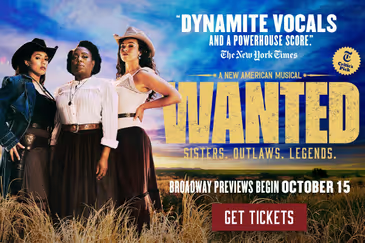
Dead Outlaw: Rip-Roarin’ Musical Hits the Bull’s-Eye
The cast of eight—all but one of whom fill multiple roles—remains stellar. Andrew Durand (of Shucked, War Horse, Yank!, and other entertainments) heads the cast as the titular desperado, and it is quite a performance. Behind that mostly ever-present scowl lie sweetness, violence, and a burlesque-type vulgarity. The demands of the plot call for him to spend almost half the 100-minute running time playing dead; not sitting immobilized in the shadows like Floyd Collins, that other historical lad presently on Broadway, but standing—dead—in a harsh spotlight’s glare. Durand manages to remain thoroughly and expressively immobile, except when he isn’t.
Sondheim’s Old Friends: Musical Cornucopia Makes an Overstuffed Banquet
“Sondheim’s Old Friends, the new revue at Manhattan Theatre Club’s Friedman Theatre, offers wonderful numbers well performed by talented performers. But to quote Charley Kringas, in act two of Merrily We Roll Along: ‘true greatness is knowing when to get off.’”
The Last Five Years: Stuck on the Seesaw
Director Whitney White—who has done notable work of late in both Jaja’s African Hair Braiding and Liberation—sees fit to disrupt Brown’s cannily crafted plan. (Brown seems to have permitted this, as he has been on hand contributing modernized alterations to some lyrics.) With the two characters frequently interacting through the 15-song evening, a first-time viewer might not glean that while Jamie ends the evening five years older and five years sadder, Cathy is just embarking on what will hopefully be—as Jamie earlier puts it—the next 10 minutes, and then another 10 minutes, and then the next 10 lifetimes. An enigmatic song list, hastily inserted into the Playbill during the final previews, doesn’t help.
Love Life: Lost Lerner/Weill Musical Demonstrates Why It Was Lost
But Love Life is not one of those lost gems; were it not for the participation of composer Weill, the show likely would have disappeared along with other flops of the time. Sleepy Hollow, anyone? Which is not to say that there aren’t some elements on hand that work. Baldwin and Mitchell, both, are consummate actor/singers. Just about every one of their songs lands exceptionally well. Child actors Jordan and Guzman, who appear to have more than twice as much to do in this version as their counterparts in 1948, are both delightful. Singer John Edwards—who walks on stage from out of nowhere, story-wise—makes a strong case for one of the two stunning songs in the show, “Love Song.” (The other number that deserves high ranking in Weill’s catalog is the exquisite “Here I’ll Stay.”) And there’s the Encores! Orchestra, with longtime music director Rob Berman returning for the occasion. Berman has a keen understanding of the score, and the players know just how to play it. But Love Life, the musical, simply isn’t very good.
We Had a World: ‘Virginia Woolf, Part 2,’ With Jokes
Playwright Harmon himself seems to inhabit the character Josh, pulling strings and shifting time not only from scene to scene and exchange to exchange but sometimes within the words of a sentence. The sense of where and when and what, though, remains clear from moment to moment. The cast is abetted in this by the unseen hand of director Trip Cullman (who also guided Choir Boy and Harmon’s Significant Other). We Had a World proceeds without a forced moment, without a time lag, without a moment where attention starts to lap.
DEEP BLUE SOUND: A QUIET, GENTLE, WHALE OF A PLAY
To the credit of the author—and to director Arin Arbus and the entire cast—each of these characters come across as warmly human, flaws and all. Is Ella the primary character of the play? Or is it just that the always-astonishing Maryann Plunkett is playing the role, and when Maryann Plunkett speaks—or even sits alone in the light, clearly thinking but unable to express the words—you can’t help but be riveted.
Grangeville: Art, Anguish, and Wonder from Samuel D. Hunter
Arnold is firmly in control of the play, the situation, and his emotions; until, suddenly, he isn’t. Actor Brian J. Smith—who might be remembered for his Tony-nominated role of the Gentleman Caller in the Cherry Jones/Celia Keenan-Bolger production of The Glass Menagerie—offers a wonderfully shaded performance. Jerry, meanwhile, calls for a wide range of character-shading. Paul Sparks is so true in the initial scenes—during which the author seems to have painted an intentionally stereotyped picture—that his performance becomes almost startingly impressive as the 90-minute play progresses.
Gypsy: Everything’s Coming Up Audra
Wolfe’s production captures the proper Gypsy flavor. No overwhelming Broadway-style scenery here; instead, we get sets by Santo Loquasto and costumes by Toni-Leslie James flavored with the faded dinginess of the final days of vaudeville. Jules Fisher and Peggy Eisenhauer, longtime collaborators of director Wolfe, provide the evocative lighting. Andy Einhorn is in the pit, leading a rousingly good 25-piece band through the ever-vibrant orchestrations by Sid Ramin and Robert Ginzler with updates, as required, from Daryl Waters of Shuffle Along. For those curious about such things, let us point out that the unfamiliar introduction to the song “Small World” (“Here I been, looking for a suitcase…”) is authentic: it was cut during the 1959 Philadelphia tryout, in conjunction with a scenery mishap. Not an overwhelmingly dynamic discovery, perhaps, but illustrative of how Styne and Sondheim took Rose and Herbie from dialogue to song. If there are minor lapses around the fringes of this production, no matter. First and foremost, this is Audra’s Gypsy. Audra is magnificent, everything’s coming up roses.
The Dead, 1904: James Joyce and The Living, 2024
A return production, in fact. The Dead, 1904—adapted by Paul Muldoon and Jean Hanff Korelitz from the Joyce short story, directed by Ciarán O’Reilly—originated as a site-specific production at the Historical Society back in 2016. A delightful divertissement, it was remounted in 2017 and 2018. Now, after a hiatus, it seems to have grown even more evocative. Or perhaps our perceptions of ghosts and the dead have changed since 2016. This two-hour trip through time, fueled by piano and violin, cider and stout, is a decided change of pace from a typical evening’s entertainment. Between the talents on display, the turn of the century (1900) ambience, and the hearty meal served communally to the 1904 and 2024 guests, The Dead is a distinctly unique evening’s entertainment.