


Review: SEAGULL Updates a Standard at Quantum Theatre
Quantum's world premiere runs through August 17
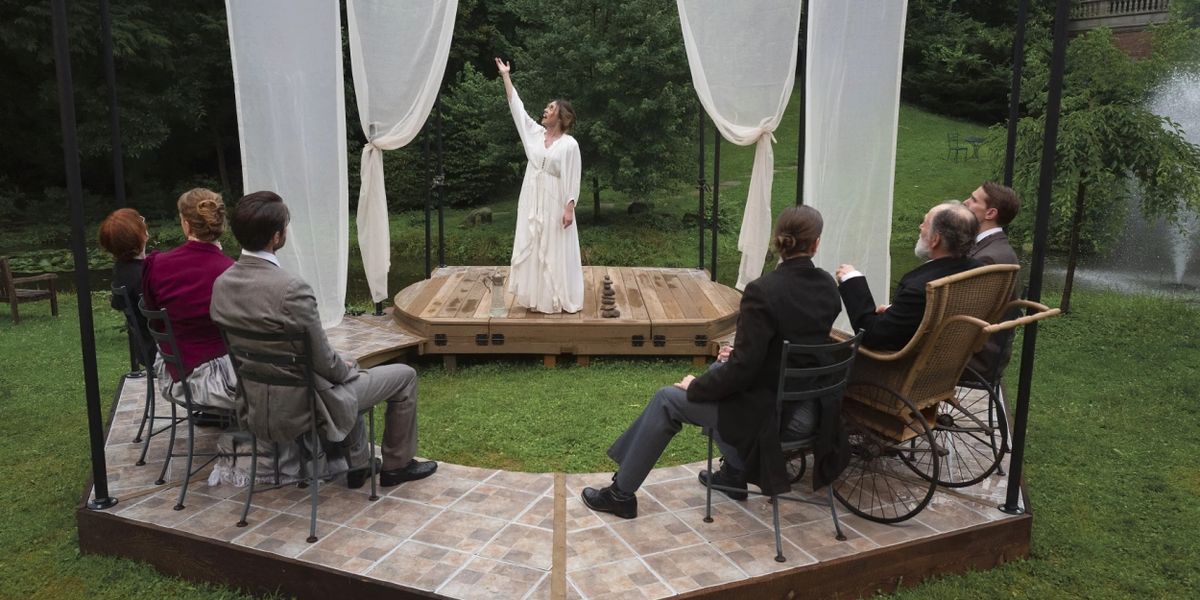
One of the biggest debates in the world of theatre is over the genre of Anton Chekhov's masterpiece of early modernism, The Seagull. It's been almost universally acknowledged as a tragedy... except by Chekhov himself, who intended it as a comedy. For nearly two hundred years directors and translators have staked their own claim on the show's tone, albeit typically leaning towards the script's serious (and occasionally self-serious) moments. Director/adapter Joanie Schultz has plotted a course for the middle of this great divide in her production, which a note in the program indicates is partially inspired by her own experience running a production company. In Schultz's vision, the tone is instantly recognizable as one of the twenty-first century's dominant creative voices, the prestige mumblecore dramedy. From the messy and almost unstructured realness to the arch, verbose wittiness, there are echoes of such modern classics as Girls and Succession in Schultz's dialogue here... or perhaps I should say these critically acclaimed dramedies merely have Chekhovian elements in their modern speech.
In a setting that is implicitly but not specifically late-ninteteenth-century Russia, a country estate belonging to the extended family of famed actress Irina Arkadina (Lisa Velten Smith) turns into an impromptu artists' retreat. The extended family, locals and visiting lovers begin to knit themselves into a series of overlapping love triangles and rivalries, all of which seem to feature or impact rootless struggling artist Constantine (Phoebe Lloyd). Tragedy descends in large and small ways across the entire community over the course of two years, leading to heartbreak, marriages happy and unhappy, and of course the famous "Chekhov's gun."
At the heart of all this artistic and romantic chaos is Constantine, played deftly by Phoebe Lloyd in an impactfully messy and earthy portrayal. Constantine is very much her own invention, a young woman whose bohemian leanings and relatively understanding mother allow her to live essentially "as a man," adopting male name, male dress and the freedom to love women. (I'm saying woman and using female pronouns here because these seem to be agreed upon in the script; though the script never explicitly says "butch lesbian" or "trans-masc," Constantine is at one point deadnamed, and the exact specifics of how the character identifies are intentionally vague.) Lloyd's portrayal of Constantine is deep and three-dimensional, but never so polished as to make Constantine seem to have her life together. Much like Hamlet, whose role runs parallel to Constantine's, Lloyd finds the intelligence within the chaos of this lost soul, making this complex and ahead-of-her-time figure feel totally believable within the world of this lightly eccentric community.
Brett Mack, seen as a damaged lover in A Moon for the Misbegotten last season, returns here as Trigorin, a middlebrow writer who becomes the lover of both Constantine's mother and her own lover, the actress Nina (Julia de Avilez Rocha). As de Avilez Rocha brings passionate and youthful intensity to her role, Mack brings a louche, detached boredom to his: this is a man with a little power and a lot of appetite, encountering someone he can casually chew up and spit out. They are perfect tragic foils for each other and for the less conventional Constantine, stuck in the middle of yet another tale as old as time. Constantine is avant-garde, a woman, queer; Trigorin is conventional, a man, straight. Only one of them has the privilege of doing whatever they want with impunity.
Surrounding the central love triangle is an ensemble of further interlinking connections. Lisa Velten Smith's Irina Arkadina is appealingly arch, with that old-world blue-blood poise meets bitchiness that has defined Christine Baranski's onscreen persona. Smith manages to be both immensely comedic and genuinely upsetting in her role as the grande dame turned sugar mama to Trigorin. Daniel Krell and Ken Bolden, as a sardonic doctor and a regretful older relative, contribute both wisdom and foolishness but with a great sympathy for the lovers. Finally, Maxine Coltin finds new depths in the secondary role of Masha, aided by Schultz's adaptation and direction. No longer merely a hopeless philosopher, Masha the alcoholic proto-goth is hopeless because she is in unrequited love with Constantine, but lacks the familial and cultural freedom to be queer in her working class environment. Coltin's dour humor in the role bounces well off Evan Vines's sweet but hapless portrayal of Medvedenko, a schoolteacher who is all too aware that his orientation is incompatible with Masha's but loves her anyway.
It wouldn't be a Quantum review without discussing the location, and scenic designer Chelsea Warren has done wonders staging the show on the pond at Chatham University. The dark-academia setting of the campus blends well with the natural beauty of the pond and greenery, all of which DOES conjure the feel of a quaint but not-so-rustic artists' retreat. Whether strolling and taking pictures before the show, or meeting and greeting after the ending, it was so easy to feel myself as an artist among the show's artists, part of the tapestry of love and creative idealism that has brought both happiness and misery to so many. Between the script, the cast, the director and the weather, it was an unforgettable night of feeling many, many things at once.

Sign up for all the news on the Fall season, discounts & more...

|
Hadestown Benedum Center for the Performing Arts (10/27-11/01) |

|
The Dinner Detective Pittsburgh True Crime Murder Mystery Show The Dinner Detective Pittsburgh (11/14-11/14) |

|
Cosmic Microwave Background New Hazlett Theater (11/19-11/20) |
|
In Clay City Theatre (9/19-10/11) |
|
Nunsense The Strand Theater (3/12-3/21) |

|
The Dinner Detective Murder Mystery Dinner Show The Dinner Detective Pittsburgh (10/31-10/31) |
|
Little Shop of Horrors Paragon Theatre (11/12-11/21) |
|
A Night at the Symphony Byham Theater (3/26-3/26) |

|
Refugee Rhapsody Pittsburgh International Classic Theatre (10/09-10/25) |
|
Othello of the End Zone, or The Steel City Tragedy New Hazlett Theater (10/22-10/25) |

Reader Reviews
To post a comment, you must register and login.