


Review: JESUS CHRIST SUPERSTAR Feels New Again at Pittsburgh Musical Theater
The production runs April 3-13 at the Byham.
Is Jesus the hero of Jesus Christ Superstar? It's a question people have debated for years, first spurred by lyricist Tim Rice quipping (possibly sarcastically) in the early seventies that Christ was the villain of the piece, not the hero. The brilliance of the piece is in its almost ambivalent reportage: we see one week in the titular messiah's life, with a just-the-facts approach that never editorializes per se. The characters are all a lot quippier and more inclined to wordplay than they are in the Bible, but there's basically nothing invented or made up from whole cloth. Unless you're the sort who can't stand to see Jesus depicted at all, it's hard to point to anything in the show that is "blasphemous" or wrong, even as the show refuses to state whether Jesus is the divine being he is hyped up to be. All this goes to say that in the last fifty-five years, the once-shocking rock opera has become commonplace, even cuddly; it's a favorite of the born-agains and the fedora-wearing atheists alike. It is even, occasionally, boring, hence the constant attempts to reinvent it. Some have worked better than others (go eat a gummy and watch Jesus Christ Superstar 2000, if you haven't seen it already), but the actor-muso production currently running at the Byham is a breath of fresh air.
Directed and choreographed by legendary Pittsburgh duo Danny Herman and Rocker Verastique with collaborator Lucas Fedele, and music directed by Francesca Tortorello, this Superstar shifts its attention away from narrative storytelling towards an immersive, music-based presentation. All the leads play musical instruments at a virtuosic level, and the supporting cast and ensemble are full of string, drum and brass instrumentalists augmenting the proggy five-piece pit orchestra. The storytelling here is somewhat more abstract than your typical Superstar, but that's no loss; it is, after all, a story everyone has heard already.
Anchoring the show is Brecken Newton Farrell as Jesus/guitar. Farrell has the chops to play a classic Superstar Jesus: his rock scream is savage and piercing when he brings it out. But it's to his credit how much he does NOT go where you expect the role to go, vocally and performance-wise. He eschews the Zeppelinesque vocal performances of Ian Gillan and the strutting rock-god physicality that often accompanies the role, playing Jesus as a man nearly broken not only by his mission but by the attention he receives and does not enjoy. Dressed in a baggy white t-shirt and jeans for most of the show, his shepherd's robe reconfigured as a baggy knit cardigan, this Jesus isn't John Lennon or Bob Dylan, he's clearly Kurt Cobain. (The lighting design by Forrest Trimble even echoes the shadowy funereal MTV Unplugged set during "Gethsemane.") His chemistry with Kamilah Lay, as Mary/violin, is similarly low-key, not setting off sexual sparks or romantic passion, but the appreciation of having the one person he doesn't have to be "on" around. Lay's presence is warm and gentle, and her violin playing is exquisite, especially her solo on "John 19:41 at the close of the show."
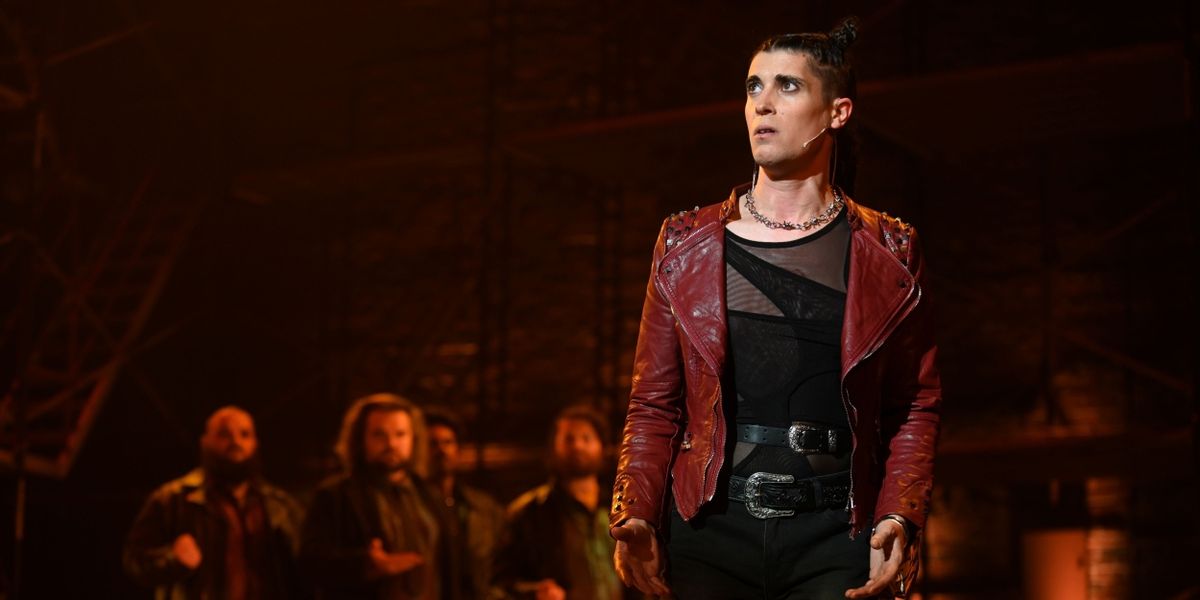
But if anyone is the show's raison d'etre, it's Treasure Treasure, in the role of Judas Iscariot. From the first moments onstage, shredding the Overture's guitar solo in an androgynous red leather suit straight out of Zoolander, Treasure sets a high bar for both performance chops and presence. Treasure's vocal range is wide, from a smooth contralto to an anguished tenor wail. She plays Judas as a man one could feel both pity for, and fear of, without contradiction. And then, there's the final two scenes (surely there aren't spoilers for a fifty year old play about a 2000 year old religion, right?) in which Treasure and her directors tear something new and confrontational out of the script. Having betrayed Jesus and seen him handed over to death, Judas has his famous breakdown ("My mind is in darkness now... Oh god, I am sick! I've been used, and YOU knew all the time!") Treasure speak-sings Judas's lines with a bitter mockery and a cold laugh, and the subtext is very plain: the all-too-common feeling among queer people that God "made them wrong" and left them no path to be their authentic selves in a world and a religion that seems to hate them. It's surely no coincidence that when Treasure appears as Judas's spirit for "Superstar" and the finale, Judas's costume has abandoned its androgyny and gone fully, affirmingly femme: only in death can he be what she truly is, especially for a song questioning identity and asking "are you what you say you are?"
The supporting roles are full of actors, singers and musicians with multiple talents: Million Dollar Quartet perennial Taylor Isaac Gray as King Herod/piano camps it up as the role demands, while also playing piano with his leg on the roof of the instrument. Broadway et Paul Binotto plays both delicate acoustic guitar and heavy electric in the role of Pilate/guitar, while giving the governor the delicate, fey affectations of British royals Philip and Andrew. Last but not least, Justus Wheatley nearly steals the whole show with a vocal pyrotechnic run in the role of Simon Zealotes that appears to span three octaves with no sign of needing to stop there.
My favorite moment of the show was one in which the actor-muso concept was finally taken to its logical extreme. Instead of bows in silence finally erupting into the "Superstar" theme for a playout, as is common, the whole stage floods with every instrument we have seen in the show thus far. The entire cast, en masse, pick up whatever they can play and launch into a massive jam session on "Heaven on Their Minds," in which not only do the major leads get solo time, but also featured ensemblists like Dylan Pal as High Priest/trombone. It's an invigorating, communal, free-form celebration of the show's music, and of the thrill of making music. Greatest story ever told? Try greatest score ever played.
|
Bruno Mars & DJ Pee.Wee Acrisure Stadium (8/29-8/29) |
|
Golden Girls The Laughs Continue Byham Theatre (10/02-10/03) |
|
Broadway at the Overlook Pittsburgh Musical Theater (8/27-8/30) |
|
Nunsense The Strand Theater (3/12-3/21) |
|
Man of La Mancha The Strand Theater (9/11-9/20) |

|
Rainbow Kitten Surprise Stage AE (9/23-9/23) |
|
The Lion King Benedum Center for the Performing Arts (9/09-9/27) |
|
Zac Brown Band PPG Paints Arena (9/13-9/13) |
|
The Dinner Detective Murder Mystery Dinner Show The Dinner Detective Pittsburgh (9/12-9/12) |
|
Pierre & Marie Iron Horse Theatre Company (8/07-8/22) |
Reader Reviews
To post a comment, you must register and login.