


THE GRAVEYARD GIRLS Haunts Columbia Theatre’s Studio as Part of Fanfare 2025
The Graveyard Girls will run October 17-25.
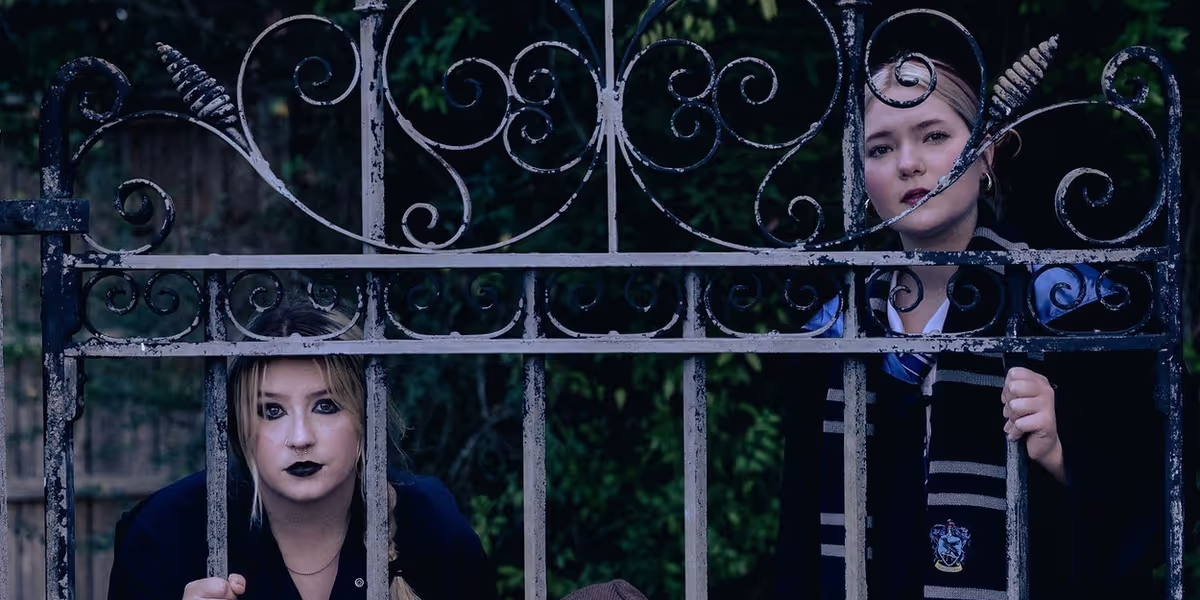
Columbia Theatre for the Performing Arts is leaning all the way into spooky season with the world premiere of THE GRAVEYARD GIRLS, a Halloween-night anthology spun amid headstones, fog and the distant yip of coyotes. BroadwayWorld.com caught up with Columbia’s Resident Playwright Tommy Jamerson to talk inspiration, the “Gore Four,” Hayden Kimball’s original score and how intimacy turns up the chills.
BroadwayWorld.com: This is the world premiere of THE GRAVEYARD GIRLS. What inspired you to set a spooky story in a cemetery on Halloween night?
Jamerson: Jim Winter, my dear friend and the Artistic Director of the Columbia Theatre for the Performing Arts, asked me at the beginning of the year if I’d be interested in writing something fun for “spooky season.” Of course, I immediately jumped at the chance, and we started batting around ideas, trying to find a setting that perfectly encapsulated the mood we wanted to convey. A graveyard was one of the first locations that popped into our heads, and the rest is history. I mean, it doesn’t get much creepier than an old, fog-drenched cemetery, surrounded by coyotes on Halloween night, does it?
BWW: What can you tell us about the characters?
Jamerson: Honestly, I love them. I don’t normally talk about my characters this way; I feel like it can come across as arrogant or pretentious, but I have genuinely grown to care about them. Originally, the storytellers were supposed to represent four cliché-ridden horror-movie archetypes who would guide us from one story to the next. But, over time, they evolved into so much more. Their personalities blossomed, their stakes raised, their emotions explored. The storytellers, or, as I call them, the Gore Four, are made up of high school seniors Lauree, Sydney, Nancie and Jack, Nancie’s bumbling but loveable boyfriend. They each have their own personalities, their own patterns of speaking, their own view of the world, but despite their numerous (and I do mean numerous) differences, it’s evident how much they truly love one another.
BWW: Every ghost story says something about the living as much as the dead. What do the spooky tales in THE GRAVEYARD GIRLS reveal about the teens who tell them and about us as an audience?
Jamerson: While writing this show, I made sure the stories the teens told matched their individual personalities and voices. I wanted the stories to feel like an extension of their character. Lauree, for example, the self-appointed leader of the group, prefers style over substance and loves her horror served up with a heaping helping of jump scares. She’s also a massive fan of 80s slashers and inserts aspects of those films into her work. Nancie and Sydney, on the other hand, are more reserved and will gladly take a nice, atmospheric slow burn over an in-your-face gorefest. They also have their own ways of speaking and would never tell their stories the way Lauree does. It took a long time to pair the right stories and words with the appropriate teen, but I think we’ve finally stuck the landing.
BWW: From what I know of you as a writer, THE GRAVEYARD GIRLS is going to balance thrills, laughs and heart. How did you approach that mix in your writing?
Jamerson: I love to make people laugh, but more than that, I love it and am honored when an audience connects with my work on an emotional level. I knew that for this show to truly work, the audience had to be as invested in the teens as they were with the scary stories, if not more so. The teens, for the most part, were intended to provide the heart and humor, while the stories did all the heavy lifting, scare-wise. In the end, this style of writing proved to be a difficult balancing act, trying to make you jump one moment, then fall over laughing the next, but I tried to approach the show from a place of honesty. I kept asking myself, “Does this feel right?” “Am I buying this moment?” There were a lot of lines, jokes, subplots that were actually tossed out early on simply because they muddied the soup and slowed down the momentum of the overall play. One joke in particular that I was determined to shoehorn in never made the cut, simply because it didn’t belong in this world and didn't add any value to the show. Jim always says the editing process is the time when we “kill our darlings,” and that’s exactly what happened with this piece. In the end, the show is tighter and clips along at a much better pace, but there’s a part of me that still misses all of it.
BWW: This production includes an original score by Hayden Kimball. How does the music shape the mood of the play?
Jamerson: Just like with any horror movie or audio series, music plays a crucial part in heightening the emotion and the scares. We are so fortunate to have someone as gifted as Hayden on our team. I worked with him a few years ago when the Columbia approached me to adapt The Jungle Book, and he’s only gotten smarter and savvier. Some of the melodies he’s come up with are infectious; they’re guaranteed to not only give you goosebumps but also be stuck in your head for the rest of the evening.
BWW: The Studio Theatre makes for an up-close experience for the audience. Was the intimacy of the space something you had in mind while writing the play?
Jamerson: I knew from the beginning it would take place in the Studio space, but I didn’t want that knowledge to hinder the show or my imagination. When I wrote Aladdin! Choose Your Own Arabian Night for the Columbia’s studio, I intentionally kept it simple. It was so simple, in fact, that during the writing process, Jim eventually had to step in and say, “You can go bigger! Whatever you come up with, we’ll figure out a way to stage it.” I took those words to heart while crafting this one. And you know what? Jim was right. He and his team have taken some of the most bizarre stage directions I’ve ever written and magically brought them to life.
BWW: This show is part of Columbia Theatre’s Fanfare 2025 lineup. How does it feel to premiere your newest work as Resident Playwright?
Jamerson: Being the resident playwright of the Columbia Theatre is truly a dream come true. Most playwrights are fortunate to have their new play staged in the basement of an old deli. I have been given a gorgeous, historic, 800-person playhouse steeped in history, and run by some of the kindest, not to mention most talented, people I've had the privilege of meeting. The fact that this will be my fifth show and fourth world premiere here boggles my mind. It’s a pinch-me moment if ever there was one.
BWW: Tell us a little about your other works in horror.
Jamerson: While most of my shows are, by nature, much giddier and breezier than THE GRAVEYARD GIRLS, I do have two plays that certainly live within the horror realm. The first one I wrote in 2019, when I was asked by interACT Theatre Productions to adapt the campy, Vincent Price classic, House on Haunted Hill, for the stage. Having grown up with the movie, I leapt at the chance and am happy to report it was an absolute blast to work on. I’m also thrilled to say that since its premiere, Haunted Hill has been performed all over the country. There’s even a high school adaptation, so that younger actors can get in on the fun. My second horror-themed show, Amityville ‘74, is based on the infamous Amityville Horror house. Instead of exploring the lives of the Lutzs, the family that most Amityville media focus on, my adaptation tells the story of the DeFeos, the family who preceded the Lutzs, and were gunned down at 3:15 am by Ronald and Louise DeFeo’s oldest child, 23-year-old Ronnie “Butch” DeFeo. Ronnie claimed that demonic forces were behind the murders, but police evidence suggests otherwise. Both plays are available for licensing and can be purchased through Next Stage Press.
THE GRAVEYARD GIRLS premieres in Columbia Theatre’s Studio Theatre as part of Fanfare 2025 on October 17 and runs through October 25. For tickets and more information, visit Columbia Theatre for the Performing Arts.
Sign up for all the news on the Fall season, discounts & more...

|
The Rocky Horror Show Rivertown Theaters (10/23-10/31) |
|
The Rocky Horror Picture Show (minors must be accompanied by a guardian) Mahalia Jackson Theater (10/29-10/29) |
|
The Nutcracker Jefferson Performing Arts Center (12/19-12/20) |
|
Sweeney Todd Westwego Perf Arts Theatre (11/06-11/22) |
|
|
The Marvelous Wonderettes Westwego Perf Arts Theatre (1/08-1/24) |

|
Steel Magnolias Rivertown Theaters (11/06-11/22) |

|
Finding Neverland Riverview Performing Arts Center (9/11-9/27) |

|
The Lion King Saenger Theatre (10/21-11/08) |
|
Les Miserables Jefferson Perf Arts Center (2/26-3/07) |
|
Rudolph the Red-Nosed Reindeer Jefferson Performing Arts Center (12/04-12/13) |
