


Review: ŁUKASZ TWARKOWSKI: ROHTKO, Barbican Theatre
Stunning in scale, this digs deep into the fine line between fakery and reality.
 It was a canvas with Mark Rothko's name on it, big solemn blocks of colour meant to make you think deep thoughts. Only it was cooked up in a garage by some quiet Chinese gent who taught maths in Queens and commissioned by crooked dealers who advertised it as a lost masterpiece. It was the kind of crime that didn't need a gun, just a steady hand and a long line full of greedy connoisseurs. It was sold and sold again until it landed in the hands of a grateful buyer with $8.5m to spare. Well, grateful during the 15 years it took for the truth to come to light.
The true crime genre has already provided one bona fide London smash this year in the sublime Kenrex but Łukasz Twarkowski takes a very different approach with this four-hour-long opus. While Jack Holden and Ed Stambollouian relied on a gritty narrative which cleaved close to the historical events and the individuals involved, ROHTKO hangs back and circles the scandal at its heart. In its description of how this high-society deceit unfolded, it studiously avoids the documentary approach taken by Netflix’s Made You Look and instead hops through time and space, picking apart all the arguments before diving in for the kill.
Say what you like about Twarkowski but the Polish director certainly can’t be accused of a lack of vision. In January, Twarkowski brought The Employees to the Southbank Centre. The innovative in-the-round staging of Olga Ravn’s sci-fi novel allowed the audience to walk up to and around the set during the show. The reactions from public and critics were heavily divided between those mesmerised by its intensely immersive presentation and those who derided the often languid direction and meta pretensions.
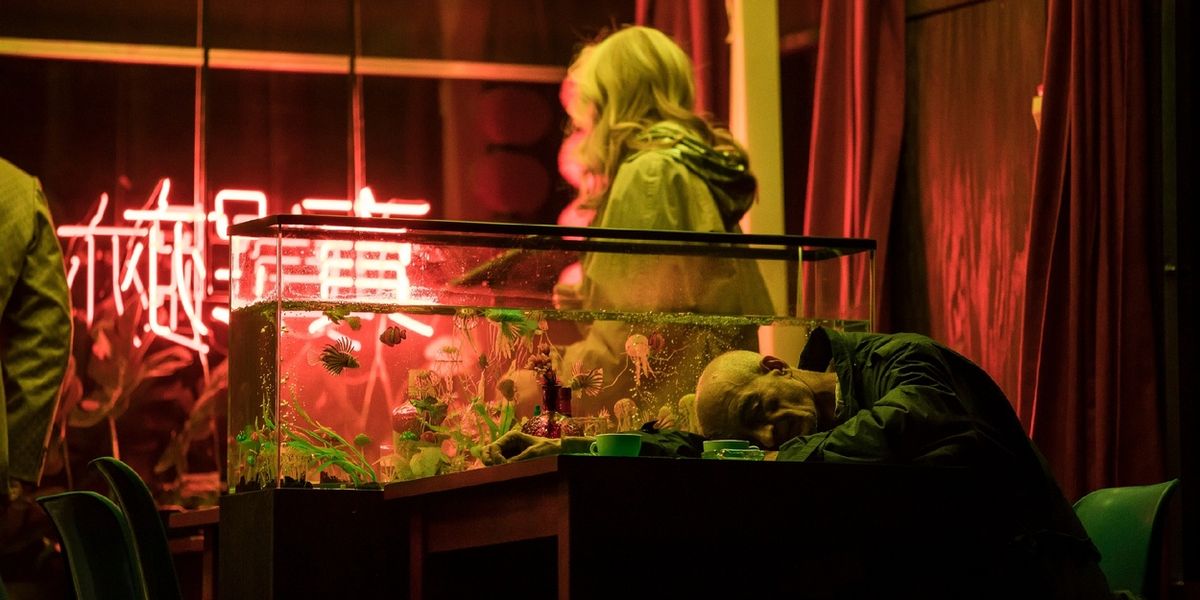
Like the eponymous famed Latvian artist deliberately misnamed in the title, this drama knows how to use the largest of canvases to paint its story. Two large video screens are moved around at will while a bigger overhead screen tracks the movements of actors in and around the set captured through roving steadicams. A modular stage comes together for precisely choreographed restaurant encounters before splitting apart for more intimate scenes. Inside a shipping container, a Chinese couple cook and chat to themselves in between sessions serving customers. Centred surtitles in English keep us looped into what is being said as the dialogue hops across (at least) four languages.
Conversations follow conversations as, like a genuine Rothko painting, layer upon layer is added. The initial focus on the real fake painting gives way to an array of faked realities. There’s no attempt to hide the numerous artifices: a couple of actors announce themselves with their own names before introducing their character and what role they will play; everyone walks around with wireless mics clearly strapped to one cheek; and the video playback is (deliberately?) out of sync with what we are hearing.
The four pillars of the art world are all present and correct and we spend time listening to endless banalities expelled from artists, museum curators, dealers and buyers as much in love with – and seemingly bored by – their own hackneyed verbiage (at some point, a restaurant customer asks those around him to stop talking as if this was a Tarantino movie).
In contrast, we hear from Rothko himself. A dinner date with his wife Mell underlines his utter contempt for the capitalist collectors looking to commission him for their posh Park Avenue restaurant; “empty dickheads” is one of his politer epithets he uses as he gets angrier and angrier, throwing down one whisky after another. Later, in Twarkowski’s least subtle scene, we see the pair barely able to get out of bed, deep in discussion and depressed almost beyond words as a black dog lollops behind them and the camera captures their movement in black-and-white imagery. Large text tells us coldly of how Rothko soon after left his wife and then this world by his own hand.
This epic masterpiece has already been around Europe and has plumped for the only venue in town that actively goes out of its way to host long-form theatre like this and last week’s three-hour-no-interval LACRIMA. Ivo von Hove arguably had his finest moments here with his four-and-a-half hour Kings of War and his six-hour Roman Tragedies. Would the offbeat Opening Night have found a warmer reception in this City of London temple to high art than it did in the West End? We’ll never know.
What we do know is that Twarkowski isn’t one to take theatre lightly. When not twisting its conventions this way and that, he crawls inside the art form from crown to corns, putting its innate fakery up on a pedestal and asking hard questions especially around the intersection between money and art — whether in 2D form like a Rothko or the 3D variety he himself sells to those in the pews. Style meets substance at every turn as they both clamour for the spotlight. Without a doubt, this is one of the most impressive theatre events we will see this year.
Like the art world seen in ROHTKO, London theatre is in its own insular bubble: overpopulated by screen-to-stage musicals, clinging to endless Shakespeare revivals and evidently too afraid to dream on the kind of scale that this talented director brings with him. West End ticket sales figures suggest that the post-pandemic public’s appetite for the same old same old has reached a plateau. Maybe it’s time for a different approach?
ROHTKO continues until 5 October.
Photo credit: Artūrs Pavlovs





Reader Reviews
To post a comment, you must register and login.