


Interview: Suzanne King of DANCING AT LUGHNASA at Theatre Suburbia
Irish accents, knitting, and all the challenges of bringing the story to life!
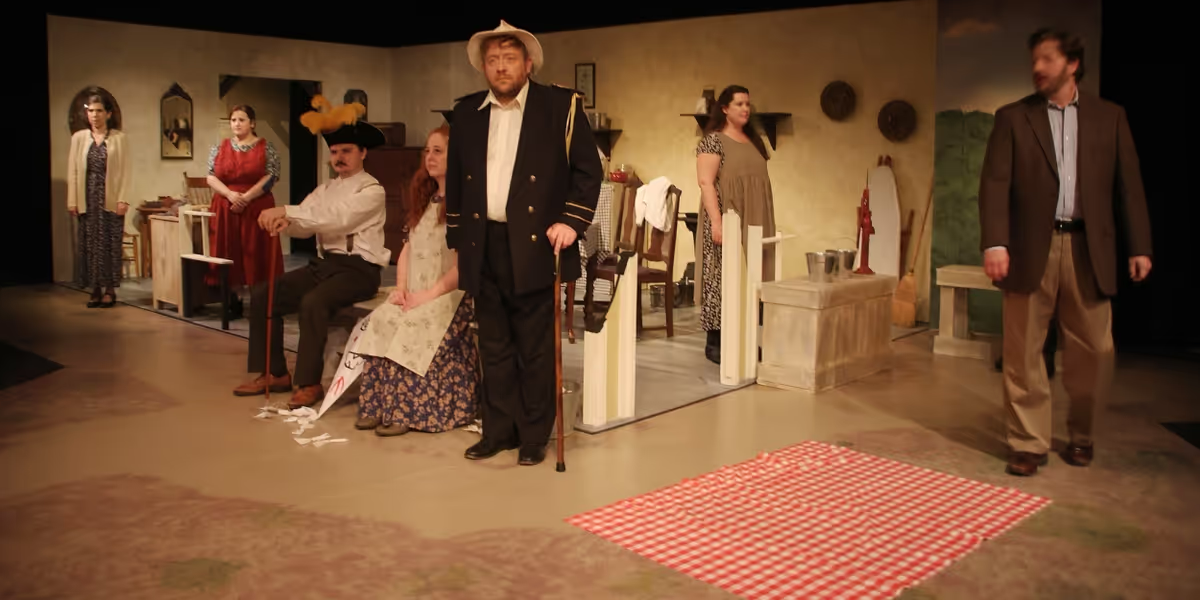
Suzanne King is the director of DANCING AT LUGHNASA, which has begun its run at Theatre Suburbia through May 17th. Suzanne has been a wonderful part of the Houston Theatre scene for over twenty-seven years and has directed many productions for this company. The actress has also appeared in so many shows, I couldn’t even start to rattle them all off. She has said this is a passion project of hers ever since she first read the play by Brian Friel over twenty-five years ago. Broadway World writer Brett Cullum got a chance to talk with Suzanne about producing a piece about five sisters in Ireland during 1936.
Brett Cullum: Brian Friel wrote DANCING AT LUGHNASA back in 1990, and there was a pretty popular film adaptation starring Meryl Streep in 1998. What in the world made you want to do this show at Theatre Suburbia, because this is a tough one? I think it would challenge any company to produce because of the Irish setting and medium-sized cast.
Suzanne King: I'll tell you why I decided to do it; then I'll tell you about the toughness, but I read this about 1999, and just loved it. It made the hairs on my arms stand up, especially visualizing the very last scene with the entire cast swaying back and forth, and giving the illusion of them not swaying. You're not sure if they are or not. Still, it just seems like the whole set is moving and just all of the changes, the relationships, the changes that are going on in the world, and the relationships that each of the family members has, and how the sisters all love each other. However, they still bicker, joke, enjoy, and care for one another. And it's those relationships that really helped me fall in love with the play.
As far as the difficulty of the play, I had one of the actors say, “This is probably the hardest show I've ever had to do, because not only did I have to learn my lines, but I had to learn an accent. Learn how to knit, learn how to dance. All these things, and hold down a job during the day!” So yeah, it was a tough one to do.
When I first designed my set, I had much more yard than I did house, and I got all eight people onstage, and I thought, “Nope, we're going to have to redo this whole design.” It took a little bit of adjustments throughout the rehearsal period to get to where we were.
Brett Cullum: Well, and for anybody that doesn't know, basically describe the play for me just real quick.
Suzanne King: This is 1936 Ireland, and we have five sisters, their older brother, and a young boy. The brother is Father Jack, a priest who's been in Uganda, working with people with leprosy, and he's been there for over twenty-five years, and he's adjusted his faith to take in some of the culture he's been around in Uganda. Not only is he sick with malaria, but he's kind of “gone native,” as they say in the play. The oldest sister, Kate, is the breadwinner for the family and the only one with a real job. They don't have a whole lot of money.
The other sisters work as knitters on contract. They knit gloves, and the Industrial Revolution is coming into play. They're going to lose their jobs because a knitting factory has opened up in Donegal, a nearby city. They don't know how they're going to survive.
One of the sisters, Chrissie, has had a child out of wedlock. None of the sisters has any kind of love interest other than Chrissie, and the father of her child is a kind of “a Ne'er do well,” who has at least one other family that we know of, maybe has more.
It's just about all of the change that's going on in the world. We're about to go into World War II. We've got the new wireless set that they have that brings music for the first time inside a household without having to have an instrument or singing. They have news coming in for the first time over the radio when it is working. So all of the different changes that are going on in the world, as well as inside their house, are basically what it's about. It's a memory play told from the perspective of the 7-year-old son. It's only two days that took place in the summer and fall of 1936, when he was seven years old.
Brett Cullum: You brought in an accomplished Houston actor named Brian Heaton to play Michael, the young son, and we never see him as a child; we just have him narrating. It is a particularly challenging role for Brian because he has to do these monologues and catch up with the history and things like that. Brian is really great in this. I enjoyed his monologues a lot!
Suzanne King: Yeah. So I've worked with Brian in the past. We've done shows together. And I knew he had a really good Irish accent, so I think he's a fine actor. I knew it would be something that he would be able to handle. So I asked him to come and audition, and he loves the play, so he was very excited to take on the role, and he did a lot of research. He found some recordings of Brian Friel actually talking. He did a lot of research to develop his character and backstory.
Brett Cullum: A man sitting next to me turned to me after the show and said, “Man, that guy can monologue!” and I had to agree. And you've got five awesome women with disparate acting experience playing these sisters. One of the great things about this show is that I couldn't tell who was new to the stage or a veteran. They all rose up to each other's level! Lauren Lawson plays Chrissie, Brit Garcia as Maggie, Kristen Sheils portrays Agnes, Kennedy VanDeMore becomes Rose, and Jennifer Norten inhabits Kate. Two other guys are here, Father Jack from H. Levi Smiley, and Maxwell Metyko gives life to Gerry Evans. Julie Burks is the understudy, and she is covering all five sisters?
Suzanne King: Yeah, I had her come in because you never know when there are five women. Something might happen, and it worked out well. Because Brit had a death in the family, she had to step out like the week before tech week. Julie was able to get in there, and just by being in rehearsal, she was able to do the blocking pretty much and not throw all the actors off as much as they could have been. She also helped with all the knitting! She taught the other girls how to knit and knitted a few of the gloves that we had on stage!
Brett Cullum: So they all got to learn how to knit? Yeah, that is crazy. Well, the one thing I wanted to ask you about is the accents, because one of the things that impressed the heck out of me is that they all do a very passable Irish accent. Even professional actors often can't get away with this brogue. It was amazing that they actually all got rid of that Texas twang!
Suzanne King: I kind of have a good ear, but I don't think I could do it, even after listening to them, do it for six weeks. We had Magdalen Vaughn come in for one night and gave them some exercises to do and a few like videos they could watch that would help out. As soon as the cast started getting into it, being around everybody and listening to those videos, they really stepped it up. And everybody ended up with a good accent.
Brett Cullum: Oh, gosh! When I came to the show, the audience was talking about how great the set looked and how you designed it. It's a really nice-looking production, Suzanne. This was definitely a push for Theatre Suburbia. This is really a hard memory play, and this is one that even the Alley would have a hard time getting off the ground.
Suzanne King: I'm gonna tell you! Zach Nelson showed up one day for set construction. And Elvin Moriarty just said, “Okay, we need to do this, this, and this!" And Zach went, got the tools, came and did it. He did the texturing on the walls, which made the inside of the house look amazing. He did the whole inside of the floor. I did the outside, the garden looking area.
Brett Cullum: Well, what do you think that this play says to today? What do you want this 1990 play by Brian Friel to communicate to an audience in 2025 between now and May 17th? What do you want them to walk away with?
SKING: Father Jack says that people he's been with in Uganda may be different from us. They may believe different things from what we do. But essentially, we're all the same. We're going through a rough time politically right now, and just be kind and love each other.
Brett Cullum: It feels like a time where, obviously, in 1936, Ireland, a lot of things were coming, such as the Industrial Revolution. Factories changed everything for these five women, and I feel like we may be at a time where that may be happening again. A lot of people are working from home, and we're not always in offices anymore. Stores sometimes don’t have clerks, and at Starbucks, you enter everything into an app. Things are changing.
In your play, the wireless that the family has in their house must have seemed like magic to them to actually have music playing. And it's so nice to return to a time when that sort of thing seems magic, because we take so much of our magic for granted. Look at the magic and the family that you have. Appreciate that.
Community theater like Theatre Suburbia. One of the things I love about it is that you all come together, you make something, and you say something to the community, and it's all personal. Nobody's paid. They're doing it from their heart, and I really did feel that from this cast. So I was glad to experience it. It is not a large space. You can feel the audience move.
Suzanne King: Yeah, they can feel every little thing. And they feed off the audience, too, even if it's just some comic moment. Just hearing that little laughter or hearing the person say, “Wow!” Or whatever. You can hear all of that, and you can feed off of that as an actor. I'm really proud of them. They've all risen to meet each other on that stage.
Brett Cullum: That's the thing that I love the most about this theater - it creates community. And it's a beautiful play, and I'm really glad that you're sharing it with the world, and you've got till May 17th to do that. Thank you so much, Suzanne. You have a lot to be proud of!
Photo provided by Pin Lim and features the cast
|
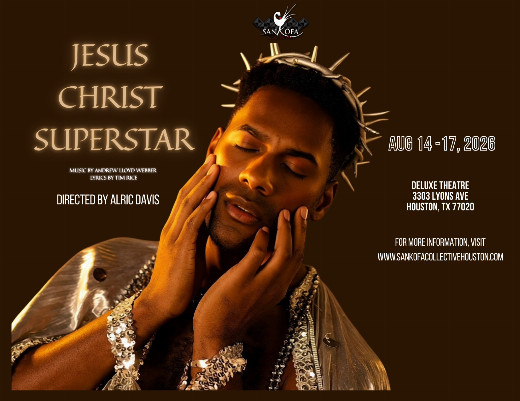
Jesus Christ Superstar Deluxe Theatre (8/14-8/17) |
|
Wicked Hobby Center for the Performing Arts (6/23-7/25) |
|
|
Wicked Hobby Center for Performing Arts (6/23-7/25) |
|
The Music Man Theatre Under The Stars (9/15-9/27) |
|
Rocky Horror Picture Show House of Blues Houston (10/23-10/23) |

|
Therapy Gecko Punch Line Houston (9/20-9/20) |

|
Xanadu MATCH (Midtown Arts & Theater Center Houston) (8/14-8/30) |

|
Anarkali Reimagined Luxtrium (10/22-10/25) PHOTOS |
|
The Rocky Horror Picture Show Spooktacular Tour with Nell Campbell House of Blues (10/23-10/23) |

|
The Who's Tommy Theatre Under The Stars (2/02-2/14) |