


Review: World Premiere of Moravec-Campbell ALL SHALL RISE At OSNY under Tritle at Carnegie Hall
Oratorio Society Pairs Stirring Contemporary and Classical Works with Exciting Results
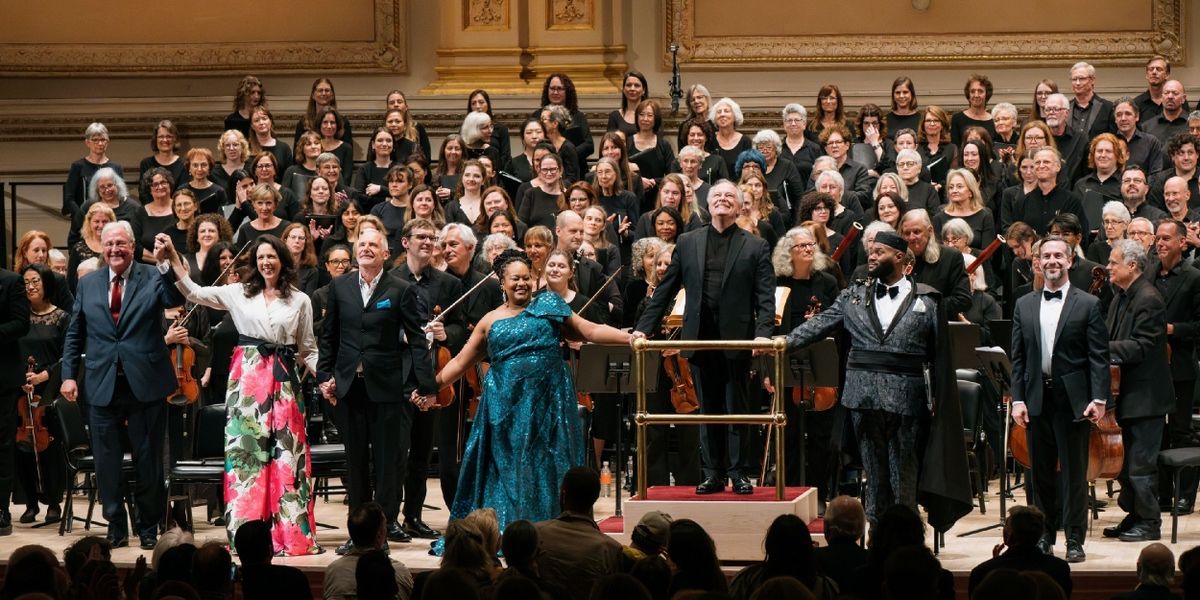
By definition, the historical view of the oratorio is that it’s typically religious in nature and performed unstaged, with no costumes or scenery. Going by that description, The Oratorio Society of New York’s (OSNY) program at Carnegie Hall this week—a combination of contemporary and classical works--under conductor Kent Tritle, broke some rules in both parts of its stirring, gorgeously sung and played program.
The evening started out with the World Premiere of ALL SHALL RISE by Paul Moravec and Mark Campbell, a splendid, moving examination of the history of voting rights in the United States.
With a lushly modern score, including an interesting use of percussion, by Moravec and a fascinating look at 200 years of the fight for the right to cast a ballot in this country, it made for an interesting updating of the oratorio form. Campbell combines the words of historic figures on the subject with fictional recreations of the experiences of “unsung American heroes” as they fought for the vote—the intertwining stories quite compelling.
ALL SHALL RISE is the concluding part of the collaborators’ American Voices Trilogy, commissioned by OSNY, which also includes SANCTUARY ROAD, about the Underground Railroad, and A NATION OF OTHERS, which covers a day in the life of Ellis Island in 1921 with the influx of immigrants who crossed the sea to get here.
Though both those other pieces were superb, the current work seems particularly timely, even though it was commissioned and written before the current political climate made it particularly meaningful.
Anyone who thought that Moravec and Campbell’s opera setting of Stephen King’s THE SHINING was terrifying, hasn’t yet seen ALL SHALL RISE. Of course, the piece is not polemical in nature-- and while there are no outward scary aspects of the oratorio, its mere existence at this political moment, when basic democratic rights are under fire in this country, can’t help but strike a note of fear for many Americans.
Tritle's leadership gave a vibrancy to the massive forces of the OSNY, with a quartet of soloists who brought the combination of historical speeches and fictionalized “heroes” to life-- “ordinary people caught up in extraordinary circumstances,” as Moravec has said.
Campbell made interesting choices of quotables found in his research, including Anneke, a German-born, adopted American on the subject of women’s rights, rather than the more famous Elizabeth Cady Stanton, and Frederick Douglass rather than the more familiar Martin Luther King Jr.
Among the singers, I was particularly taken with the work of mezzo Lucia Bradford in “I Continue On” as she tells of being intimidated as she went to the courthouse to vote in Alabama in 1964, and soprano Susanna Phillips, as she headed the female chorus as Mathilde Franziska Anneke in “The Holy Palladium.”
Singing on the subject of suffrage (“Don’t exclude woman, Don’t exclude the whole half of the human family…”), her soaring voice added much to the stories, including that of Belinda, in “I Drive Now” from 1972, whose husband was one of those who bought into “I Like Ike” and tried to keep her from the polls because she did not.
The male soloists did nicely as well. Baritone Steven Eddy was Stu, a man in Florida in 2019, singing of the states being given priority in setting up voting rights, as well as a pithy quote from Benjamin Franklin (“A man owns a jackass. Because he has property. He can vote….).
Tenor Charles Williamson was John Adams (“Admit all men without property to vote, And you’ll have to admit All women and children. There will be no end of it….”) and Frederick Douglass (“Not benevolence,…But simple justice”). He was also Thomas, from Texas, in his bar, at the Obama election of 2008 (“…For my father who worked all his life as a porter, Give him a chance….”)
But of course, the excellent chorus of the OSNY, along with the fine members of the orchestra, all under Tritle’s splendid direction, brought the piece thrillingly to life. As they performed the stirring final words, “All shall rise,” the audience was on their feet, as if taking it literally as a call to arms.
Mendelssohn Symphony No. 2
Mendelssohn’s Symphony No. 2 in B-flat Major, “Lobgesang,” ("Hymn of Praise") is not a traditional oratorio either—mixing symphonic form with the religious text of a cantata. This rare and wonderful performance by the OSNY made it puzzling why this work isn’t among the composer’s “greatest hits,” except for the resources needed to pull it off this well.
The composer wrote it to commemorate the 400th anniversary of Gutenberg’s invention of the printing press and the famous Bible he produced. OSNY’s gigantic vocal forces and its impressive orchestra could let even those without the religious interest in it be totally engaged and enchanted.
It was a confident and exhilarating performance, sharing some of the soloists from ALL SHALL RISE: soprano Phillips, mezzo Bradford and tenor Williamson, were quite appealing in the Mendelssohn, with the latter’s voice shown to better effect here than earlier in the evening. Tenor Ongama Mhlontlo and bass Gyasi Barber were added to the list here.
Caption: Oratorio Society and Orchestra. Front row (left to right): Paul Moravec, Susanna Phillips, Mark Campbell, Lucia Bradford, Kent Tritle, Charles Williamson, Steven Eddy
Photo credit: Brian Hatton.
Reader Reviews
To post a comment, you must register and login.