


Review: I Want a Divorce from the Met’s NOZZE DI FIGARO!
Despite Game Cast, Mozart Revival is Too Rough Around the Edges
What’s a Mozart lover to do? Great music and a more-than-decent cast don’t necessarily add up to an enchanting night at the opera. Yes, it’s true that LE NOZZE DI FIGARO ("The Marriage of Figaro") has some of Mozart’s most delicious music and a strong libretto by Lorenzo da Ponte; there’s no denying that.
Where do I start? “Porgi amor” and “Dove sono” for the Countess, “Voi che sapete” and “Non so piu” for Cherubino, Susanna’s “Deh vieni non tardar,” Figaro’s “Non piu andrai” and “Se vuol ballare,” and the hilarious ensemble, “Riconosci in questo amplesso,” when (SPOILER ALERT!) Figaro and Susanna find that two of the heavies of the piece (Marcellina and Bartolo, mezzo Elizabeth Bishop and bass-baritone Maurizio Muraro) are really Figaro’s parents. Even a minor character, Barbarina (soprano Mei Gui Zhang), gets a choice aria, “L’ho perdu me meschina.” If you don't recognize the names of the arias, you'll certainly know the music. And these are only the tip of Mozart’s great iceberg of a score.
What the audience was served on Monday at the opera’s first performance of the season, was staging that was frequently dull, particularly in the ugly, claustrophobic set design of Rob Howell--which hasn’t improved with time--in the Richard Eyre production restaged this time around by Jonathon Loy. (Howell did have a good idea in designing a unit set, which gave the audience a look at the “upstairs/downstairs” of the Almaviva household during the overture, though not enough was done with it during the rest of the piece.)
Add debutant German conductor Joana Mallwitz, whose presence seemed not to have jelled with the Met Orchestra, taking a lighter touch that the orchestra wasn’t buying (it was visible), and not paying much attention to the cast. The result was that the opera was frequently underwater.
Oh, I know that rehearsal time for revivals is quite limited, but we’re not supposed to be so aware of it. I certainly was. The charm of the piece’s opening, for example, with Susanna (Ukrainian soprano Olga Kulchynska, a lively presence) and Figaro (take-charge American bass-baritone Michael Sumuel) getting ready to move into their marital quarters, I found was completely lost.
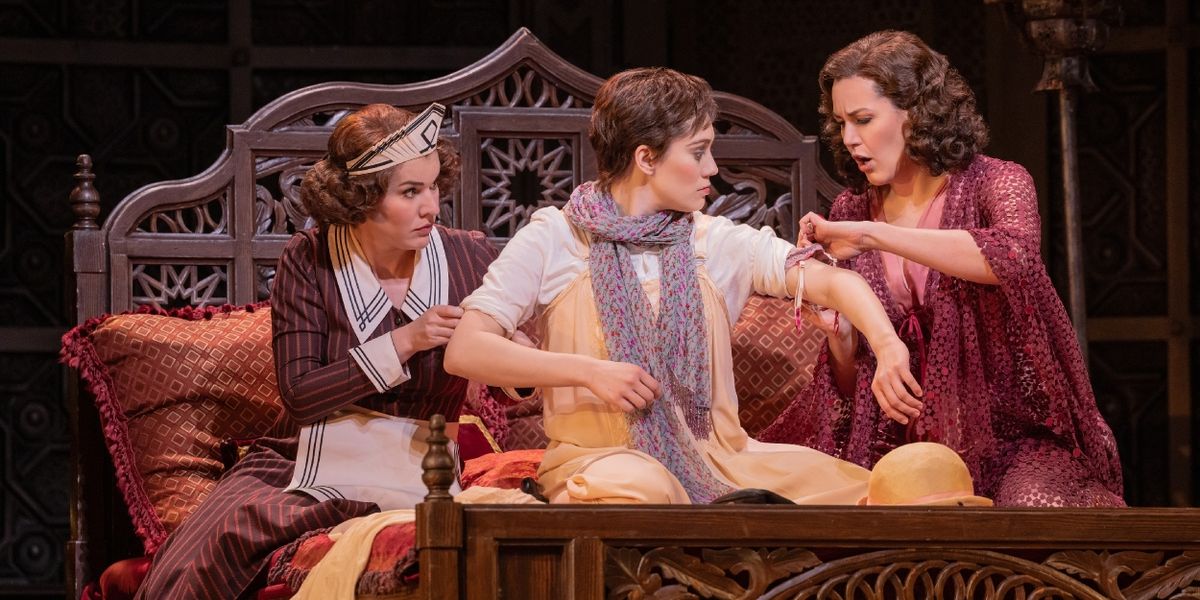
And things took a while to improve. The first act-and-a-half were a long slog, until Susanna and the horny teenage page Cherubino (light, lively American mezzo Sun-Ly Pierce) switched places in the dressing room of the Countess (lovely Italian soprano Federica Lombardi) and caught the Count (Canadian baritone Joshua Hopkins) by surprise, since he expected his wife was cheating with the page.
It looked like things were decidedly improving for the better, but, alas, it was up and down for the rest of the evening. Among the highlights were Lombardi’s rendition of “Dove sono,” Kulchynska’s “Deh vieni non tardar” and Pierce’s “Voi che sapete.” And it was a blessing that the production was staged with a single intermission, between Acts II and III, so the running time was about 3-1/2 hours rather than over four.
Of course, there is an underlying sadness to the opera, which is a follow-up to Rossini’s BARBIERE DI SIVIGLIA (both based on plays by Pierre-Augustin Caron de Beaumarchais): In Rossini, the Count (Almaviva) is chasing after Rosina (Mozart’s Countess) and there are lots of fun and games; by the time we get to the Mozart, the flame has gone out of their marriage and she’s devastated, while he beds any female in sight. Yes, there’s a happy-ish ending. But how long will it last?
As a matter of fact, there is a third part to the Almavivas’ story by Beaumarchais. “La mere coupable” (“The Guilty Mother”), which incorporates the story of the illegitimate child of Rosina and Cherubino, was taken up by composer Darius Milhaud and his wife, debuting in 1966 and having its US premiere in 2017 by On Site Opera in New York. Yes, the Count and Countess are still together, and Cherubino’s child was brought up by them as their own. (Cherubino is dead, by the way.) It’s far from standard repertoire. John Corigliano’s THE GHOSTS OF VERSAILLES, which premiered at the Met in 1991, adopted certain aspects of the story.
The Met’s production will be performed through April 22. For more information and tickets, see the Met’s website.
Caption: (left to right) Olga Kulchynska as Susanna, Sun-Ly Pierce as Cherubino, and Federica Lombardi as Countess Almaviva.
Credit: Evan Zimmerman/Met Opera
Reader Reviews
To post a comment, you must register and login.