


Review: DALIBOR is Smashing Smetana at Bard’s SummerScape under Botstein
The Opera Proves that the Composer is More than the BARTERED BRIDE and “Ma Vlast”
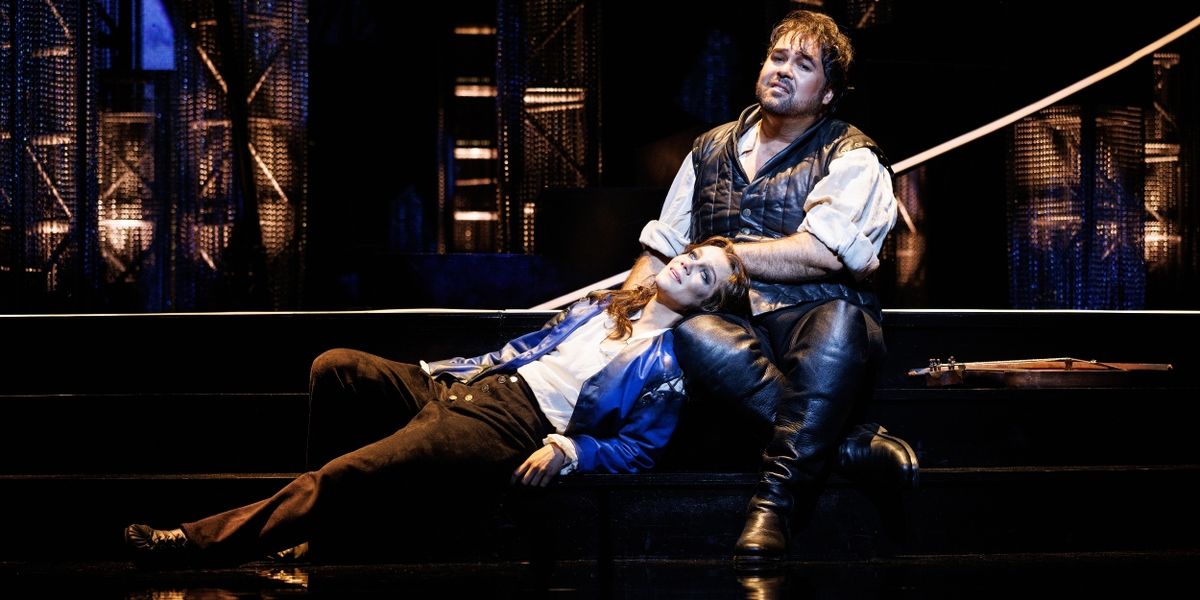
Though Bedrich Smetana’s DALIBOR—seen this week at Bard SummmerStage in a wonderful production by Jean-Romain Vesperini, with an ingenious set design by Bruno de Lavenere, a fine cast and the American Symphony Orchestra in impeccable form under Leon Botstein—was reputedly the composer’s favorite among his eight operas, it was a failure at its opening in Prague in 1868. There was never a fully staged production in this country until this current one. (I saw the July 30 matinee.)
And what a staging it was, with its shimmering curtains sometimes used in conjunction with brilliant projections by Etienne Guiol. (The lighting design was by Christophe Chaupin and costumes by Alain Blanchot.) The compelling score and fluid libretto were brought to life by the cast, a couple of whom were brought in late in the game because of visa issues.
The result was that the audience treated it like an old friend rather than something they’d never heard before, even if its Czech language seemed very foreign indeed to these American ears. (The cast sounded so much at ease that I often expected to understand some of what was being sung, which I definitely did not. There don’t seem to be many cognates between Czech and English.) When Leon Botstein chose to lift this work out of obscurity (in this country, at least), he was spot on.
Parallels are often drawn between it and Beethoven’s FIDELIO—the jail setting, the cross-dressing female who tries to save the day (unlike the Beethoven, she fails and she and the knight Dalibor both die)—but this tale of Czech nationalism, of friendship and revenge, is quite different. The “weapon” of choice is not a sword or a knife but a violin, which belonged to the knight’s best friend, Zdenek (who only appears as a ghost, Patrick Andrews) whose execution set the story in motion, as Dalibor sought revenge.
In its day, the opera was considered out of step with the developing Czech opera scene, which was expected to draw from local folk songs and dances, while DALIBOR was “suspiciously Wagnerian,” as noted in the program. (As was expected in the opera’s time, the libretto was originally written in German, by Josef Wenzig, then translated into Czech, by Ervin Spindler.) John Matthew Myers, who sang the grueling title role, sounded, indeed, like a burgeoning heldentenor.
The cast as a whole was first rate. Bass-baritone Alfred Walker, who sang the title role in Saint-Saens’ HENRY VIII recently at Bard SummerScape was a superlative Czech king here, while the two very different sopranos—Erika Petrocelli and Cadie J. Bryan (another late replacement)—both gave standout performances.
Petrocelli’s richly velvety sound brought excitement to the role of Jitka, an orphan befriended by the knight who tries to set him free, while Bryan’s lighter sound was beautiful in the role of Milada, sister of the burgrave of Ploskovice (who was killed by Zdenek); she starts out as Dalibor’s enemy but falls in love with him and helps Jitka in trying to free him from his jail cell.
In smaller but key roles, tenor Terrence Chin-Loy did fine work as Vitek, one of Dalibor’s mercenaries; bass Wei Wu sounded firm as Benes, the jailer (though his acting was a bit basic), baritone Eric Greene impressed as Budivoj, commander of the castle guard. The chorus did some wildly impressive work under chorus master James Bagwell.
Now that we’ve been introduced to this piece of Smetana arcana, there are still another half-dozen left to explore. Many years back, Eve Queler’s Opera Orchestra of New York ventured into Smetana territory with LIBUSE, one of his better known works (at least in the Czech Republic, that is). I wonder what Botstein and his team could do with that!?
Caption: John Matthew Myers as Dalibor and Erika Petrocelli as Jitka
Photo credit: Maria Baranova
|
Samson et Dalila Union Avenue Opera (8/14-8/22) |
Reader Reviews
To post a comment, you must register and login.