


Review: At NY City Flamenco Festival, Sara Baras Soars
Baras's four-act show is a tribute to the famed flamenco guitarist Paco de Lucía and an ode to the creative process.
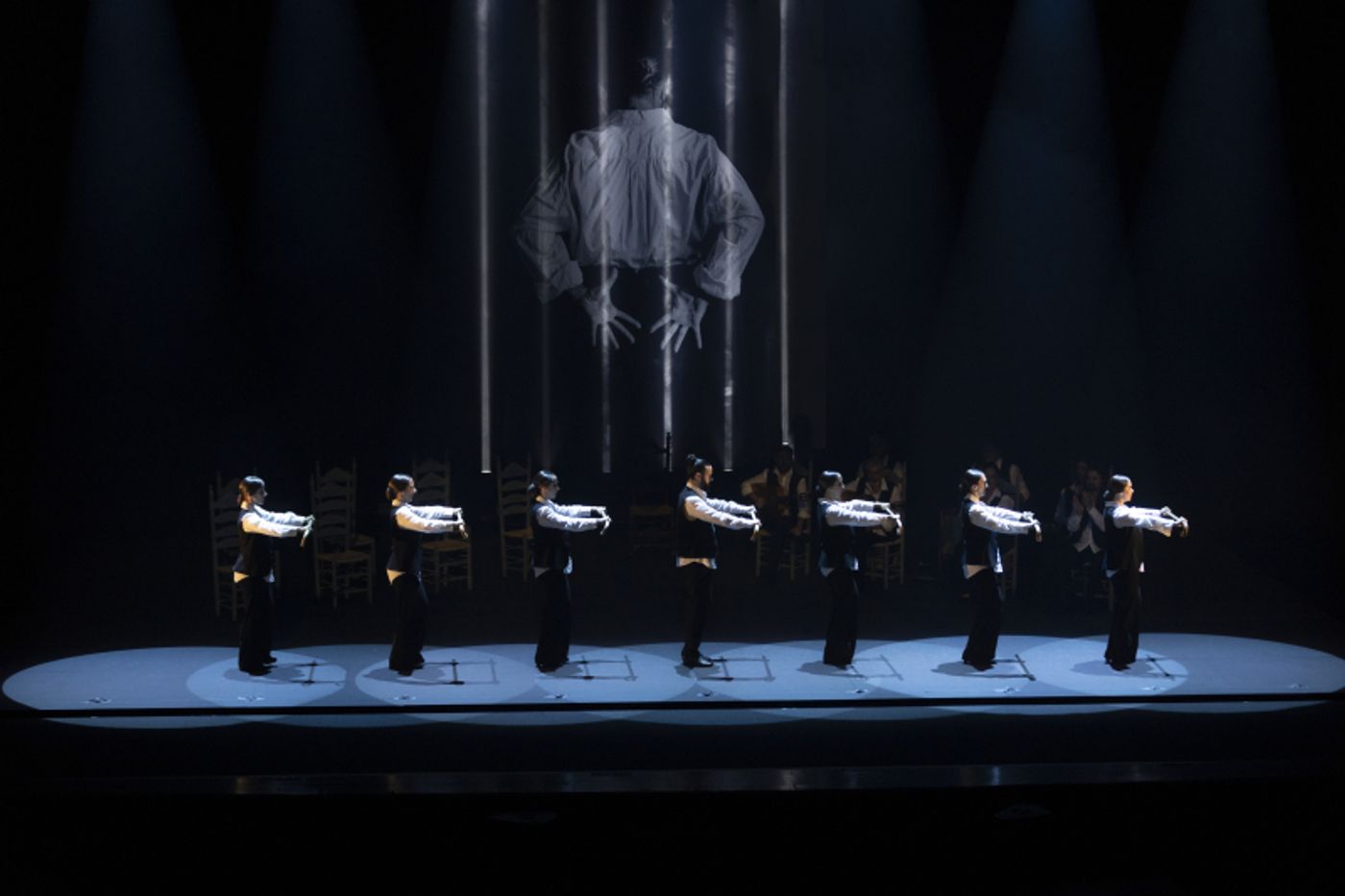
Few performers can get away with unironically using a picture of themselves as their stage backdrop. Sara Baras can. In her latest show, we are greeted by an enormous image of the Spanish flamenco star photographed from behind—fingers splayed, bun secure. The New York City Flamenco Festival might be celebrating its 25th anniversary, but Baras has been performing in—and headlining—it for over two decades. Her flamboyant showmanship and signature zapateado aren’t just highlights; they’re the festival’s heart and soul.
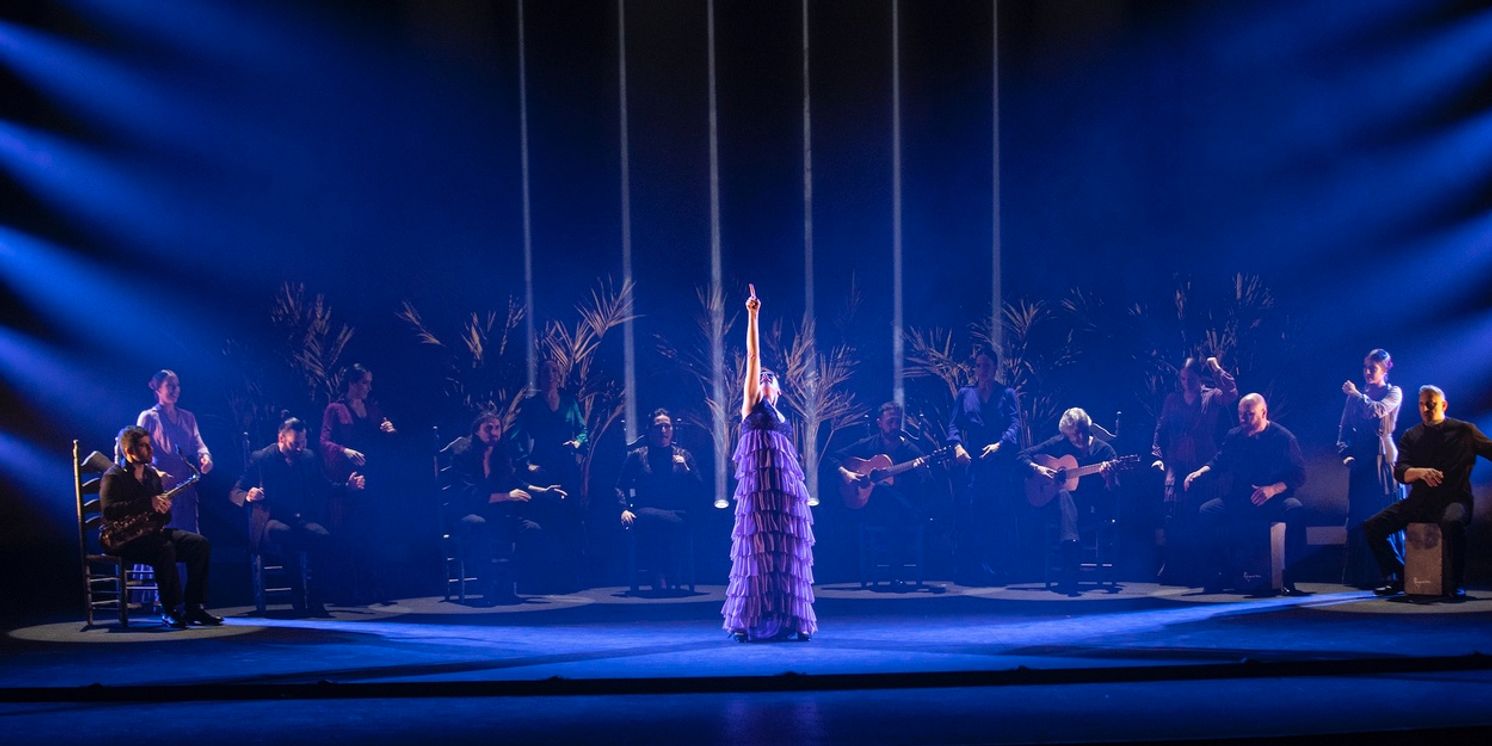
Baras’s four-act show is an homage to the famed flamenco guitarist Paco de Lucía, and she begins by immersing us in his blistering, soulful rhythms. On stage is an empty chair; above it, 6 lines of swirling white light materialize one by one, echoing the strings of de Lucía’s guitar. When Baras appears, it’s clear that we aren’t just missing the beloved guitarist but the dancers who bring his music to life.
Yet Vuela doesn’t just pay tribute to De Lucía; it traces Baras’s creative evolution. The opening section hews closely to no-nonsense flamenco technique. Clad in white collared shirts and black slacks, Baras and her six-woman ensemble are all percussive footwork and crisp gestures. The dancers wield canes and stomp in sync, shifting our focus away from emotionality (usually expressed in the arms) and toward their absolute command of rhythm and mechanics. With each stomp, they burrow deeper into flamenco’s centuries-old roots.
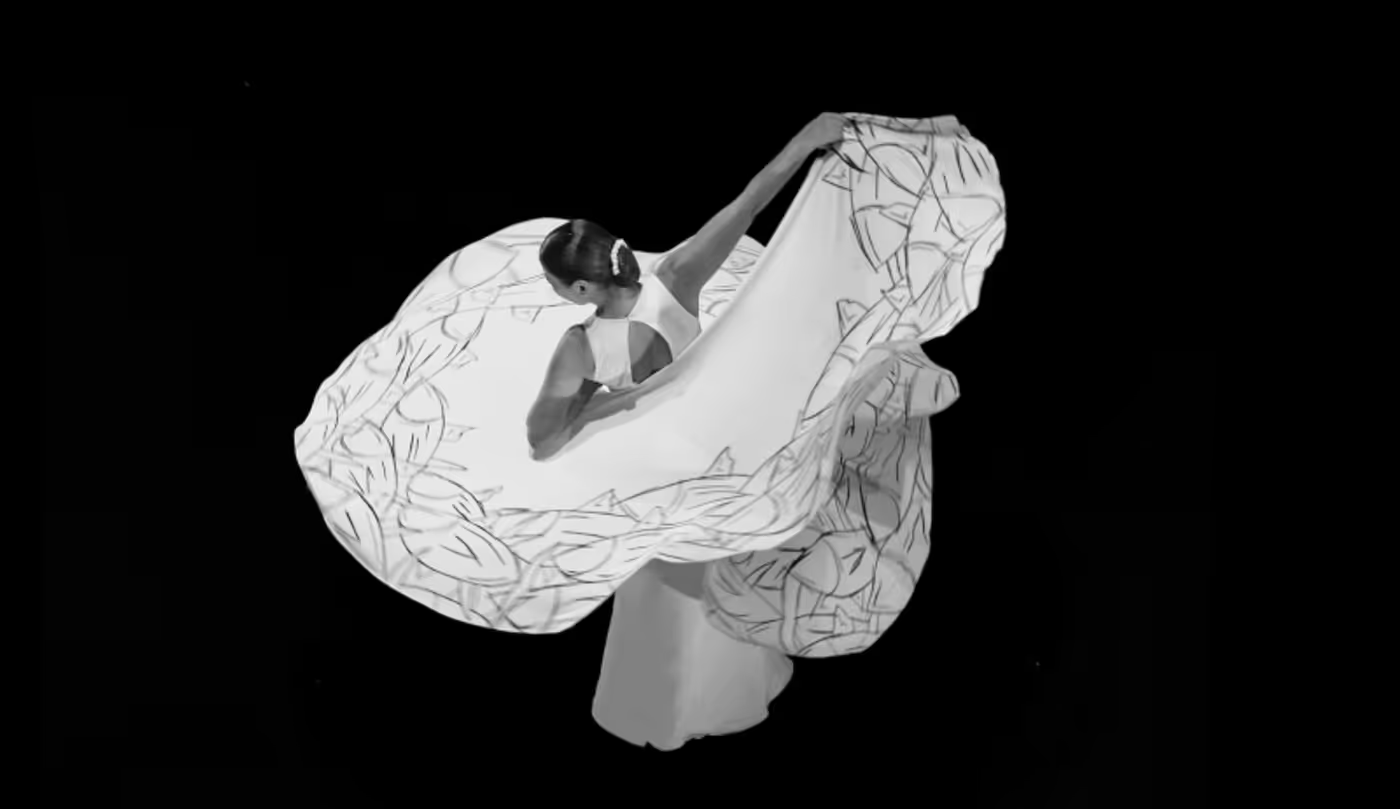
Act two follows the artist’s shift from tradition toward emotional exploration. This is Baras at her finest: energy surges through her spinning, twisting body as her white dress billows in fluid arcs. Every flick of her wrist carves the air; every stomp of her heel sets the rhythm. Her face flashes between fierce concentration and bursts of pleasure. She’s not trying to make her movement look effortless but to show us the joy of exertion, and the resulting intensity is spell-binding.
If Baras is air, her dancers are the sea: barefoot, they undulate, a calming interlude before their leader’s next storm. Adept as they are, their talent shrinks next to Baras. On the flamenco stage, their youth and freshness become a disadvantage. They’re lovely to watch, but Baras’s lived-in movement and time-worn features—she’s now 54—allow her to portray real emotional depth. Her third act, “Death,” would be shallow and overwrought if danced by anyone else. But somehow Baras’s gravitas makes even a large silver censer suspended above the stage feel necessary and appropriate.
Baras’s soulfulness and exertion are matched only by her singers, May Fernández and Matías López, whose gravelly crooning is a full-body exercise. Seated next to them, a cast of musicians—Keko Baldomero is particularly impressive on guitar—remind us that flamenco is simultaneously music and dance; neither serve as mere accompaniment. Baras tunes her body like an instrument, and the musicians seem to dance alongside her. In the finale, she engages each musician in one-on-one dialogues, answering their strums with spins, echoing drums with accelerating heel strikes. The six strings of light that launched the show (expertly designed by Óscar Gomez de Los Reyes and David Reyes) return to suggest that the ensemble of bodies and voices functions as a single, living instrument.
Yet even when Baras cedes the spotlight, Vuela is ultimately a star vehicle. The show ends with Baras in the center of a semi-circle of her dancers and musicians, all of them cheering her toward the finish line. She knows the audience came for her (by the fourth act, applause has given way to chants of “Sara”), and she’s happy to deliver. For the most part, her shameless self-congratulation is charming. Who doesn’t love a diva? After the third curtain call, though, half the audience has left (they thought the show ended two bows ago), and the olés have quieted down. For all her expertise, Baras has yet to master the first rule of performance: always leave your audience wanting more.
New York City Center is located at 131 West 55th Street, New York, NY 10019. For tickets to upcoming performances at the Center, please visit Home | New York City Center.
Reader Reviews
Videos