

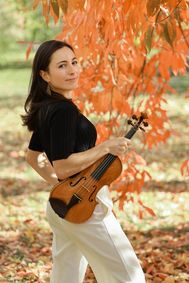

This concert celebrates Eastern European musical heritage through several compelling works. At the heart of the program is a deeply personal tribute: CCCO violinist Sophia Szokolay performs a Violin Concerto by her Hungarian grandfather, Sandor Szokolay. Composed a few months before the 1956 Hungarian Revolution against the Communist Regime, the concerto gained international recognition and put the young composer on the map at a pivotal moment in Soviet history.
Like Szokolay, Grazyna Bacewicz contended with Soviet censors in her native Poland. In Grazyna Bacewicz, The 'First Lady of Polish Music', author Diana Ambache writes, "There was a particularly oppressive period under Stalin's control (1948–53) with the diktats of socialist realism, when the creative process was compromised by state censorship." Despite the cultural confines, her career flourished. In 1948, Bacewicz wrote what would become her most frequently performed work, Concerto for String Orchestra in three movements. The concerto premiered in June 1950, during a meeting of the General Assembly of the Polish Composers' Union. That same year, it received the National Prize and was performed in the US by the National Symphony Orchestra in Washington, DC. Bacewicz was praised by Polish critic Stefan Kisielewski for being a woman who saved the "honor of Polish composers," branding the work as "a modern Brandenburg Concerto." In a 1958 letter to Lithuanian composer Vytautas Bacevicius, Bacewicz wrote, "The work of composing is like sculpting a stone, not like transmitting the sounds of imagination or inspiration.... There is a saying: The house will fall down if it were to be built without principles." In composing her concerto, Bacewicz applied the foundation of the Baroque concerto grosso form, combining it with a rigorous approach to tonality and motivic development that features individual players. (Courtesy of LA Phil)
A prominent figure in the Czech musical world, Joseph Suk composed his The Serenade for Strings in 1892. the Serenade was written on the recommendation of Dvorak, who felt that the 18-year-old composer, at that time his student at the Conservatory, should broaden the emotional content of his compositions, which to that point were very dark and tragic, and write something more cheerful. The result was splendid. While Dvorak's influence is quite apparent, it is very much original music.
Together, these pieces form a powerful tribute to the artistic richness of Eastern Europe-its histories, its voices, and its enduring musical spirit.
Program
Brahms: Hungarian Dance No. 5
Sandor Szokolay: Violin Concerto (featuring Sophia Szokolay, violin)
Grazyna Bacewicz: Concerto for String Orchestra
Joseph Suk: Serenade for Strings
Time: 15:00 to 17:00
News About Cape Cod Chamber Orchestra presents 'Legacy' On May 03, 2026 at Pilgrim Congregational Church
We have no news on this show at the current time.
About the Theatre
Pilgrim Congregational Church Frequently Asked QuestionsFAQ
Pilgrim Congregational Church is at 533 Massachusetts 28, Harwich, MA.
More Boston Coverage
Videos