


Review: Spectacle, Realpolitik, and Mixed Motives: MARY STUART at Chesapeake Shakespeare Company
Lesley Malin as Elizabeth, and Lisa Bruneau as Mary deliver that clash in fine fashion.
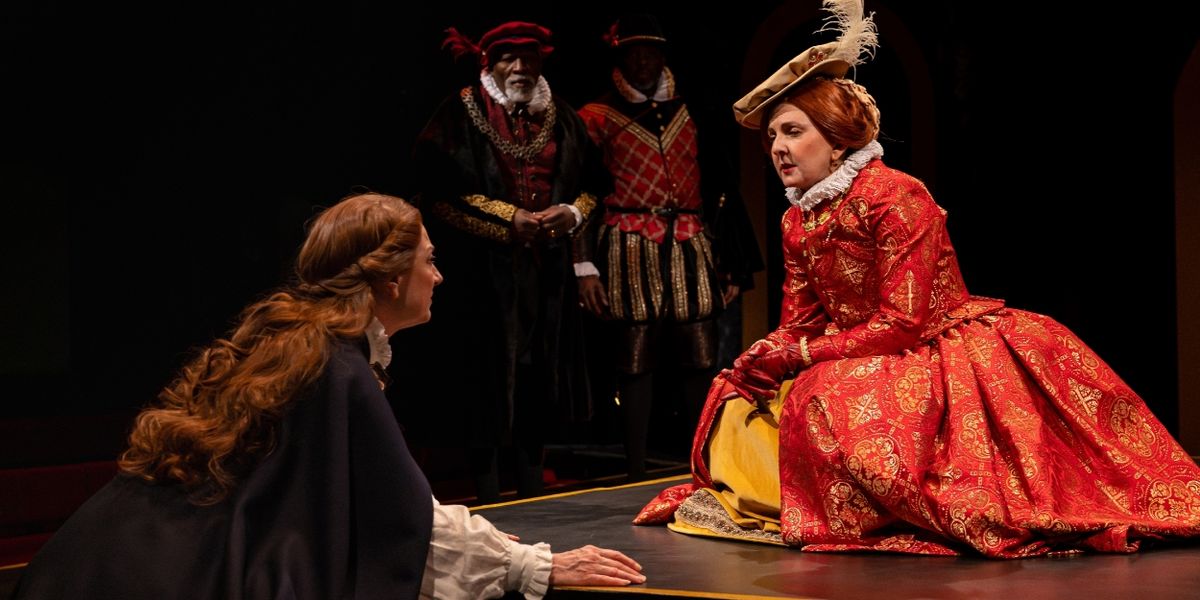
There’s no suspense around how a play called Mary Stuart is going to end, any more than there is around how a movie called Titanic is going to end. Everyone knows these stories, at least in outline. Mary and the ship are each going down, no doubt about that. And in Mary Queen of Scots’ case, most of us know that her cousin, the English Queen Elizabeth, will be the iceberg on which she founders.
Beyond that bit of common knowledge, however, what most of us know for sure peters out. Much of the story is lost among rumors and conflicting scholarship. Indeed, the more scholarly, the more ambiguous the retelling of the tale is likely to be – and so, to come to grips with the tale, we tend to leave it in the hands of the filmmakers and the dramatists, like German poet, playwright and philosopher Friedrich Schiller (1759-1805).
Schiller’s play, first produced in 1800, keeps being produced because, when you unpack the riches in it, there is so much there: a disquisition on the conflict between reasons of state and family ties, an inquiry into the ugliness of realpolitik, especially the uses of what we’d now call plausible deniability and cults of personality as political tools. As well, there is something that arrests the imagination about the clash of two queens, representing so many dualities (e.g. Catholic and Protestant, Scottish/French and English, triumphant and supplicant, virgin and parent).
Which isn’t to say it’s an easy show to take in. I’ve now seen it three times, each in a different translation from the German (most recently courtesy of Chesapeake Shakespeare Company, using Peter Oswald’s translation, directed by Ian Gallanar). And every time, I’ve found the political machinations constituting the plot murkier and harder to follow than Schiller probably intended.
I now think that the basic problem is that so many characters are so duplicitous that it makes it hard to figure out, as Aretha sang, who’s zoomin’ who. Almost every character is carrying out some kind of con or treason or betrayal, and/or engaging in the self-deception endemic to games of thrones. And Schiller, writing at a time as close to the events depicted as it was to our own, presupposed a public familiarity with the cast of characters that may once have been justified, but that I at least, being a denizen of the twenty-first century, didn’t come to the story possessing.
I’ve gone back to the Peter Oswald text, and also to another, more literal, translation, and I can see how hard Oswald, understanding this, has struggled to leave the audience in possession of enough information to follow the tale closely, sprinkling identifying names and explanatory phrases in. Somehow it’s still just not quite enough when you’re actually in the audience trying to keep up.
In Schiller’s take on the Mary Stuart story, the simplest explanation of the outcome is that Mary (played here by Lise Bruneau) shows herself too emotional to do realpolitik all that well, while her cousin Queen Elizabeth (Lesley Malin) always does realpolitik very well, though Mary ends up the more human and likeable of the two. Still, not doing well with realpolitik around Elizabeth can be deleterious to one’s health, as Mary learns to her cost.
The story takes place in 1587, moving between Elizabeth’s space, the Royal Palace of Westminster, and the place where Mary had been imprisoned for 18 years, Fotheringhay Castle, about a hundred miles away. This was a distance far enough to assure the real-life Elizabeth that she and Mary would never meet, but in Schiller’s imagination, they do, in the pivotal scene of the play. In Schiller’s take, there were also intermediaries moving back and forth between these two worlds, including the Earls of Leicester and Shrewsbury, and one Mortimer (a non-historical character).
Of those three, there’s not a one who’s a total straight shooter, including two who have ostensibly pledged themselves passionately to both Team Mary and Team Elizabeth. And yes, as one might expect, in each case one of those conflicting pledges is ultimately shown to be false and unreliable. But in the meantime, we in the audience may feel ourselves in the position of trying to tell the players without a scorecard.
So, yes, Schiller does sometimes trip on his own shoelaces. That said, there is so much of value here. Mary is one of the great tragic heroines, almost irrespective of what you think about the issues just discussed. She’s clearly damaged goods, having been through so many changes (three husbands, three countries, a victim of abuse or neglect of one sort of another, and with many years spent forcibly separated from her son); it’s great that this production has her talking with a French accent (courtesy of dialect coach Gerrad Alex Taylor) which underlines her utter deracination. There is clearly nowhere she can really call home, regal title or not. And she’s an emotional mess, once a habituée of the epicurean French court, now apparently starved of life’s simplest pleasures like running around barefoot on the grass, after having been locked inside for so long. On the other hand, she may be accessory to a murder, and she definitely is not above exploiting the infatuation of impressionable young Catholic men who flock to lay down their lives in her cause. These deprivations and the bad luck she has endured have helped set up her most tragic flaw, the inability to control her tongue for long. Sometimes she can belie the hostility she feels for a little bit, but she can’t keep her feelings bottled up nearly the way her cousin Elizabeth can.
Which brings us to Elizabeth. She may have private emotions that she has to suppress, and indeed she allows us to view them in action at certain difficult moments. Or at least, so we are led to think (with Elizabeth it’s always hard to be sure). But her emotions never seem to interfere for long with her agenda, which is Tudor absolutism, the consequences and the moral compromises it demands notwithstanding. And so constituted, it’s not in Elizabeth’s nature to blurt out anything. To the contrary, much of the second act is devoted to a breathtaking act of self-disciplined cynicism, Elizabeth erecting a wall of plausible deniability around her involvement in Mary’s execution. And behind that, perhaps a greater act of cynicism, the pretense that there was ever any serious consideration of letting Mary live, given all the reasons of state that concatenated in favor of doing away with her.
Hence the assignments for the actors portraying these queens are complementary but different. Bruneau’s tact-challenged Mary unwinds to the point that she can at least be thought to share responsibility for the infliction upon her of the sentence which has been suspended for most of the play and arguably might have stayed suspended. To be sure, she rallies at the end in a surprisingly touching religious turn. That earlier unwinding may have doomed her, but it has also made her free to die in her own way. Malin’s Elizabeth, on the other hand, must convey the experience of being wrapped up ever tighter in the impregnability that is her stock-in-trade and her protection, to the point where she sits alone, entombed in it, all empathetic emotions (if she had ever truly felt them) eradicated at last along with her enemy. And in aiming for these distinct targets, each performer hits a bullseye, especially in the climactic scene in which they confront each other.
The cast is uniformly excellent. I especially enjoyed Joshua Williams as Mortimer, one of the characters who is definitely dissimulating as to which team he supports; I won’t spoil surprises by saying on which team he ends up fighting, but he well embodies impetuous if slightly deranged youthfulness along the way. Gregory Burgess as the Earl of Shrewsbury, another one of those characters in the middle, is appealing in his efforts to avoid the logic of the overall situation. Much the same could be said of DeJeanette Horne as Leicester. And it’s worth mentioning the two members of Mary’s household, Melvil (Paul Diem, an old Single Carrot company stalwart) and Mary’s nurse Hanna (Jamie Virostko), perhaps the only characters who are entirely what they seem. We in the audience are probably desperate amidst this moral chaos to see somewhere some portrayals of uncomplicated virtue, and these performers convey that well. And Michael P. Sullivan as Lord Burleigh, the most security-minded of Elizabeth’s lords, dominates every scene in which he appears, as a good security professional and statesman should. He may not always be showing his cards, but he is always playing them, and it's grim fun to watch.
It would also be close to criminal not to mention as well the amazing costumes, designed by Kristina Lambdin, whose work I have often been astonished by. I’m thinking back to a dress for Anne of a Thousand Days, for example, in 2016, a sensuous scarlet swirl for the doomed heroine. This time, the outfits, particularly for Elizabeth and the men around her are insanely ornate, mutely conveying their owners’ vanity and their sheer financial power, but they remain things of beauty as much as of show.
Without belaboring this, I’d add that there are several points in the show where the echoes of current politics ring loud enough so I could hear and see, in the responses of the audience, the making of the comparisons. It’s not a parallel story, but some of the less admirable behavior on display may also stir up thoughts about our present state.
In any event, the case for this production rests most firmly on the sheer spectacle and melodrama of the clash of the queens. Malin and Bruneau, as directed by Gallanar, deliver that clash in fine fashion.
Mary Stuart, by Friedrich Schiller, translated by Peter Oswald, directed by Ian Gallanar, presented through May 18 by Chesapeake Shakespeare Company, 7 South Calvert Street, Baltimore, MD 21202. Tickets $31-$69, available at box office, 410-244-8570, or via www.chesapeakeshakespeare.com . Some violence, including suicide and forced sex.
Photo Credit: Kiirstn Pagan Photography

|
Bocking Baltimore Center Stage (8/14-9/06) |
|
SIX (Boleyn Tour) France-Merrick Performing Arts Center (10/25-11/01) |

|
Hamilton (Angelica Company) Hippodrome Theatre- France-Merrick Performing Arts Center (3/09-3/28) |
|
MET Comedy Extravaganza Maryland Ensemble Theatre (9/05-9/06) |

|
Into the Woods Maryland Ensemble Theatre (9/11-10/04) |

|
The 39 Steps Maryland Ensemble Theatre (5/21-6/13) |

|
Classic Theatre of Maryland presents "DAMES AT SEA" Classic Theatre of Maryland (4/29-5/16) |

|
The Pigeon Gets a Big Time Holiday Extravaganza! Maryland Ensemble Theatre (11/28-12/20) |

|
The Crater Sisters' Christmas Special Maryland Ensemble Theatre (11/20-12/20) |

|
Blood of the Lamb - regional premiere Rapid Lemon Productions (8/28-9/13) |
Reader Reviews
To post a comment, you must register and login.