VOICES UNBOUND Benefit Concert Raises Funds at Carnegie Hall
Young composers mentored by Meng Wang showcased chamber and electroacoustic works alongside guest premieres from Manhattan School of Music and University of Louisville.
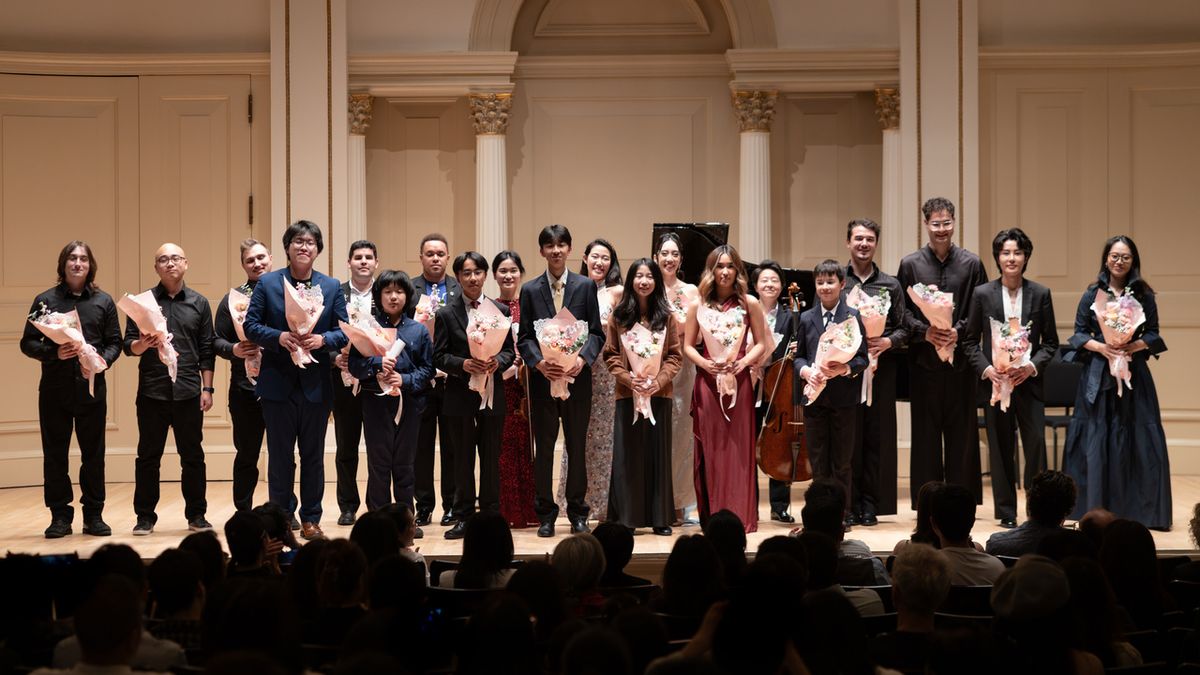
On the evening of October 2, 2026, Voices Unbound: A Benefit Concert of New Chamber Works for Facta Non Verba-presented by the Meng Wang Music Academy and produced by the Paulus Hook Music Foundation-was successfully held at the Weill Recital Hall of Carnegie Hall in New York.
The concert featured original works by nine young composers, alongside special guest premieres by Reiko Füting, Academic Dean and composer at the Manhattan School of Music, and Yunze Mu, professor of electronic composition at the University of Louisville. Spanning solo, chamber, and electroacoustic formats, the evening successfully showcased cutting-edge creative talent while raising vital funds for Facta Non Verba to support children's education in Madagascar.
Led by founder and composer Meng Wang-a faculty member in the Pre-College divisions of both the Manhattan School of Music and the Mannes School of Music-the Academy is dedicated to cultivating young composition talent and fostering international musical exchange. Spanning over two hours, the performance achieved an exceptionally high artistic standard, earning high praise from renowned New York music critic Rorianne Schrade. Reviewing the event as an "inspiring evening," Schrade noted that "All of the young composers' works showed commendable accomplishment and promise..." She particularly highlighted that "One had to admire that so many of these young talents have worked with one mentor, Meng Wang, and yet there was still considerable individuality among them. Aside from a penchant for nature-based compositions, there were distinct musical personalities emerging among them."
Program Highlights and Critical Review
The program opened with a captivating piano solo called Continuum composed by Winston Qin. It started with a simple repeated six-note motive that reappeared in the harmonies and through varied iterations to build a beautiful arc - before receding touchingly with remnants of its theme. In just roughly two minutes, it captured the idea of its title as Mr. Qin explains it in the notes, that 'what we leave behind keeps shaping the people who come after us.' A piece of music needn't be long to make an indelible statement, and this did just that. It couldn't have been a better introduction for the speech that followed by his teacher Meng Wang, about the charitable mission behind this concert.
More piano music followed with When the Wind Stops by Ciara Zhang. In a style reminiscent of musical Impressionists, though with a certain individuality, it suggested the alternating movement and stillness of nature. The piano background of this composer was evident in some brilliant treble figuration evoking the wind.
Further inspiration from nature (a recurring theme in this concert) came through a piece for clarinet and piano by eighth grader Nick Leatherman who based his Impressions of Mürren on views of the Swiss Alps, with two movements - 'Day: The Flower Trail' and 'Night: Stillness and Dreams.' There was a certain Schubertian quality to this music, with virtuoso flourishes suggesting influences of later composers, though with a budding style of his own.
A piano trio by Charles Z. Wang followed, entitled Paradox. As the young composer wrote to sum it up, 'It seems like you're moving forward or making progress, but in the end, you always end up in the same place.' Full of slides from the strings and questioning gestures, it proceeded with increasing intensity, complexity, and chromaticism, offering the most modernistic style of the program so far.
Kanonensong, next, from The Threepenny Opera by Kurt Weill, was something of an anomaly on the program but a welcome one, and it was especially interesting in the two-accordion arrangement of Marius Staible and Daniel Roth. The two German musicians are a duo, touring under the name 'con:trust' - and they brought this famous number considerable skill and some surprising theatrics as they played.
Marius Staible then was solo accordionist in the work entitled ineo by Reiko Füting, head of the composition department at the Manhattan School of Music. 'Ineo' refers to St. Augustine's words (translated from Latin as 'I enter') and for the composer (according to his notes) refers to ideas of Hannah Arendt on 'the potential for political change represented by the birth of each human being.' The relationship between this reflection and the actual piece requires some speculation, but contrasts were clear between the hymn-like keyboard parts (fragments of Josquin Desprez) and the extended techniques, including non-verbal utterances, loud breathing, gasping, and sounds produced by shaking, tapping, and dragging the hand across the bellows of the accordion.
To close the first half was a piece called Galactic Railroad by Yunze Mu for electro-acoustic ensemble. The composer's notes state that 'It was inspired by Night on the Galactic Railroad by Japanese author Kenji Miyazawa. In my imagination, the Milky Way is filled with steam trains. They meet, travel together for a time, and eventually part ways. None of them knows its final destination; they simply continue moving forward, restlessly, toward the unknown.' The University of Louisville Electro-Acoustic Ensemble - including its composer plus Trexler Cook and Myles Hayden - came onstage with laptops and devices in hand to recreate this conception, controlling the electronic output with at times expansive arm gestures. Many classically trained musicians like to critique such creations as 'sound effects' rather than music, but frequent exposure can start to affect how one hears everyday sounds. Case in point, just as the performance conjured sounds of being on a train (perhaps near a loud construction site, with storms brewing in the distance), this reviewer's actual subway trip home after the concert almost had her searching the train platform for whom to applaud.
After intermission, we heard another Kurt Weill composition, his September Song, played sensitively by Daniel Roth, back with his accordion. His fluid jazz style was winning, showing expert timing and a flair for musical 'punchlines.'
After the Weill, young composer Ella Bao came onstage to speak, not only as one of the featured musicians but as the philanthropic liaison whose experience staying in rural Madagascar gave rise to the charitable effort, 'Voices Unbound.' Her song, Whispers of Silence followed, and it was lyrical and engaging. One wished that there had been a printed text for it though, as even with the soprano's commendable diction, it was impossible to understand longer words, especially as the piano shared the spotlight.
A piano trio came next, Blossom, by Chongyu (Austin) Ma. Described by the composer as 'reflecting on 'the fragile and changing nature of human connection,'' it came off thoughtfully, evoking the hesitations and remembrances.
Feathered Flight for cello and piano by Zoey Fang followed, conjuring the wonder of birds overhead with fluttering piano figuration and soaring cello lines.
More nature inspiration was evident in a piano trio called Glimmering River by Jasper Luan. Again of somewhat impressionistic style, it went far beyond glimmering into an intense exploration with quite a bit of percussive dissonance.
The concert concluded with a quintet for flute, clarinet, violin, cello and piano, entitled Idyll by Yunxuan (Michael) Li. Young Mr. Li, who is described in the biographical notes as drawing inspiration from Rachmaninoff and Tchaikovsky, is described in the program notes as moving in this work 'beyond his musical comfort zone.' Indeed, there were hints of Shostakovich and others of a later vintage here. Most importantly, though, there was skillful treatment of his material, which he developed with fiery energy and a conversational fluency among instruments. It was quite compelling and made a great finale to the concert.
World-Class Performances
A major highlight of the evening was bringing the young composers' new works to life through the collaborative efforts of top-tier instrumentalists and orchestra principals. This stellar lineup included Qianwen Shen (Violin, Metropolitan Opera Orchestra), Yi Qun Xu (Cello, Juilliard School Pre-College Faculty), Ying Li & Jiacheng Xiong (Pianists), Hector Noriega (Principal Clarinet, Rochester Philharmonic Orchestra), Guilherme Andreas (Flutist), and Yvette Keong (Soprano). In addition, the evening featured special guest performances of contemporary and electroacoustic repertoire by the German accordion duo con:trust (Marius Staible and Daniel Roth) and the University of Louisville Electro-Acoustic Ensemble (featuring composer Yunze Mu alongside performers Trexler Cook and Myles Hayden). All the performers poured their hearts into the music, approaching every piece with the rigor and passion typically reserved for classical masterpieces.
Supporting Education in Madagascar
The philanthropic mission of the concert stems from the personal experiences of young composer and Philanthropy Cooperation Director Ella Bao during her travels to rural Madagascar. All proceeds raised from the event will go directly to Facta Non Verba to improve educational conditions for impoverished children in the region. Fundraising is currently ongoing, and the organizers cordially welcome continued support from the community. Contributions can be made via the official GoFundMe Donation Page to help light up the hope of a transformed future for the children of Madagascar.
Sign up for all the news on the Fall season, discounts & more...