


Review: PORN PLAY, Royal Court
Ambika Mod stars in a story of a ruinous porn addiction.

 Ani has a problem. Well, two problems, but they are on very friendly terms: she’s addicted to hardcore porn and her boyfriend Liam has had enough of seeing it when they're in bed. She doesn’t care so she cums, he goes, and - even before the door slams - she’s back on her phone scrolling through an endless feed of videos.
Rising star Sophia Chetin-Leuner impressed us last year with her This Might Not Be It, an unflinching look at the UK's crumbling NHS mental health services as seen through the eyes of a new temp. English literature professor Ani (Ambika Mod) is anything but a novice in her field, having just won a prize for her book on the works of the seventeenth century poet John Milton and his epic poem Paradise Lost.
Despite her career being at a zenith, her affliction strains every relationship she has. After she splits from Liam, a sleepover with her friend Jasmine goes awry after Ani attempts some midnight masturbation in their shared bed. Her father, walking into her bedroom to see a slammed-down laptop and guilty looks, worries that his daughter’s problems are returning. An attempt to go cold turkey leads to disastrous results for Ani’s job and achievements.
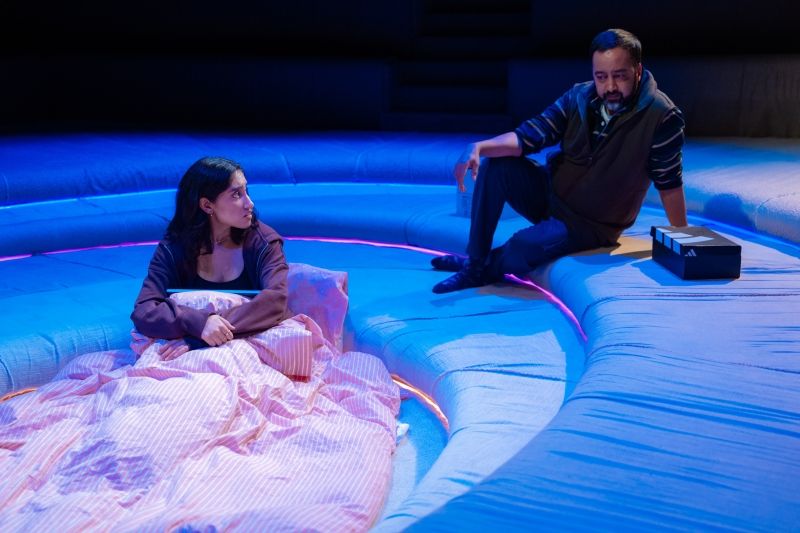
Even before Porn Play’s bleak final chapter, Chetin-Leuner leads us down some harrowing paths. The toll on Ani is not just emotional but physical: one scene sees her lying back on a doctor’s table as the GP examines her damaged clitoris. A family history of addiction is mooted at one point to explain Ani’s behaviour. In a grim scene, we see her attempt to enact the violent scenes she masturbates to lead to a shocking conclusion.
This is not an easy watch by any means but neither is it a particularly informative one. There’s an early nod to the capitalist side of pornography when Ani lies about paying for what she sees but that’s as far as it goes. Female sexuality — arguably the last great taboo of the modern era — is an incredibly lucrative industry whichever way you look at it. EL James banked $95m when her e-book Fifty Shades Of Grey hit the internet in 2012. In that year alone, the percentage of UK households with an e-reader or tablet leapt from 11% to 24%. The sex toy industry is worth around $40bn globally with the UK alone spending almost £1.5bn on sex toys in 2022.
Disappointingly (though, perhaps, realistically), Chetin-Leuner shows Ani’s circle actively disengaging from her issues. Her father blocks out the sex noises from his daughter’s phone whenever he hears them. Liam has a binary approach to the porn he sees every time he gets intimate with his girlfriend: either it goes or he does. Jasmine tells her friend that, “as long as it’s not animals or children”, she doesn’t want to hear about what is troubling Ani. This is despite studies having shown that talking helps: one study suggests a correlation between an individual's own sexual self-disclosure and their own sexual satisfaction and functioning, with an emphasis on women suffering sexual problems; another study points to a statistically significant association between sexual communication and happier relationships and sex life.
Moreover, there’s an underlying message that masturbation is A Bad Thing. There are no healthy examples here of anyone playing with themselves, leading to an implicit but perceptible connection between the physical action and Ani's mental health issues. Sure, (as with anything pleasurable) you can have too much of it, but the act has long been reclaimed by women as something to enjoy in and of itself: East End Cabaret’s 2012 indie classic “Dangerwank” amusingly extolled the virtues of ladies enjoying a public furtle while the peri-menopausal heroine of Miranda July’s sleeper hit All Fours casually writes about her multiple bouts of daily self-pleasure as if it was almost (gasp) A Normal Thing.
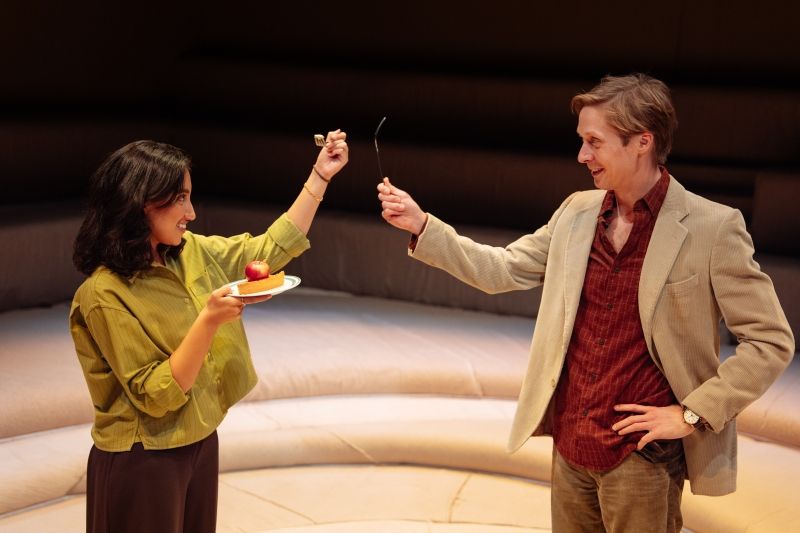
What Chetin-Leuner does focus on are the parallels between Ani’s fall from grace and Eve’s in Paradise Lost. The allusions could hardly be less subtle. In the opening scene, Liam eventually persuades his celebrating lover to take a bite from a slice of apple pie that has an actual rosy red apple on top of it (see below). Whenever the phone comes out and the porn starts playing, we hear female moans but see a large, shiny apple on the screen. In the closing scenes, Ani is presented with a crystal trophy which is in the shape of — you guessed it — an apple. If the hints were any heavier, the Royal Court should think about reinforcing the foundations.
By accident or design, Mod has built up a meaty track record of playing dark roles. She was excellent as Shruti, the doctor pushed over the edge in Adam Kay’s TV adaptation of This Is Going to Hurt. More recently, she won plaudits as the tragic co-lead Emma in Netflix’s One Day and her part in this year’s run of Every Brilliant Thing about a child with a suicidally depressed mother. Directors looking for someone who isn’t scared to get up close and personal with the more morbid side of life could do worse than hire Mod.
Director Josie O’Rourke does her best to bring out Ani’s inner conflict beyond what is explored through dialogue but the overall effect is strangely unaffecting. If the professor is feeling mountains of guilt, shame or recrimination, there’s insufficient physical evidence in either the acting or the Wayne McGregor-designed movement.
Moreover, Mod is overshadowed by the outstanding work of her multirolling colleagues. Lizzy Connolly is phenomenally flexible, one minute a petulant student calling out her teacher for referring to rape as “sexy”, the next comforting her as the laidback Jasmine or (playing a brutally matter-of-fact doctor) peering between Ani’s legs at her ravaged vulva.
Probably best known for his role as Harry Kane in James Graham’s Dear England, Will Close spins us about as he goes from playing the porn-averse partner to a can’t-believe-his-luck teenager preparing to shag his BDSM-loving tutor with the help of a sturdy bike lock. As the father who has seen it all before and realises his daughter is falling into old patterns, Asif Khan has the most engaging role of all and brings real tenderness to his lines.
What is most memorable here is Yimei Zhao’s intriguing set design. With soft padded flooring material in place throughout, all audience members are asked to wear shoe-protectors and find a spot around the outside of the room. Those sitting at the rear will get the luxury of back support; those in front get a Globe-like bench experience and the opportunity to work on their seated posture or their kegels. The central area consists of cushions arranged in concentric purple ovals of increasing depth; from between them, a staggeringly vast range of props from a mobile phone to an entire folding table are pulled out. Again, the imagery is hardly subtle but the ingenuity of Zhao’s creation frankly deserves an award of its own, apple-shaped or otherwise.
It's hard to believe that this relatively tame exploration of a very modern topic is in the very same room that birthed a far more sexually provocative work over fifty years ago. Despite the fine acting, Chetin-Leuner has little new or valuable to say about her eye-catching subject that hasn't already been well covered by the likes of Steve McQueen's 2011 sex addiction drama Shame. By the end, we are left with a softcore spectacle that is all promise and no penetration.
Porn Play continues at Royal Court until 13 December.
Photo credits: Helen Murray
Prefer BroadwayWorld in Google Search?
Add us as a preferred source so our stories show up more often in Top Stories and Google’s AI answers — for you.
Sign up for all the news on the Fall season, discounts & more...


.png?format=auto&width=365)





Reader Reviews
To post a comment, you must register and login.