Debut of the Month: Esteban Andres Cruz in DOG DAY AFTERNOON - 'It Has Been a Product of Love'
Cruz discusses what this role means to them, working alongside Jon Bernthal and Stephen Adly Guirgis, and more.
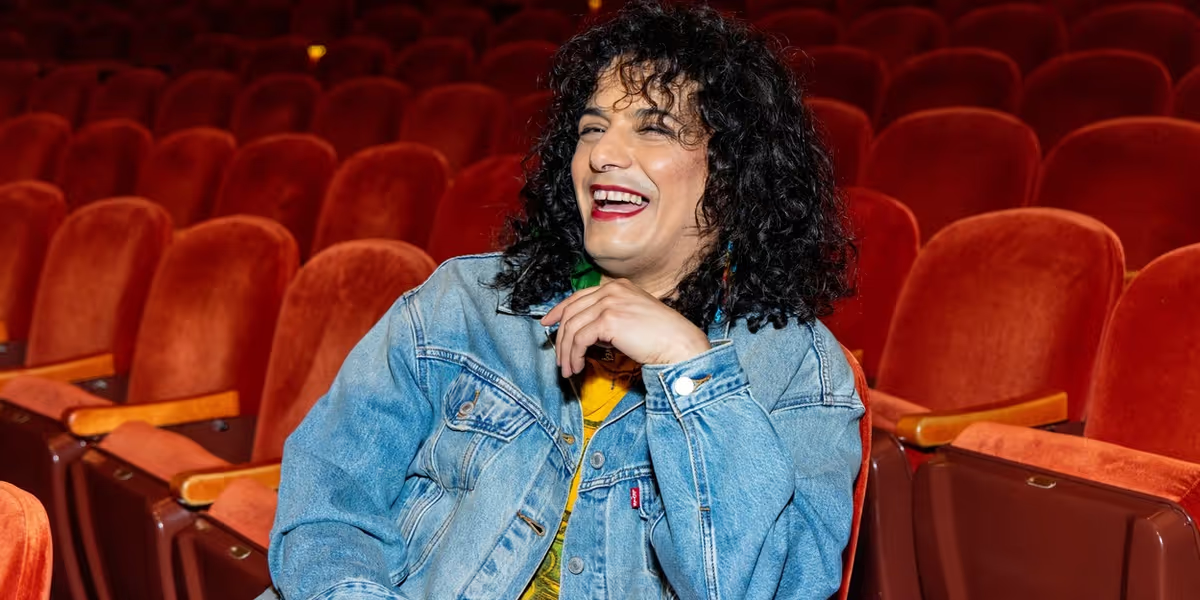
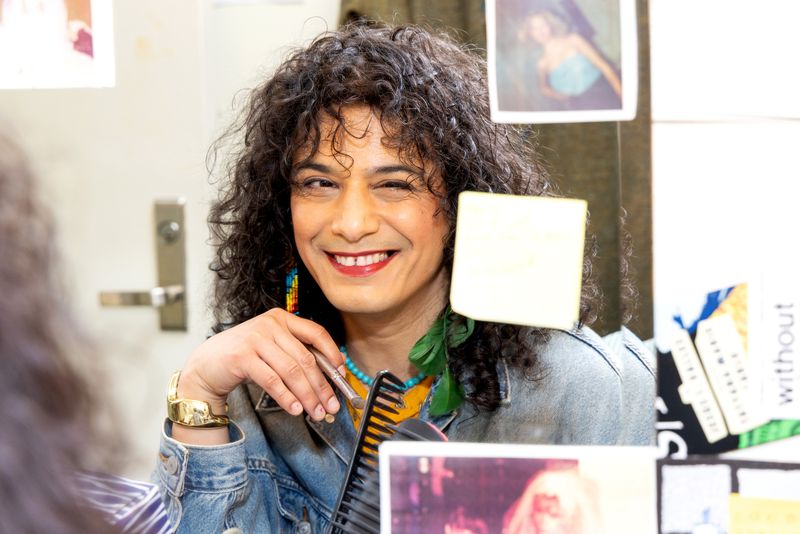
Esteban Andres Cruz is currently making their Broadway Debut in Stephen Adly Guirgis' Dog Day Afternoon as Leon/Liz, following nearly a decade with the production throughout its development.
Cruz's Off-Broadway credits include: Halfway Bitches Go Straight to Heaven (Drama Desk nomination Featured Actor), Cornelia Street, Bathhouse.pptx and The Potluck. Film credits include: Spa Night, Valley of Bones, The Thin Line, A Very Harold & Kumar 3D Christmas and Rattled. TV credits include: “Chicago Fire,” “Awkward,” “Easy,” “Idiot Sitter,” “The Bridge,” “You’re the Worst” and “South Side.” Cruz is also an ensemble member with A Red Orchid Theatre and co-founder of The VIVERO.
In BroadwayWorld's Debut of the Month interview with Andres Esteban Cruz, they discuss making their long-awaited Broadway debut, developing collaborating with Jon Bernthal and Stephen Adly Guirgis, developing the role of Leon/Liz over nearly a decade, and their commitment to honoring the trans community.
Making your Broadway debut is a major milestone! What has surprised you most about stepping into Dog Day Afternoon at this level of scale and visibility?
I know this might sound a bit naïve, but all of the attention is a little bit off-putting for me, because I’m not the main character in this show by far. The first time that we went outside and people were asking for my autograph, I thought, ‘Maybe they have confused me for somebody else.’ There was one evening performance early in the run where we were supposed to do a champagne toast. I’ve been reading this role in workshops and readings for the last eight years, the only people that have ever called me Leon are people in the play, or Stephen, or Rupert [Goold, director]. So, I walked outside and audience members started calling me Leon, and it kind of freaked me out, and I did not go to the champagne toast, I ran home and hid. Which, if you know me, sounds very outside of my personality because I love attention!
How has it felt to have lived with a character for that long, to be able to build a character over that many years?
That is a privilege I have in working with Stephen, and having helped to find Liz. The character’s name in the play is Leon, but I always refer to her, and myself, as Liz, because that is what Liz did in her life. So I have had the privilege of all of the time to do a bunch of research on this actual living being that existed in the world, and that lots of people knew, especially here in the village.
The second time that Stephen and I ever met, I went to the LGBTQ center downtown, and I had a half an hour to take a photo of every single bit of information that they had. So, I got pictures from their wedding, I got letters between them from jail, between him and Warner Bros., between her and Warner Bros., I got pictures of her post-op, and what her life was afterwards. So, I feel like I made out like a bandit as far as research and dramaturgy goes, to feel like I could be closer, and do as honest a portrayal of this woman as I can.
That’s such a privilege to have so much to go off of in forming who this character is. This story has such a strong legacy from the original film also, how are you approaching the show and your role in a way that honors that history while still making it your own?
The film, it definitely told its own tale, and it told it’s own tale from the perspective of Al Pacino, it was his agents that found the IP and the Time Life article, and when they brought it to him, at first he rejected it because it had too much of a queer theme to it, and there were several times during the process where they had to water down the queerness of it. So even though that was a source that was important to Stephen, and his commission from Warner Bros.—so we had to say ‘Attica!’ and there were other certain moments and scenes that were essential to the movie that we knew had to be done—but I actually did not feel at all encumbered by the film or any duty to serve the film, because in my opinion, the film didn’t serve the queer community. I really just based all of my work around serving the trans community, and serving Liz. So, unlike most people, my interpretation was almost exclusively based on first-hand data that I had about Liz, and not based on the film at all.
How has it been collaborating with the cast and creative team?
It was a dream that I never thought was possible. I wrote my manifesto about Stephen's work in 2014, and I’ve been pursuing his work since about 2005. And we finally met in 2018 when I won the Fox Fellowship, a grant through Theatre Communications Group. And I asked them, “Hey, do you all know Steven Adly Guirgis?” and they were like, “We publish his plays!” And I was like, “Would you mind, maybe, possibly, perhaps, introducing us?” And they were like, “Esteban, that’s what this grant is for.” And I was like, “Oh my!” So they introduced us, and right away from the first meeting I just spilled my guts to him, told him how his art shaped my art, and how I found my voice in his work, and how I found a blueprint for a hope for a humanity that through his work we might be able to infect a society with a bit more empathy.
So, going into it, I had all of that. So, the eight years of collaborating with him, and there are several who were there at the beginning with me, Andrea Syglowski, Wilemina Olivia-Garcia, Paola Lázaro, and John Ortiz, in the very first reading we did of Dog Day, he played the Sonny role, and now he’s playing the Brooklyn detective Fucco. So, it’s been a very lovely ride to be building this beautiful thing with people that I love and have admired for years. John Ortiz was my first Sonny, and after a couple years Bobby Cannavale stepped in, and I turned to Stephen and I was like, “You’ve really spoiled me with all these handsome men, thank you so much."
And then when we met Jon Bernthal, that was at the Ojai Playwrights Conference, about almost four years ago. And something magical happened with Jon. I had been hearing other men for the past five years. There’s a moment between my only two scenes toward the end of the play, where Sonny’s character is screaming my name, “Leon! Leon! Leon!” and I’ve been listening to other men scream my name for five years, and there was just something very different, very visceral, very heartbreaking, about the way that he was calling for me. And I’m a disabled actor, I’m blind in my left eye, and my eyes don’t look in the same direction most times, and that’s very off-putting for people, and I use it as a tool in my acting to basically get a quick snapshot of the depth of somebody’s humanity. And because of the nature of the scene, it’s a phone call, we never look at each other. So, when I went up to the plate to finally do it with him, I felt completely vulnerable, because his call for my name rendered me a puddle, and then I also didn’t have any of my typical actor tricks to go up and use on him because I couldn’t look at him. So, I was without a net, and I was just like, ‘Well, dear lord, let’s hope and pray I don’t lose my job today.’ And so, I went up there not knowing what to do, and just let it fly.
And then later that night at the party, Jon Bernthal grabbed me and was like, “Hey, I wanted to talk to you," and we confessed how much we loved working with each other, how inspired we were to play with each other, and he kind of Jedi mind tricked me and leveled up my acting gig, and I confessed to him that I didn’t know what I was doing, and the whole time I was completely following him. And then he had this revelation to share with me, that he also had no idea what he was doing, and he was just following me! So, it turns out we both had abandoned any kind of training, or history, or any chops that we had, and were just giving ourselves over to something that was greater than each of us individually.
It's been an incredible experience to have these magical moments with these amazing artists, and when you get right down to it, it’s really just about being human. So, I guess that’s what’s been so cool about doing it all these years with these amazing folks!
That’s amazing, that’s what you hope art does for the performers and for the audience, and it’s really cool to hear that’s what happened.
The whole dream thing, there’s not a moment along this journey where I could have asked for something better, or something more magical. In a way, we really fell in love with the play, and with each other, and it has been a product of love this whole time. And during the whole rehearsal process too, Jon and I, we really didn’t rehearse it that much, because we were both like, “We’ve been doing this together for three years, it’s such a beautiful aria that Stephen has given us, let’s not overwork it, it’s good.”
I think the first day, Rupert was like, “Okay guys, I just want you to go through the lines.” And we looked at each other like, ‘Really? The lines? Bruh, we never worked on memorizing it because we’ve always had it.’ So, we just messed around. And Jon started doing the lines, and he just started walking in space. Alexandra Billings is my mama, and she was my teacher of Viewpoints at the school at Steppenwolf in Chicago, so if you start spitting out text, and you start moving in the space, well, guess what? That’s the game. So, Esteban is gonna play it.
So, I started moving around the space and doing the text. And then we started listening to each other, and feeling each other, and we would stop and start movements, sometimes we would face each other, sometimes we wouldn’t, and it turned into a very big, meta, post-modern dance scene thing, and afterwards Rupert was like, “Okay, that was lovely, I think perhaps we may just set this scene like that.” And Bernthal and I were like, “No! No, no, no, we were just playing around, that was just fun! We were just getting it out, this is a simple scene, it’s very minimal and very basic, and very minimalistic, we weren’t trying to do something arty with it!” You’ll see if you see the show what we do, but we all got what we wanted, including Rupert [laughs].
What do you remember most from opening night?
Oh my gosh! It was so big, the whole event, and I remember that the red carpet was actually orange, and I was so glad that I went with green for my dress, because those look really good together, especially with a 70s theme. And what do I remember the most about it? It was very hard to find people at the party! And I had been desperately looking for Stephen all night, and for Jon, who I actually didn’t get to see at the party on opening night! I knew his dad was coming, and I wanted to meet him. But I know his dad is coming back, and he’s super proud of him, and I know that means a lot to Bernthal.
But the party was so big that I couldn’t find anybody, and finally when I found Stephen I hugged him, and I kissed him, and I said, “How are you feeling? How did you like it?” And he was just like, “You know how I feel.” And then I just turned to him and said, “Well, this is the happiest moment of my life.” And he just grabbed me and hugged me. I think he wasn’t able to enjoy it as much as I was, but it was nice that my little piece of joy, that he could savor it and enjoy it vicariously through me.
What do you hope that audiences ultimately take away from the show?
I hope that audiences walk away from this show with the idea that somebody who maybe looks like me on the street might be somebody that you could actually fall in love with. Might be somebody who could be your hairdresser, or your neighbor, or your child’s tutor in math. I would love for people to get the idea that we trans and nonbinary people are just people with the same wants and desires. The fact that Sonny and Jon Bernthal can fall in love with Liz and Leon and Este, that maybe the rest of America could learn to love us too.
Do you have any final thoughts?
Thomas Rusnsk was like a father to me in high school. He was my theatre director and he passed away about 7 years ago. After graduating, he continued to watch me in shows and grow in my professional career. Tom would have definitely come to New York to see this! He taught us all the importance of every job in the theatre, from stage managing, to our carbon-arc follow spot to the fly rail system, (the August Wilson’s grid is about 90 feet up in the air). I loved working the rail! In my performance as Liz/Leon, I “sing” to the rafters because that’s where all the angels hang-both him and Liz Eden and many other ancestors and transcestors. There are ghosts in the grid and I am so grateful for them!
Prefer BroadwayWorld in Google Search?
Add us as a preferred source so our stories show up more often in Top Stories and Google’s AI answers — for you.

Sign up for all the news on the Fall season, discounts & more...
Powered by

|
.jpg?format=auto&width=300)